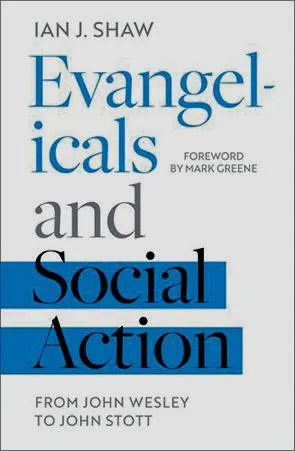
EVANGELICALS AND SOCIAL ACTION:
From John Wesley to John Stott
By Ian J. Shaw
IVP. 304 pages. £14.99
ISBN 978 1 783 596 581
‘Exhilarated, Sobered, Hopeful.’ That is how Mark Greene describes his emotions as he opens the Foreword to this timely book.
I remember seeing a cartoon of a cuckoo clock with two small doors. Under one door was the word evangelism, under the other social action. The caption of the cartoon was: ‘Why is it that we don’t seem to be able to come out at the same time?’
Vital expression of gospel work
As a corrective to this dualistic attitude, Ian Shaw drills deep into the history of evangelicalism in the past two centuries. What becomes clear is that our evangelical forebears did not view social action as a distraction from gospel work, but as a vital expression of it.
After two introductory chapters, the author presents 18 examples of historical evangelical social action, each with a brief sketch of a key evangelical involved in this area.
Contemporary relevance
What is particularly striking about the author’s approach is how his historical accounts speak with unusual contemporary relevance. Shaw drills deep into the gospel motivation of evangelical care for vulnerable people and attempts to tackle complex social injustices. The book reminds us that the range of this action is as varied as care for the poor, disaster relief, education, racism, health, prison reform, and much more.
Two examples particularly stood out for me. First, the work of evangelicals among those with addictions. Although this chapter is about work in the 19th century among those addicted to opium, it has many lessons for those who work both to relieve addiction and challenge the vested interests that fuel addiction. Second, work with the unemployed. Shaw writes about F.B. Meyer, who helped ex-prisoners pay their way by selling chopped word for fires. Meyer also funded ladders, pails and wash leathers to create a window-cleaning brigade for the unemployed. Perhaps this could prompt churches to find ways to encourage and fund micro-businesses among the unemployed.
Cautionary notes
In his brief conclusion Shaw sounds a series of cautionary notes concerning the limitations and pitfalls of evangelical action. It is important to ponder these caveats, yet the author is able to conclude that the combination of evangelisation of the lost and compassionate care for the needy ‘have been stitched into the regenerated DNA of Evangelical believers’.
I pray that those who read this book will be prompted to feel and express compassion for the vulnerable and oppressed in creative contemporary ways.