
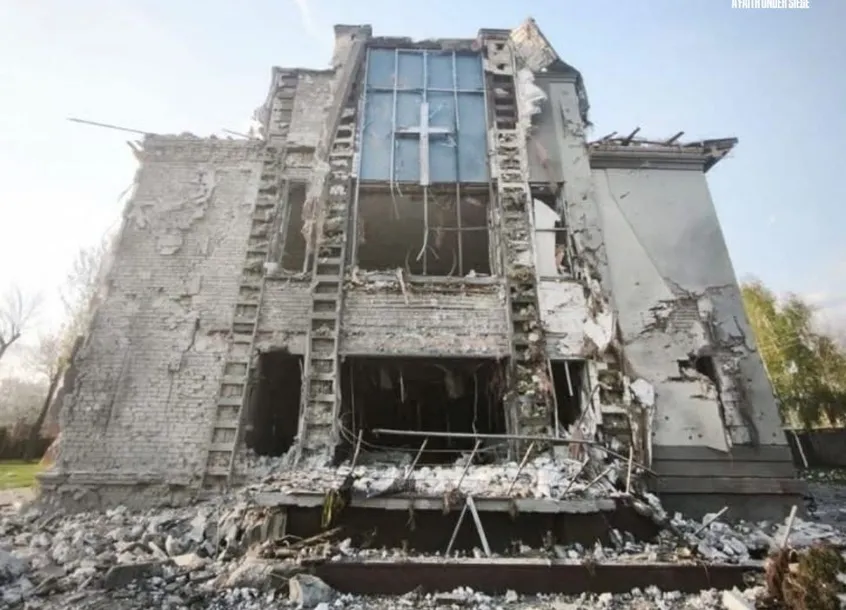
Since the beginning of their full-scale invasion of Ukraine in February 2022, Russia has repeatedly, intentionally, and shamelessly targeted civilians. In a country that has some of the largest (and growing!) Christian communities in Europe, it is inevitable that churches will be affected along with everyone else.
However, there is significant concern that attacks on churches – particularly Protestant evangelical churches – are not random or merely the product of indiscriminate assault.
This is further borne out on the ground in the occupied territories, where Russian soldiers have disrupted evangelical church gatherings, closing churches and persecuting believers.
While President Zelenskyy’s first Oval Office meeting with President Trump is primarily remembered for other reasons, the Ukrainian leader attempted to draw attention to this, sharing the pictures and stories of abducted and tortured pastors.
'Faith Under Fire'
Anyone who has watched Russian politics for any length of time should find this unsurprising. After all, in Russia itself the disadvantageous “Law on Freedom of Conscience and Religious Associations” (1997) and the more restrictive Yarovaya Law (2016), have encoded the systemic oppression of Protestant and evangelical Christians and other religious minorities. Imperialists are hardly kinder to those they attempt to colonise than they are to the folks back home!
Mission Eurasia has been at the forefront of documenting the abuses, as part of their religious freedom initiative. In 2023, they released a foundational peer-reviewed report, Faith Under Fire, that has subsequently been updated in a 2025 report, Faith Under Russian Terror, and most recently in their 2026 report Continued War against Faith: Religious Genocide in the Occupied Territories of Ukraine, 2022-2025.
All of this puts recent events in an even more sobering light.
April 2026 has seen the deadliest drone and missile strikes of the year so far. Among the places hit was House of the Gospel, a Baptist church in Zaporizhzhia, killing one, injuring several others, and leaving the building in ruins (see photograph at the top of this article).
'A strike on people who were saving others'
Mykhailo Brytsyn, a pastor from Melitopol, whose own church suffered disruption, harassment, theft, and closure by Russian soldiers and who was himself detained and accused of extremism, reflected on the bombed church on his Facebook page.
Translated, he writes: "This was not just a strike on a building. It was a strike on people who were saving others… The building was heavily damaged. In reality, it is no longer fit for worship services. But the problem is not only the broken walls. This church was one of the main centres through which humanitarian aid was sent to the occupied territories from the first days of the full-scale invasion. In 2022, many people were ready to give help. But not many were ready to take it there, into the occupation.
"These were brothers and sisters. While we stayed in the occupied city for half a year, these people were, in fact, feeding thousands of people across the Azov region.
"And they continued to do this until December 2022, while the humanitarian corridor between Zaporizhzhia and Melitopol still existed. When some people were trying to profit from humanitarian aid, these people were simply giving others their heart, their time, and their strength. No pathos. No cameras – because what cameras can there be when you have to drive into occupation? No loud words. They were simply saving people.
"Later, this church became a spiritual home for hundreds of those who were fleeing the war. I preached there at Christmas. And I no longer saw boxes of aid, pasta, or oil. I saw human souls being healed there.
"Now the 'liberators' have reached this church too. With a bomb."
Igor Bandura, a leader of the All Ukrainian Union of Evangelical Christians - Baptists, shared the news, summing up the prayers of many, which should, I believe, also be our own: "When rockets are sent to destroy houses of prayer, it shows the true face of the darkness we are facing.
"We pray for the family of the deceased and for the church community. May the Lord bring comfort to those who mourn and let His just retribution come upon those who commit such atrocities.
"God is our refuge, even in the midst of rubble."
Ryan King is pastor of Grace Baptist Church Wood Green.





Responding to racism
“I’m not a racist.” My observation is that if this were in fact the case, such protest would be unnecessary. …