
Warning: Contains plot spoilers.
The first Toy Story landed when I was ten. Since then, I’ve spent countless hours watching and playing with these characters. Now, for the fifth instalment, my own ten-year-old sits beside me.
Without his teenage brother, he is freer – no need to pretend he’s older than he is. Perhaps for the last time, he pushes up the cinema armrest to make us a sofa, rests his head on my shoulder (ducking behind it during a kissing scene), and we laugh, watch and whisper – side by side, caught up in the story.
What unfolds onscreen is beautifully nostalgic: the stellar cast, the craftsmanship, the soundtrack of friendship. Toy Story 5 is at its strongest when it leans into what we all ache for – a love that isn’t flashy or instant, but unconditional and real.
It’s not without distraction: the plot is overstuffed and the tech critique feels undermined by the merchandising around it. Yet, it still touches a nerve (and, let’s be honest, expectations for Disney-Pixar sequels are sky high).
From the guiding love of Moana to the steadfast devotion of The Odyssey and the servant-hearted sacrifice of Spider-Man: Brand New Day, this summer will be framed by stories of a love that stays alongside – not to be needed, but to see you become.
Connecting – but only screen deep
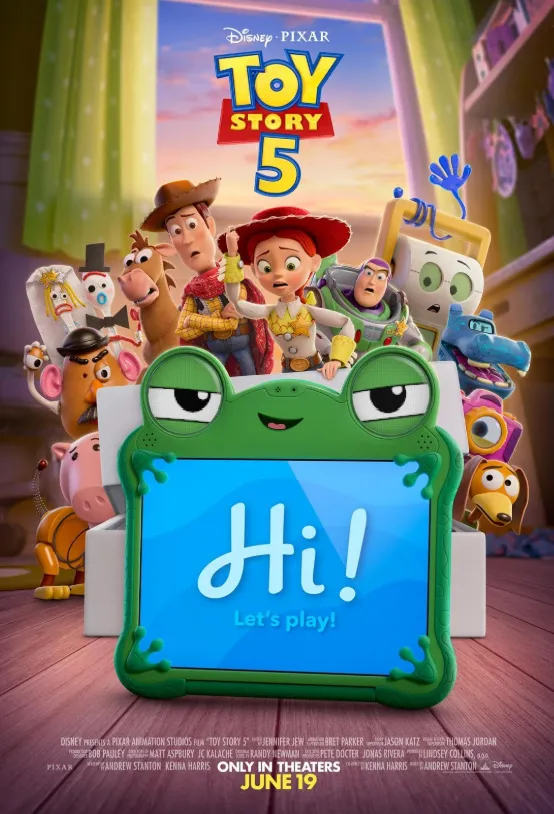
As with the first Toy Story, a new arrival threatens to replace the favourite toy – only this time, it’s Jessie fighting for her place (voiced by Joan Cusack, with warmth, vulnerability and wild energy). Her rival is LilyPad (voice by Greta Lee), a frog-like smart tablet, which Jessie sees as more of a leech, sucking all of Bonnie’s attention.
More than ever, this story belongs to eight-year-old Bonnie. Our gaze lingers longer on the children than in previous films.
Two quietly devastating questions set the scene. Bonnie asks the first: "Mum, Dad, why won’t anyone be my friend?" We never hear their answer, but LilyPad arrives as an earnest attempt to help Bonnie connect.
And at first, it works. A volley of friend requests, instant replies. The virtual world of "The Pond" introduces another familiar soundtrack to our lives: tap tap tap. Friends are made, but will this be a safe place to play?
Losing to a device
The second question comes from Jessie: "Is it me – am I just no good at being a toy?"
Toy Story 4 scared my boys, but these questions are the stuff of my nightmares.
They echo a wider anxiety. By eight, many children spend hours each day online, their worlds shaped as much by screens as by shared stories (over a quarter of children starting school don’t know how to turn the pages of a book, some tapping or swiping at it). [1]
And while nearly eight in ten parents worry about social media and screen time [2], almost half of us say we could be managing it better [3].
How do we help the next generation form meaningful relationships when they are immersed in worlds we don’t know how to navigate?
"I’m losing Bonnie to this device," Jessie sighs – and we all sigh with her. Is it me? Am I no good at putting down my attention-leeching phone to truly connect?
I knew you
Jessie’s instinct is control – also very relatable. It springs from care for Bonnie, but also from an old wound. Beneath her determination lies heartbreak.
On the day of the film’s release, Tom Hanks spoke of the "complete, total terror of losing the battle against self-loathing" that can begin each morning, and how practising thanksgiving prayer has reshaped him [4]. It’s a reminder that much of what drives us remains hidden.
Bonnie’s posture with her tablet says a lot: "locked in" when she’s gaming, shielded behind it when she’s not.
Woody reframes Jessie’s fear: "You know Bonnie better than anyone. What does your gut say?" The attention shifts – from fear to love, from self to other.
It’s a posture not unlike prayer: stepping out of the scramble for control or approval, and turning instead to serve. The film hints at something deeper – that love can bring things back to life, and that to be known is profoundly healing.
An oak tree – and a forever promise
It’s hard to invest in someone else’s growth when your own identity feels uncertain. This thread runs through every Toy Story film because it runs through each of us – we live out of who we believe we are.
The emotional epicentre of Jessie’s story is an oak tree. I wouldn’t dream of spoiling this scene for you, but it brought to mind that beautiful scene in Isaiah, of a servant-hero who raises up "oaks of righteousness, a planting of the Lord for the display of His splendour" (Isaiah 61v3 NIVUK).
Isaiah tells the greater story: the broken-hearted restored, the captive set free, the ashamed made whole. The "insteads" offered here outshine even Pixar’s most imaginative sequences.
At its heart is a relationship grounded in a forever promise: "In my faithfulness, I will reward my people and make an everlasting covenant with them" (v 8).
Our mission on this planet
So where does that leave us – with our children, our phone habits, and our quiet battles within?
In a forest of other oaks.
We are not made to grow in isolation – a truth that our blockbuster franchises are now proclaiming to us. Even as our devices shape us, we still have an enormous influence on those closest to us. That’s why Jesus spent a disproportionate amount of time with His disciples, why Paul invested deeply in Timothy, why Scripture shows that faith grows life to life.
In the film, Buzz rallies an army of high-tech space rangers, but it’s Jessie’s relational mission that carries weight. She gets alongside the hilarious "AA Team" and together they learn to really play, let go and forgive. More than that, her steady commitment to Bonnie’s good shows how much the right kind of friendship matters.
This is the invitation for us, too: to walk alongside someone – not to control or fix, but to help them grow. This is disciple-making, and perhaps it’s less intimidating than we imagine. We can become a safe place where hard questions are entrusted and explored, where people feel seen and known, and encounter something of God’s everlasting love (whether they know Jesus yet or not).
Many of us sense this calling but we aren’t always sure how to begin. That’s why initiatives like The Alongsider Course from Navigators UK are so timely – a free course designed to help ordinary Christians invest intentionally in others, one relationship at a time.
Because this isn’t just a nice idea – it is God’s love playing out in real lives.
In Isaiah’s words, God makes His people "oaks of righteousness" who will "restore" and "renew" what has been "devastated for generations".
As we walk alongside others, looking to Jesus, we find He is quietly re-storying our lives too.
- Kindred Squared, 2026
- Ofcom, 2025
- Pew Research, 2025
- The Rest is Entertainment
Holly Price is a writer and editor with Navigators UK. She writes about film, stories and faith as it is lived out in everyday life, noticing the small and often overlooked ways God is at work. She is the author of Living the Conversation: Sharing Jesus in All of Life.



Coffee, cardboard boxes and the Kingdom of God
“Not everyone will see your children clearly. But then – some do. They show up, not out of duty, but …