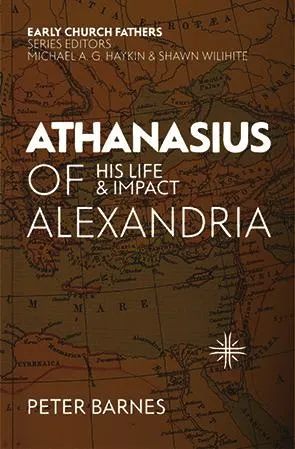
ATHANASIUS OF ALEXANDRIA:
His life & impact
By Peter Barnes
Christian Focus. 168 pages. £7.99
ISBN 978 1 527 103 924
What do you know about Athanasius of Alexandria? I suspect rather little!
This is probably not surprising, as few Christians today know much about the writers and writings of the ancient church, or even think it necessary to do so. If books are read, there are more pressing topics to think about than some ancient people who may have been noteworthy in the past but seem to have little relevance now.
This book by Peter Barnes, minister of a Presbyterian church in Australia and lecturer in Church History at Christ College, Sydney, is one of a newish series on reading the Early Church Fathers, men who wrote at the close of the first century up to the middle of the eighth century AD. The aim is not only to build an appreciation for these early writers, but also to help believers see how the battles they fought, often over key points of Christian belief, were such that we owe a debt of gratitude to them for matters of orthodox truth that are taken for granted today in evangelical church circles.
In the first section, Barnes sets the historical background for Athanasius, which centres on a time of persecution of the church leading to Constantine becoming emperor in AD312. Constantine’s conversion is discussed and seen as a significant factor in seeing himself as ‘the imperial protector of the church’ and ushering in a period of relative calm as far as outward opposition to the church was concerned. But there was dissension between various factions on a number of issues, and as far as Athanasius is concerned; the main issue was the deity of Christ, and defending this against challenges from Arianism which maintained the Son of God was created by the Father, and therefore denying the full divine nature of Christ. Constantine tried to tackle the matter at the Council of Nicea in AD325, but doctrinal battles on this topic continued to engage Athanasius and the book looks at how matters developed and issues of Christology continued to be debated, with special reference to the part played by Athanasius in the following years.
Perhaps the most valuable part of the book is the final three chapters, which discuss Athanasius’ beliefs on matters such as the nature of the atonement, the humanity and resurrection of Christ, and his spirituality and views on asceticism. An evaluation of Athanasius concludes the book, and his importance is discussed in the light of various scholars’ views of him.
I found the early chapters a little turgid, as many quotations were included, and sometimes it was not easy to see which were the important issues as Athanasius’ debates with a variety of emperors and church leaders were set out. The details at times seemed overdone and did not make easy reading. But the final three chapters were more valuable and enabled the reader to see the significance of Athanasius and how important his writings and debates were for establishing an orthodox understanding of the deity of Christ.