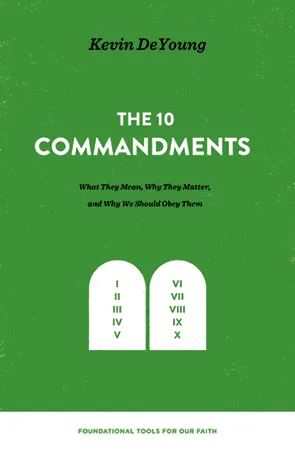
THE TEN COMMANDMENTS
What They Mean, Why They Matter, and
Why We Should Obey Them
By Kevin DeYoung
Crossway. 203 pages. £12.99
ISBN 978 1 433 559 679
Kevin DeYoung has identified another hole in contemporary Christian teaching.
For centuries, instruction for new believers was based on three things: the Apostles’ Creed, the Lord’s Prayer and the Ten Commandments. All three are unlikely to receive any special attention today. Opening his book with an introduction explaining why we should study and obey the Ten Commandments, DeYoung attempts to correct this deficiency by dedicating a chapter to clearly and simply explaining and applying each commandment in turn.
Despite a reduction in emphasis, many are still familiar with the Ten Commandments. I imagine that most Christians can list them, even if they don’t get the order quite right. However, the value of DeYoung’s book is that it takes us beyond mere familiarity and helps us to re-appreciate just how daunting and deep the commandments really are. Readers are reminded that there is a real difference between knowing and obeying these commandments.
Insightful application
DeYoung’s ability to uncover the true impossibility of the commandments is best seen when explaining those we consider easiest to keep. Do you think you obey the third commandment by not using God’s name as a swear word? DeYoung will remind you that casually remarking that God has told you to do something, or ascribing his authority to your opinions, makes you just as guilty. Furthermore, by calling yourself a Christian, you take God’s name upon yourself and, as a result, must live in a way that displays, rather than discredits, his name. The commandments are far more demanding than we often remember.
This same sharpness of application is brought to the other commandments, uncovering the root of theft in greed, adultery in lust and murder in anger.
In doing so, DeYoung displays the true value of the Ten Commandments, helping us uncover the roots of sin deep in our hearts.
Not only does DeYoung demonstrate the impossibility of the Ten Commandments, he also brings us to the promise of the gospel. Readers are clearly presented with Christ fulfilling them on their behalf. However, DeYoung ensures that by doing so he leaves us realising that we also have new obligations in Christ. In Christ, the law is not only our duty, but our delight.
Problematic framework?
DeYoung’s interpretation of the Ten Commandments is solidly orthodox. In drawing from different confessions and catechisms, he takes the same approach as faithful Reformed Christians have done for 400 years. While this is an obvious strength, it is also a potential (and perhaps only) weakness. Many are questioning this traditional coven-antal understanding of Old Testament law and some readers will be perplexed at how DeYoung moves between the Old and New Testaments.
As always, this is most clearly seen in the application of the Sabbath, the fourth commandment. After drawing out the principle of rest and weekly rhythm, DeYoung gives some practical suggestions for how we behave on a Sunday, but argues that these are subject to Christian freedom and tells us that we must rest in the finished work of Christ. Most critics will agree with where DeYoung ends up, but wonder how he has remained consistent to his principles in getting there. DeYoung argues each of the commandments is still binding today, although they have been transformed by the coming of Christ. ‘Transformed, not trashed’ is how he describes his approach, and yet the fourth commandment is left so ‘transformed’ that there appears to be little commandment (if any) left. Indeed, unlike the other commandments, the fourth commandment is left almost unrecognisable.
Increasingly, evangelical Christians are looking for a more consistent framework through which to understand the law, including the Ten Commandments, and account for both its Old Testament context and New Testament treatment. However, a short book based on a sermon series is not an ideal place for DeYoung to answer the questions being raised by New Covenant and Progressive Covenantalism theology.
The value of the book is only slightly diminished because of this. I have already strongly recommended it to others and will happily do so again. Whether you are a new or mature Christian, DeYoung provides a simple and valuable (re)introduction to these increasingly forgotten tenets of the Christian faith.