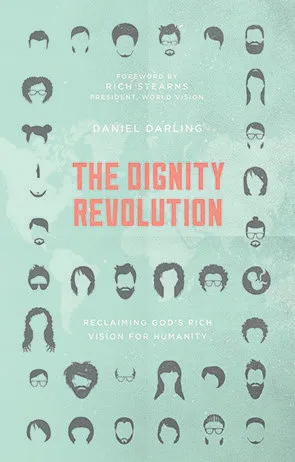
THE DIGNITY REVOLUTION
Reclaiming God’s Rich Vision for Humanity
By Daniel Darling
The Good Book Company. 219 pages. £8.99
ISBN 978 1 784 982 836
What is a human life worth? In an age of increasing polarisation, it is easy to demonise others because of our own defensiveness. We live in a time of reductions; human life is considered little more than chemicals and our value is measured by our economic output.
It is good to read a book that raises important questions and offers ways for followers of Jesus to demonstrate his image by treating other people with dignity.
Biblical concept of dignity
The book has 12 chapters in two sections. The first section, Finding Dignity, is a theological discussion in three chapters concerning: the idea of dignity as a biblical concept not found in other religions or philosophies; a survey and critique of humanity’s wilful neglect of the concept in the holocaust and other events of the 20th century; and mistakes made by the church under the influence of the culture. This is a critique of humanism, especially its inability to account for depravity. Chapter 3 is a call to rediscover dignity within the church as a witness to society.
Useful summaries
The second section, Contending for Dignity, addresses dignity in a wide range of areas: race, with a useful call to deeper listening; the foetus and the right to life with useful ideas on language; the prisoner and restorative justice and immigration and trafficking; old age, death and the cult of youth; the dignity of work and good employment practice and the relief of poverty with a call to generosity; identity, sexuality and marriage and the dignity of faithfulness; technology and a call to intentionality and thoughtfulness in its use. These chapters, crammed with illustrations, cover familiar ground and are useful summaries of the issues.
The sharp end
The final chapters Agree to Disagree and A Land Beyond Left and Right, are where the book gets sharp. They consider: the conflict between the right to religious liberty versus other rights; what we should expect in a pluralist society; and how we should behave. The ‘Outro’, or conclusion, is a reminder of our responsibility and uses the defeat of slavery in the 19th century as its example.
Southern Baptists
The book is written for an American audience, from a Southern Baptist perspective. It calls on the church to examine itself and repent of attitudes and actions shaped by the culture. British readers must work to apply the principles in a different context, but the principles are the same and it is worth the effort.
What are we going to do about it?
This is a call to examination and quiet action. Do we practice seeing the image of God in each other, not merely talking about it? Are our churches representative of a cross-section of society or are they silos of class, race, or other narrow interests? Are they kingdom churches that manifest the life of the Kingdom of God or do they just reflect our tastes? Do we work at the injustices of our age or leave it to the state?
At its heart the book is a call to a new ‘Human Dignity Revolution’, to see beyond specific issues (without ignoring them) and care about ‘human dignity wherever it is undermined or assaulted”. It is a call to allow our faith to shape our politics and not the other way round. But more than that it is a call to shape our daily interaction through the lens of the dignity of every human as made in the image of God.