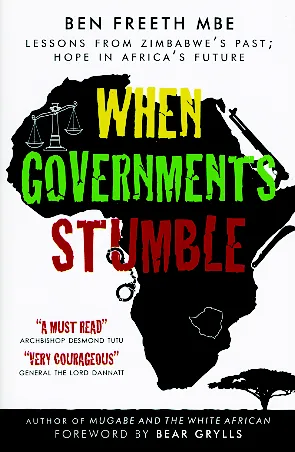
WHEN GOVERNMENTS STUMBLE
Lessons from Zimbabwe’s past;
hope in Africa’s future
By Ben Freeth
Monarch Books. 211 pages. £8.99
ISBN 978 0 857 213 747
Ben Freeth challenges us, both individually and as the church, to visibly and vocally stand against evil perpetrated by governments.
If anyone is qualified to speak on this issue it is Freeth. He has walked the talk in his struggle for justice for himself, his family and for other victims of the power and wealth grab by Zimbabwe’s political elite.
Farm invasions
The book opens with a description of Freeth’s own experiences during the farm invasions of the early 21st century. In doing so, he not only gives testimony to God’s faithfulness in the face of severe physical beating and loss of livelihood, but indirectly establishes his credentials as a commentator.
Freeth uses Zimbabwe (based on his firsthand experiences) and historical cases from elsewhere as examples of oppression by governments. He contrasts these against government as God intended it to be. In Zimbabwe the church has generally failed to live up to the call to stand up for justice, be that in its teaching or in its failure to make a stand through public statements or to organise peaceful demonstrations. He bases his assertions, of failure and of what ought to be, firmly in Scripture. There is acknowledgment of the few cases where the Zimbabwean church has stood boldly against the actions of the government, although these have been too isolated to have had a significant positive effect.
Freeth demonstrates how, conversely, a nation thrives when it is governed according to biblical principles. Basing his arguments on Scripture, he shows how fundamental to good governance an impartial judicial system and secure property rights are.
Freeth’s book is timely; the church in the West sits under governments moving steadily away from Judeo-Christian principles and gradually faces the effects of persecution. Given the relatively slow pace of change, like the proverbial frog in water slowly being heated, there is a risk that the church will not make a stand against the small injustices. It may then not have earned the right to speak out on the bigger injustices when they come. This book is a clarion call for the church to wake up and act. It may be summed up in the oft-quoted, ‘The only thing necessary for the triumph of evil is that good men should do nothing’.