SAINTS ALIVE
Artist Michael Landy
National Gallery until November 22
The Bible’s view of saints as ordinary Christian believers called by grace to a divine inheritance has no bearing on this exhibition.
Its subject is the centuries-old cult of ‘Saints’ — with its concomitant visions, relics, shrines and pilgrimages. For artist Michael Landy their histories are ancient fables, long-discarded by all but a few art historians and theologians. By nature charitable and optimistic, he laughingly identifies with the saints: like them he rejects the values of consumerism and he parallels his artistic wrestlings with their self-flagellation. His exhibition assumes the secular mindset that now prevails in British popular culture. Nevertheless, superstition runs deep in human nature: many people still dread ‘unlucky’ omens or calendar dates, and in Roman Catholic countries the saints are hardly forgotten relics.

Hugely popular
The rejection of Christian values and boundaries has led many contemporary artists to produce shocking or ugly art. Their ‘interventions’ in historic collections can make bemused visitors angry. But ‘Saints Alive’, which concludes Michael Landy’s tenure as eighth artist-in-residence at the National Gallery, is hugely popular. Landy, well known for spectacular, interactive and challenging projects, was commissioned to produce a body of work related to the Gallery’s permanent collection — daunting for someone who doesn’t paint pictures and had never visited the gallery before! But he has, as expected, bypassed conventional with the craftsmen and engineers at the media to engage positively with his audience. MDM props factory in Herne Hill, who
Landy graduated from Goldsmiths then turn his two-dimensional sketches into College in 1985, when ’Old Master’ paint-huge kinetic sculptures with a playful inter-ing had little or no relevance, since tradition-active element. His versions of the saints and al skills and the certainties that underpinned their emblems are monumental, noisy, ani-them had been sidelined. The syllabus mated and startling, a world away from the focused on semiotics, conceptualism, per-peaceful atmosphere in the rest of the formance, installations and multi-media National Gallery. events. His own drawing abilities were dis-Body parts combined with tricycle wheels missed as unimaginative copying, though in and clearly visible mechanisms are Landy’s fact, decades later, he has returned to draw-sculptural means of showing how outlandish ing at the National Gallery as a way of start-these subjects are, while his collages combine ing to look at the unfamiliar. details of flora and fauna, limbs, heads and
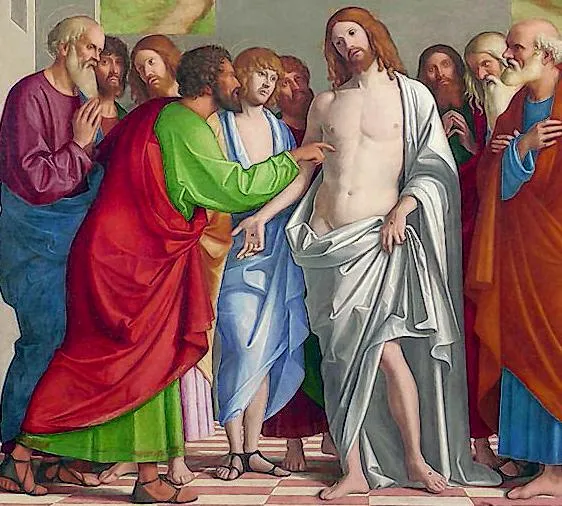
In the introductory film we see Landy dis-bizarre symbols all sliced or scissored from cussing his ideas about St. Jerome and Co. scaled-up digital reproductions of paintings. Gruesome or bizarre themes are treated with rather bewildered respect but with such humour that visitors emerge smiling. They are encouraged to visit other rooms and view the remarkable pictures used as source material, all conveniently highlighted by a ‘Saints Alive’ label. Long removed from the churches where they were objects of contemplation and purged of their religious context, these paintings still possess the life-enhancing qualities of good art.