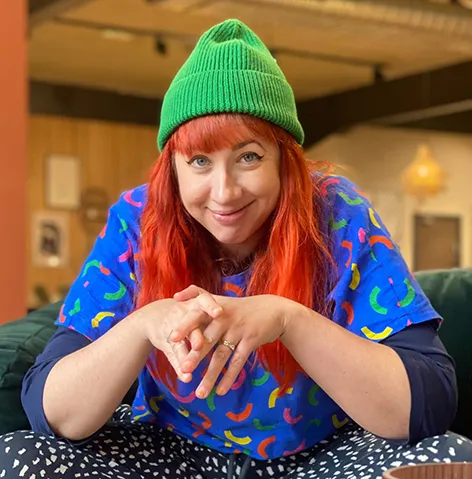
10 questions with Sophie Killingley
1. How did you become a Christian?
These stories are never straightforward, are they? As a kid I loved the Jesus I found in my stories and Bible but, growing up in church, this got crowded out by fear, shame and a kind of religious scrupulosity where I was desperate to please the church leaders, and a Jesus that was never satisfied.
I burned out in university, exhausted with trying to please a god that I didn’t connect with in any meaningful way. I had strange moment on a train reading a book; it was a John Newton quote, and I was suddenly filled with a sense of God’s immense love and care for me. It was only then that the Bible started to properly make sense.
I started going to a church which connected the truth I found there to my mind and my soul. I’m now fiercely protective of the Jesus I find in those pages and His care for the vulnerable, the broken, the try-hards, the insecure, the traumatised. Churches and culture often try to shape Him for their own ends, but He’s the undefinable God-man, a poor carpenter, a teacher, a saviour who won’t be boxed.
2. What lessons have you learnt since that you would want to pass on to a younger Christian version of yourself?
To let go of all the Christian cultural baggage that you get persuaded is part of being a Christian. Having to look or speak a certain way to be accepted. Just keep looking at Jesus, guided by the word and keep a loose grasp on the weight of other words.
3. How would you describe your prayer life?
Evolving. It’s gone through many iterations. And I’m trying to sit in God’s presence more now, rather than get clogged up with set phrases that seem to make up most prayers in our circles.
4. Which two or three Christian books apart from the Bible have most influenced your faith?
The Diary of Adrian Plass. These books were pivotal in my growing up in helping me see that although God is to be taken seriously, as Christians we can be deeply unserious people. And let’s face it, we are a strange bunch. It taught me how to laugh at our oddities.
The Lord is My Courage: K.J. Ramsey. This meditation through the 23rd Psalm has recently given me hope in Christian books again. I struggle with many, finding the answers to not be well-rounded and nuanced enough. This book by trauma-informed counsellor K.J. has been gentle medicine to my soul hurt badly by the church.
Recovering from Biblical Manhood and Womanhood: Aimee Byrd. This book helped so much to connect the woman I am made to be with Scripture, and helped to start untangling it from church culture. I needed help recovering from so much of what I had imbibed which had little to do with Jesus and more to do with making myself palatable for conservatism.
5. Who or what have been your biggest Christian influences?
This is tricky. Many of the people I revered and thought highly of during my coming to faith in the early years of the ‘Young, Restless and Reformed’ movement have fallen greatly. It’s sad and sobering. But I remain thankful for the influences of people such as Glen Scrivener, Karen Swallow Prior and Makoto Fujimura. Their clear-headed response to abuse, the polarisation of politics, and how to make culture and engage with beauty, have given me great hope and encouragement in recent years.
6. What are the main challenges you believe Christians face today?
How to remain soft and compassionate while also retaining orthodoxy. The temptation is to become brittle and harsh with just truth. Or to become unanchored from it, by being swayed only by cultural mood changes.
7. What encourages and what discourages you?
Encouraging, the number of women I speak with regularly who are attempting to be nuanced in understanding God’s word, rejecting bad practice and unspoken cultural expectations within churches. There’s a wave of women who won’t put up with less and I love it.
Discouraging, the persistence of misogyny hiding behind the banner of complementarianism. I’m not making a doctrinal point here, but a factual statement based on lived experience of myself and other women in these spaces.
8. What makes you laugh?
Nonsense, largely! We can all be so uptight and lost in the horror of the present age, I love to laugh at absurdity. And, basically, cat videos.
9. What would you want to say to the wider evangelical world?
Generous liberty. Keep the main things the main things, but PLEASE keep a looser grip on the secondary and cultural things. With many issues, parenting, school, work, enjoying culture, there is not ONE way to do things. So, let’s be generous with each other, and acknowledge that we can make different conscience/wisdom calls, which aren’t wrong or to be fought over.
10. Which Biblical person (other than Jesus) do you most look forward to meeting in glory and why?
Oooh, I would love a chat with Phoebe about what Paul was like, and the Roman church, and what her roles and responsibilities looked like!
Sophie Killingley is an artist and writer who lives in Surrey with her husband, two neurodivergent teens and cat, Major Tom. Her website is www.perishandfade.com Instagram: @perishandfade.