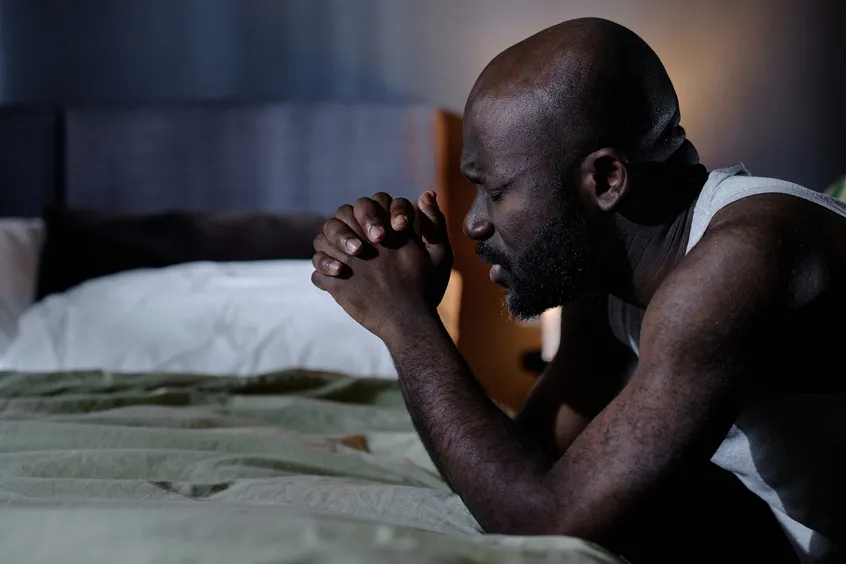
Rediscovering the 'lost' art of kneeling in prayer

Roger Carswell  |  Features
Date posted:  18 Sep 2025
Share Add       
Rediscovering the 'lost' art of kneeling in prayer

Source: iStock

A visitor to the Continental Congress in America was eager to see George Washington. He asked a steward: “Which one of those men is George Washington?”

The reply came: “When the Congress goes to prayer, the one who kneels is General George Washington.”

We are told to pray "without ceasing", so it is the privilege of every believer to be in constant communion with our Lord. We can pray when walking, driving, laying down, working, and we can pray anywhere. One old saint wrote: "Constant prayer, mental prayer, prayer of the heart, prayer everywhere, in the street and in the market, in the shop and in the warehouse, behind the counter and over the ledge, in the omnibus and in the railway carriage, in the mine and at the loom, at the plough and at the harvest field, in harbour and at sea, in the calm as well as in the storm, prayer at all times and in all places."
But what about our times of private devotion, or indeed when we are praying in church?

Have we made church kneelers into attractive yet redundant relics, and do we ever kneel before God in our personal quiet times?

Is our lack of kneeling an indication of our over-familiarity with almighty, all-holy God?

I am convinced that posture before the King of kings is indicative of our reverence and submission before Him.

Biblical examples

Solomon is hardly a godly example to follow, but when praying the dedicatory prayer at the newly completed temple he began standing but concluded kneeling as he was over-awed by the presence of God.

Had he learned this from Psalm 95? We read: "O come, let us worship and bow down; let us kneel before the Lord our maker." Notice that this verse is in the plural – it is written for a time of corporate worship and public prayer. Surely, it should not be too humiliating to kneel when praying with others.

When Elijah was to experience the great answer to prayer of the downpour of rain after the drought, we read that he went to the top of Mount Carmel, cast himself down on the earth, put his face between his knees and prayed.

Daniel is remembered as a man who prayed three times daily but let us not forget that "he kneeled upon his knees three times a day" (6v10). He did this in a foreign land when his country had been destroyed and Jerusalem burned with fire.

The prayer of Ezra in chapter 9 is one of the great prayers of the Bible, but before he commenced, we read: "At the evening sacrifice I arose from my fasting, and having torn my garments and my robe I fell on my knees and spread out my hands to the Lord God"(v5).

Each of the Gospel writers give examples of people falling down on their knees before Jesus in respect of their weakness and inability to save themselves before Him.

There is a striking example in Acts 9v40 where the apostle Peter, who for three and a half years had walked with and been with Jesus, knelt down in humility to pray for a disciple called Tabitha to be raised from the dead. He knew his position before the Lord whom he knew so well.

Stephen, the first Christian martyr, kneeled and then prayed, even when he was being stoned to death. He prayed for his own spirit, and after that for his tormentors, before he "fell asleep" in Christ.

Paul, our great pattern-believer, was a prayerful man who kneeled as he prayed. "For this reason I bow my knees to the Father of our Lord Jesus…" (Ephesians 3v14). If that is Paul kneeling and praying individually, we also find him kneeling and praying with a whole group of disciples, with their wives and children, on the beach in Tyre (Acts 21v5).

Perhaps most remarkably, and surely the greatest example and incentive to kneel in prayer, is that the Lord Jesus Himself knelt. In His hour of great crisis in the Garden of Gethsemane we find that He withdrew from His disciples about a stone’s throw and "kneeled down and prayed". Speaking to His Heavenly Father, Jesus knelt. What part of that enables us to feel that we don’t need to?

Historic examples

Throughout history, Christians have knelt to pray. Eusebius tells of James, brother of Jesus and the first Bishop of Jerusalem, having callouses on his knees because he spent so much time on them in prayer! It is said of William Bramwell, who saw revival in West Yorkshire in the late 1700s, that he “almost lived on his knees… he often spent as much as four hours in a single season of prayer in retirement.”

There is coming a day when with the four beasts and twenty-four elders and tens of thousands we will "fall down before the Lamb" (Revelation 5v8).

O that with yonder sacred throng
We at His feet may fall!
We’ll join the everlasting song
And crown Him Lord of all.

Are we examples?

The Bible tells of people sitting, standing and kneeling to pray. The important thing is that we are praying individually and corporately with others in prayer meetings. Clearly though, kneeling is not always required, but there is enough in Scripture to say that kneeling should not be ignored.

When the disciples asked Jesus to teach them to pray, He didn’t mention the posture. Nevertheless, posture in prayer is revealing. If humility, submission, repentance, and honour are in our hearts, then why not express them with our body too? Kneeling to pray is a way of speaking to ourselves first, that we want to submit in obedience to the Lord and His will. If kneeling is merely external and simply a physical act, it is just a ritual. But if kneeling is an act of worship, it will impact the meaningfulness of prayer. That is why bending the knee before the presence of the living God is something we cannot abandon.

The humble attitude of kneeling before the Lord conveys a heart of repentance and obedience, that brings us before God without any sense of glibness, over-familiarity or pally-ness. God is our Creator as well as our Heavenly Father and Redeemer. He is worthy of all homage and honour.

O, the pure delight of a single hour
That before Thy throne I spend,
When I kneel in prayer, and with Thee, my God,
I commune as friend with friend!
-
Fanny Crosby

Share
< Previous article| Features| Next article >
Read more articles on:   prayer
Read more articles by Roger Carswell >>
Features
Re-imagining the pulpit: Lectures or living Words?

Re-imagining the pulpit: Lectures or living Words?

I wonder how many sermons you have heard in your lifetime. I reckon I have heard at least 15,000. And …

UK & Ireland
Yorkshire: art and gospel

Yorkshire: art and gospel

In early July, Emmanuel Baptist Church connected with Horsforth’s annual ‘Walk of Art’ weekend in order to share the gospel. …

Looking for a job?

Browse all our current job adverts

Search

Give a subscription

Our monthly newspaper is the perfect gift for those who love to think deeply

Give here