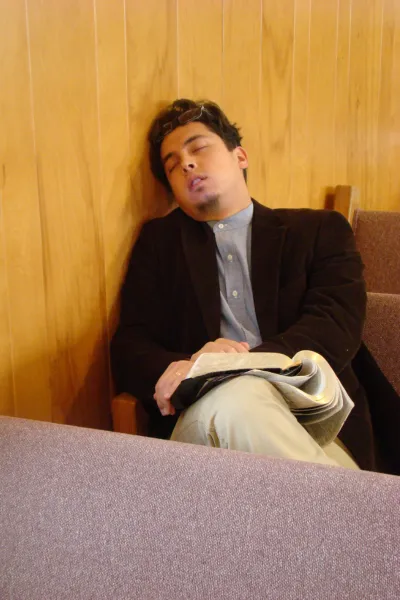
Why is some ‘sound’ expository preaching just so dull and boring?

Jon Barrett  |  Features
Date posted:  4 Oct 2024
Share Add       
Why is some ‘sound’ expository  preaching just so dull and boring?

Source: Canva

‘The preacher pulls the little cord that turns on his lectern light and deals out his note cards like a riverboat gambler. The stakes have never been higher.

‘Two minutes from now he may have lost his listeners completely to their own thoughts, but at this minute he has them in the palm of his hand. The silence in the shabby church is deafening because everybody is listening to it. Everybody is listening including even himself. Everybody knows the kind of things he has told them before and not told them, but who knows what this time, out of the silence, he will tell them?’

I love the above quote from Frederick Buechner’s memoir Telling the Truth. Beuchner, a Pulitzer-nominated novelist and American Presbyterian preacher, was no evangelical (although he was reasonably theologically orthodox and did spend a semester as a guest lecturer at Wheaton College), but his prose wonderfully captures something of the drama of preaching in a way that I suspect would seem foreign to many contemporary evangelical preachers from the Reformed Evangelical world that I inhabit.
The catalyst for this article was a conversation sparked by a review of Bob Fyall’s 2023 book Why Are We So Often Boring? Reflections on Preaching in an online group comprised largely of evangelical church leaders encompassing charismatic and non-charismatic perspectives and drawn from a number of streams ranging from Anglican to Free Church, New Wine to Proclamation Trust. It probably needs to be stated that in accepting the invitation to write this piece I am acutely aware of the maxim that ‘people who live in glass houses shouldn’t throw stones’. Like anyone with over 25 years of preaching behind them, I have no doubt that I have preached a fair number of sermons that would – at best – have been ranked only as ‘mediocre’ or more kindly as ‘very average’!

Full disclosure: I must confess that I haven’t read Fyall’s book, but the ensuing conversation owed more to the book’s title than the book’s contents, and in it I admitted that I had rarely heard what I would consider to be boring preaching until I came into contact with the culture of the conservative evangelical world whose theology had successfully convinced my head and won my heart. The early days of my Christian life, following my coming to Christ in the late 1980s at the age of 20, were spent in a mildly charismatic evangelical Anglican church, and while the sermons weren’t necessarily the most theologically sophisticated, they were always warm, engaging and applicatory, and I looked forward to them with anticipation every week. During the same era, I was a regular visitor to Spring Harvest, where the preaching was guaranteed, if nothing else, to be entertaining. (I may just have unfairly damned early 1990s Spring Harvest with overly faint praise, as I can recall some Biblical exposition of excellent quality from R.T. Kendall, Steve Gaukroger and Clive Calver, as well as some other talks which, although lightweight in content, would not have disgraced either the comedy or after-dinner circuits!)

My ‘conversion’ to a Reformed theological position was largely as a result of a combination of my own personal reading and the long tentacles of childhood experience extending themselves into my adult life. (My parents are Christians and were members of a conservative evangelical Baptist church which I had attended as a child, and although I stopped attending it myself while still a teenager, I retained some memories of it.) A few years after becoming a Christian, I found myself as a 27-year-old heading off to an evangelical theological college to study for ordination in the Anglican church, and it was here that I encountered both a culture that I never quite fitted in with, and where I was first exposed to preaching that was worthy in its aspirations but not infrequently dull in its delivery.

In the interests of balance, it’s important to say that my three years at college were happy years, the lecturers and lectures were excellent and I benefitted enormously, and am thankful to God for all that I received there. It wasn’t the college that was the problem, it was the previously unknown corner of the evangelical landscape that it brought me into contact with that presented me with a way of ‘being evangelical’ and an experience of preaching I often struggled with. Inevitably, everything I go on to say will run the risk of falling prey to accusations of extreme caricature and crass generalisation, but it represents something of an external processing of half-formed thoughts that have occupied part of my brain for the last quarter of a century or so. They’re brief and undeveloped thoughts and I suspect that, in the hands of someone better qualified and more erudite than me, they might in time make a good paperback book that itself could be the subject of critique in social media groups!

Preaching that takes the text seriously but not the audience

To its credit, the attitude towards preaching that has emanated from some of the well-known and successful courses and training schemes that exist within the more conservative corner of the UK evangelical scene are worthy in their aspiration to accurately convey Biblical truth, serious in their approach to the text, and rightly place a high emphasis on the place of preaching. Their commitment to the pre-eminence of expository preaching is also to be commended. However, the obsession with ‘getting the text right’ (a phrase I’ve heard countless times) often seems to appear to be the ‘be all and end all’ of the preaching enterprise, and at times seems to almost occur in a frenzied hive of hermeneutical activity that takes place in a vacuum that forgets that, ultimately, it will be delivered to an audience comprised of people! While taking the inspired text seriously is our foremost task, we forget the ‘end users’ at our peril.

Preaching defined as teaching

Preaching should never be less than teaching, but my observation is that there is an unfortunate tendency among those of us who take the Biblical text and the task of exegesis seriously to reduce preaching to being little more than teaching. R.C. Sproul, in an article originally published in Tabletalk magazine extolling the need for churches to develop their teaching programmes, wrote: ‘Typically, we distinguish between preaching and teaching. Preaching involves such things as exhortation, exposition, admonition, encouragement, and comfort, while teaching is the transfer of information and instruction in various areas of content’, before acknowledging that: ‘In practice there is much overlap between the two.’ A sermon should aim to do more than just impart information to the head, but rather should be a vehicle by which the heart is warmed and worked on as the Holy Spirit moves.

Preaching that’s paranoid about ‘performance’

Sadly, pendulums never seem to stop in the middle (unless, of course, the pendulum is broken!) and the conservative evangelical preaching pendulum often seems to have swung too far from any notion of the sermon as performance or ‘happening’. The reasons for this are both understandable and commendable: Rob Bell, Joel Osteen, Mark Driscoll and a host of other speakers are testament to the fact that being an able communicator is no guarantee of either character or theology. But the fear of manipulating people’s emotions or sweeping them along on an oratorical tide has created an almost extreme suspicion of the speaker’s art and craft. One can only assume that John Chrysostom, George Whitefield and Charles Spurgeon (all blessed with rhetorical skills and each with more than a hint of the performer about them) would be viewed with suspicion by some contemporary conservative evangelical preachers.

Preaching that’s fearful of emotions

Erik Raymond, in a 2007 article on the Gospel Coalition’s website, wrote: ‘Ever since I have been exposed to the Doctrines of Grace I have wondered aloud as to why those who are theologically Reformed tend to be the most unemotional. And on the other hand, those who, by comparison, tend to downplay doctrine and be more man-centred, those in the traditionally charismatic, and now increasingly in the Arminian evangelical wing, tend to be more wrought with emotion.’ This need not, and should not, be the case – the preoccupation with the glory of God that is a key part of Reformed spiritual heritage ought to make our preaching more, not less, emotionally charged. Emotion and emotionalism are not the same thing, and while the latter is to be avoided, the former ought legitimately to be a desired consequence of Biblical preaching and should be welcomed rather than treated with suspicion.

Preaching that comes from a monoculture

As someone who left school at 16, played for years in football teams mostly comprised of tradesmen, and whose immediate family background is probably lower middle-class – and from my grandparents probably all the way back to Adam and Eve, working class – training for ministry at an evangelical Anglican college was something of a culture shock. It may be less the case now, but there was a preponderance of white, privately educated young men from what I would describe as upper middle-class backgrounds. There is, of course, nothing wrong with being from one particular social demographic or another (we can’t choose our ancestors!) but it would be hard to view this lack of diversity as anything other than a weakness.

The five observations I’ve offered are just that – they’re one person’s observations and I realise that they may chime with the experience of some readers and not with others. They are my thoughts, and as such will be prey to all of the blind spots and prejudices that we each of us possess by virtue of being flawed humans but, if you’re a preacher, as you prepare this Sunday to ‘deal out your notecards like a riverboat gambler’, you could do worse than to heed these closing words from Tim Keller: ‘First you need to preach the text in its Scriptural context; second you need to preach the gospel every time; and finally, you need to preach to the heart.’

Share
< Previous article| Features| Next article >
Read more articles on:   preaching
Read more articles by Jon Barrett >>
Comment
‘The God who is’

‘The God who is’

In recent years I’ve discovered and learned to appreciate the Westminster Shorter Catechism. It’s a bit of a niche thing …

Comment
What makes you erupt in praise?

What makes you erupt in praise?

If you had to finish this sentence: “I find myself erupting into praise when…” I wonder what you’d say. Possible …

Subscribe

Enjoy our monthly paper and full online access for just £40/year

Find out more

Need to advertise?

We can help you reach Christians across the country

Find out more

