True faith: ‘A matter of both head and heart...’

Michael Haykin  |  Features  |  history
Date posted:  1 Sep 2023
Share Add       
True faith: ‘A matter of  both head and heart...’

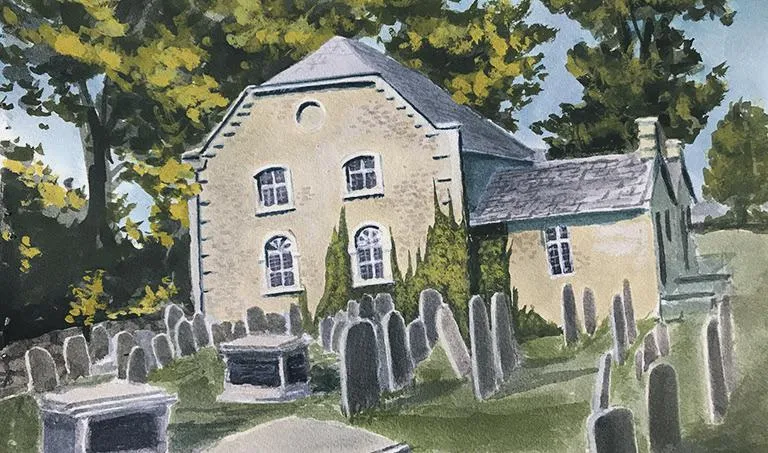
Bourton Church in Beddome’s time

Benjamin Beddome, whose life and ministry we began to look at last month, first visited Bourton-on-the-Water in the spring of 1740.

Over the next three years he laboured with great success in the Bourton church. Significant for the shape of his future ministry was a local revival that took place under his ministry in the early months of 1741. Around 40 individuals were converted, including John Collett Ryland, a leading Baptist minister in the latter half of the 18th century, now chiefly remembered for a stinging rebuke he gave to young William Carey.

It may well have been this taste of revival that made Beddome a cordial friend to those who were involved in the evangelical revivals of the mid-18th century, men like George Whitefield and the Mohegan Indian preacher Samson Occom, who preached from the Bourton pulpit.

This taste of revival also gave Beddome an ongoing hunger to read of revival throughout British society on both sides of the Atlantic. Within a year of the Bourton awakening, for instance, Beddome had purchased a copy of Jonathan Edwards’ The Distinguishing Marks of a Work of the Spirit of God (1741), which provided him with a marvellous foundation for thinking about and labouring for revival.

In July, 1743, the Bourton church extended an invitation to Beddome to become what they called their ‘teaching elder’. Readily acceding to their request, he was ordained on 23 September of that year. The early years of Benjamin Beddome’s ministry at Bourton-on-the-Water saw great numerical growth in the membership of the church. Between 1740 and 1750 the church membership more than doubled. By 1751 it stood at 180. Describing the state of the church members in 1750, Bed-dome could thus declare: ‘My labours have been, and are still, in a measure, blest unto them, above a hundred having been added since my first coming amongst them’.

Gloucestershire local historian Derrick Holmes notes that the success of Beddome’s ministry during his first ten years at Bourton is probably due to a number of factors. There were a number of good men active as deacons and in the leadership of the church during this period, including Beddome’s father-in-law, Richard Boswell.

Then, Beddome had developed the ability to preach in a manner fully comprehensible to his village congregation. Robert Hall, Jr., himself a celebrated Baptist preacher, noted that as a speaker Beddome was ‘universally admired for the piety and unction of his sentiments, the felicity of his arrangements [of sermons], and the purity, force, and simplicity of his language’.

The Baptist Catechism

Finally, Beddome was thoroughly convinced that vital Christianity was a matter of both heart and head. And like others in the Reformed tradition of which his denomination was a part, Beddome found the method of catechising helpful in matching head knowledge to heart-felt faith. In fact, when Beddome’s obituary was written in 1795, it was observed that ‘one considerable instrument’ of his success at Bourton during the 1740s had been his use of catechetical instruction.

During the early years of his ministry Beddome used Benjamin Keach’s The Baptist Catechism extensively, but clearly felt that the questions and answers of this catechism needed to be supplemented by further material. So, he composed what was printed in 1752 as A Scriptural Exposition of the Baptist Catechism by Way of Question and Answer, which basically reproduced the wording and substance of the catechism drawn up by Keach, but added various sub-questions and answers to each of the main questions.

The Scriptural Exposition proved to be fairly popular. There were two editions during Beddome’s lifetime, the second of which was widely used at the Bristol Baptist Academy, the sole British Baptist seminary for much of the 18th century. In the 19th century it was reprinted once in the British Isles and twice in the United States, the last printing being in 1849.

Share
< Previous article| Features| Next article >
Read more articles on:   history
Read more articles by Michael Haykin >>
Features
The sword and doctrine:  Killing in the name of God?

The sword and doctrine: Killing in the name of God?

The acceptance by Constantine the Great in 313 of Christianity as a legal religion within the Roman Imperium was a …

Reviews
Raising an Ebenezer!

Raising an Ebenezer!

What a delight it was to come across this board book in a Christian bookstore, Reformed Book Services in Brantford, …

Looking for a job?

Browse all our current job adverts

Search

Subscribe

Enjoy our monthly paper and full online access for just £40/year

Find out more