Sceptics of the New Testament include a fringe element who dismiss the historical existence of Jesus altogether.
It is commonplace for those who hold such a view to claim that there is no archaeological evidence for various sites connected to Jesus, particularly in the area of Galilee. One example is so-called mythicist, Rene Salm, who published The Myth of Nazareth. He proposes that Nazareth was not settled until after AD 70 and that there was nothing there at the time of Jesus. Published in 2008, archaeology made the book out of date by 2009.
Nazareth
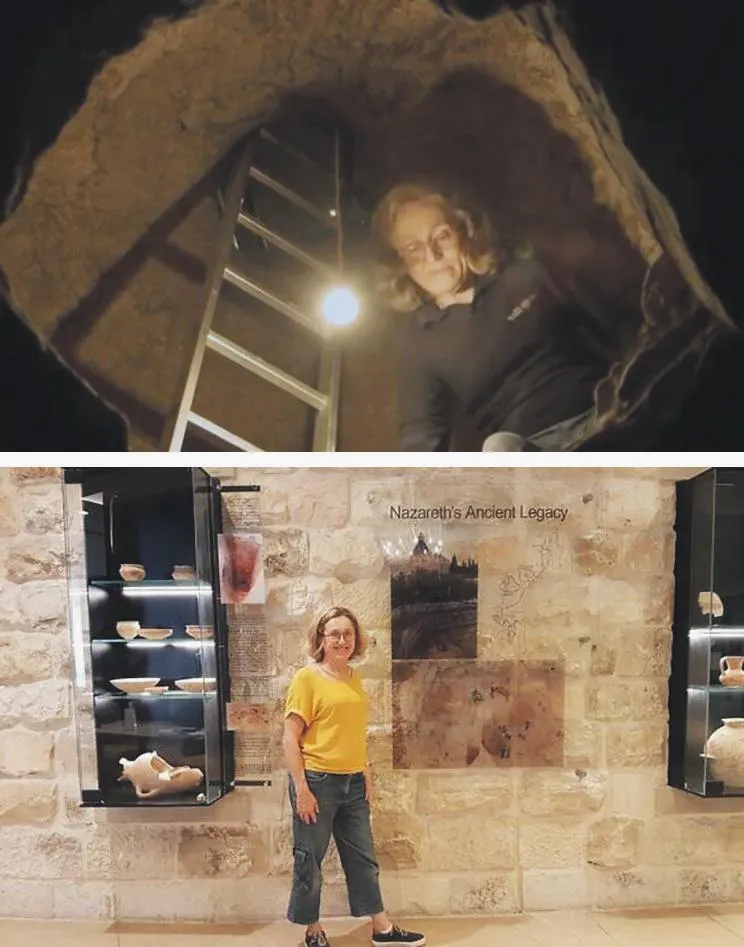
Beneath the modern Church of the Annunciation are rock-cut tombs and storage caves that were reused in Byzantine times. While this is the traditional site for the house of Mary and Joseph these remains are difficult to date. However, in 2009 a reinvestigation of ruins beneath the Sisters of Nazareth Convent made an unexpected discovery. Carved into a rocky hillside, a significant house had been built that included remains of first-century pottery. Further discoveries provide evidence from the same period of agriculture, including a wine press carved into the bedrock.
Capernaum
Capernaum, home of Matthew the tax collector, has been the subject of excavations since 1905. This has led to the discovery of a beautiful Byzantine-period synagogue and, beneath it, a simpler synagogue dating to the time of Jesus. A small house from this period was also discovered that had been gradually adapted into a modest church. Many archaeologists admit the possibility that the early veneration of this one home indicates that it may have been the original home of Jesus during his residence in Capernaum.
Bethsaida
Bethsaida, home of Andrew, Peter and Philip, had been lost to history long ago. Until archaeologists came along and have now provided us with two contending sites. The first is the impressive town at Et-Tell, a little inland from the sea, but boasting evidence of harbour, fishing tackle and first-century coins, it neatly fits what we would expect of Bethsaida at a time when the lake of Galilee stretched further north. However, recent excavations at El-Araj, nearer the shore, has revealed a Byzantine church which includes a mosaic that may refer to the Apostle Peter. There is a continuing debate over which site is the Bethsaida of the Gospels, and there may be a connection between the two, but in the meantime we can be sure this lost city is emerging from the ruins.
Magdala
A whole new city on the town of the Sea of Galilee was excavated from 2009 at Magdala. This could be the home town of Mary Magdalene, whose name means ‘of Magdal.’ Of particular note is another functioning synagogue from the time of Jesus. It includes a carving of the menorah candelabrum from the temple in Jerusalem.
Enough is enough
There are critics for whom the evidence will never be enough. The goalposts will keep moving for what must be required to establish the historicity of the Gospels. But with each new season there are more fragments of evidence that establish the trustworthiness of what the Bible writers wrote.
It is true that Nazareth was a relatively poor, rural community leaving only fragile traces in the record. This would certainly explain the reputation of the town (John 1:46). Bart Ehrman, an atheist scholar of the New Testament world, rightly observes: ‘Most people had never heard of it and those who had heard didn’t care. Even though it existed, this is not the place someone would make up as the hometown of the messiah. Jesus really came from there, as attested in multiple sources.’ The modest remains from archaeology actually fit very well with the modest origins of Jesus described in the Bible.
Chris Sinkinson is a Lecturer in Theology at Moorlands College.
The Jewishness of the Gospels proves they're true
When speaking to Jewish and Gentile friends you might have heard the accusation that the Gospel accounts were written centuries …