
Eugenics is the practice and belief that you should control population growth by screening out undesirable characteristics.
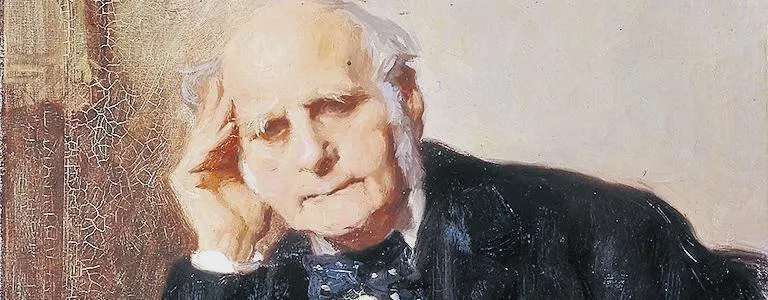
The word itself was coined in 1883 by Francis Galton, a polymath who invented fingerprinting. His cousin was Charles Darwin and, fascinated by evolution, he thought the advancement of medical care, meaning longer lifespans, was muddying the gene pool. Following his investigations, he developed the theory of eugenics. It was hailed as a brilliant discovery. Since then, the practice of eugenics has grown in this country under the radar.
Horrendous distinction
Go back to 1990 and a piece of legislation called the Human Embryology and Fertilisation Act was passed by MPs and Peers. In 2008 it was updated, and Westminster again passed all the proposed changes. Buried in the legislative forest created by the Bill is a horrendous distinction. Simply put, the legislation drew a distinction between able-bodied people and disabled people. It said, in effect, that you could have an abortion up to birth in the case of serious disability, but not in any other case. In other words, abortion law is more relaxed for ‘serious handicap’ than for other criteria.
In practice we know that ‘serious handicap’ has been taken to mean Down’s syndrome, club foot, cleft lip and so on. The latter of these are entirely treatable. But our current law still discriminates against people with these conditions and promotes the idea that they render that baby’s life less valuable than others. If that isn’t a form of eugenics, then I don’t know what is.
Down’s syndrome – the message
Focusing on Down’s syndrome, it is strikingly inconsistent the way we treat people with Down’s syndrome in our society, compared with pre-born children with the same condition. Through advanced technology, we’ve empowered people to screen out pre-born babies with Down’s syndrome, and there’s a new screening test available on the NHS which is contributing to fewer babies with Down’s syndrome being born. But we’ve done so with little thought to the effect this has on those living with it. What does it say to someone with Down’s syndrome when they read about fewer and fewer babies being born with the condition?
In effect, this is eugenics in all but name. No wonder there’s been such outrage over a plotline in Emmerdale that sees two parents abort their baby because of a Down’s syndrome diagnosis. It’s been hugely heartening to see the courage of Heidi Crowter, who is taking on the abortion law that allows for abortion to birth for serious handicap by challenging it at the High Court.
This attitude to disability is utterly wrong and outdated. But the practice of eugenics goes much further. Today, there are gene editing techniques that aim to create superior genes. Sperm banks openly advertise the fact they can screen things, from autism to hair colour. You can find out if you’re having a boy or a girl, and in some parts of the world this is used to abort girls because boys are more desirable. The day of the designer baby is not ‘on the horizon’. It’s already here.
We are a strangely inconsistent society. We’ve made great strides towards respecting people with disabilities outside the womb, but fail to do the same to those in the womb. It’s not good enough to argue there’s any moral difference between the two. There’s absolutely not. Life begins at conception and so both are equally valuable. Believing as we do that every human being is made in God’s image, we therefore hold passionately to the idea that our worth and value are not linked to our characteristics, as such. Rather, we matter, warts and all, because we are irreversibly imprinted with the likeness of our Creator. In a mixed-up society like ours, this is a powerful antidote to the overly subjective approach to people’s dignity and worth we see all around us today.




The case of David Campanale: 'Neither liberal nor democratic'
It was Lord David Alton, a committed Catholic Peer and pro-life legend, who described what he called a "mutant liberalism" …