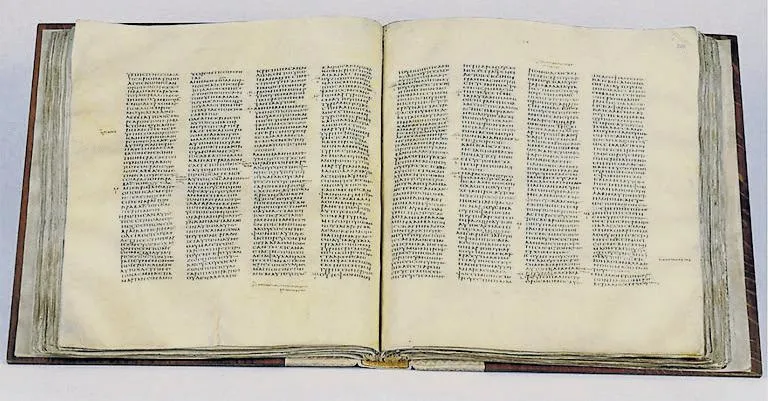
Humans like to count things. We like to know how many steps we’ve taken, how many birthday cards we received, how many days until Christmas. So it’s not surprising that scholars are keen to know how many manuscripts we have for the New Testament.
It’s encouraging to discover that even the most cautious academics affirm that there are more than 5,000 known hand-written documents of the NT in its original language. Before we get too carried away, it’s worth pausing to ask what this number actually tells us.
The period during which the NT text was copied by hand lasted until the end of the 15th century, and, as one would expect, many more-recent manuscripts were preserved than older ones. Though parchment can survive a long time in ideal circumstances, many ancient documents have simply perished. This is even more the case for papyrus, the other material used as ‘paper’ – only in rare circumstances will it have survived into modern times. Consequently, the calculation of over 5,000 manuscripts before the first printed Greek NT is heavily tilted towards the most recent times.
Still, a good number of early manuscripts exist. The dating of manuscripts is an area of much debate, but according to my count we have just over 400 listed items from the ninth century and before. Remarkably, this early group of manuscripts is quite evenly distributed over the centuries – apart from the second century where we have only a few (and no, as yet we do not have anything that is generally regarded to be from the first century).
Fragments and complete NTs
Obviously, this number of roughly 400 is much lower than the 5,000 or more with which we started. But even this number requires further thought. Everyone who has worked with manuscripts knows that there is an enormous disparity in the amount of text that a single manuscript can represent: both a surviving single leaf and a complete New Testament count as a single manuscript. The vast majority of early manuscripts are fragments, and often very small fragments at that.
Yet, we find two manuscripts from the early period that contain (nearly) all the NT (Codex Sinaiticus and Codex Alexandrinus, from the fourth and fifth centuries), in addition to two manuscripts that contain much of it (Codex Vaticanus and Codex Ephraemi Rescriptus, also from the fourth and fifth centuries). It may strike us as strange that there are so few complete NTs. However, the majority of surviving manuscripts that are more or less complete were written to contain only part of the NT. We have manuscripts containing the four Gospels, or manuscripts of Acts and the General Epistles (James to Jude), or of the letters of Paul, or containing some cross-over between these. Complete Greek NTs are rare, and as far as we can see from the evidence, most churches would have had the NT only as a library of books rather than in a single volume. These large Bibles, in addition to the nearly complete manuscripts of sections of the NT, are highly valuable as tools to study the history of the text.
While we can be fairly sure that, for example, Codex Sinaiticus comes from the fourth century, there is far less certainty about manuscripts believed to be from the first four centuries. Dating of most manuscripts is done by comparing their handwriting with other examples. Some of these examples may have a date written on them or are written on the back of a dated and re-used document. Often, however, we have to rely on a reconstruction of how a certain script developed over a number of centuries – assuming there is not too much overlap between the various phases of a specific script – and then assign the manuscript to the most probable time frame within that development.
The basic assumption of this method is intuitive: my parents’ handwriting is different from my generation’s, just as my children have learned to write in a different way. So far so good. Yet there was a time that these three generations overlapped, and all three ‘phases’ were being written at the same time. Something comparable is found when we look at books printed in the 19th century. There is something about the layout and the font that gives it away as being from the past. Still, a modern publisher might decide to produce a book that incorporates archaic elements.
All this should encourage us to regard the dates assigned to manuscripts within the limitations inherent in the discipline of palaeography (the study of historical handwriting). And of course, even dating to a particular century puts a manuscript into a fairly artificial box – are we really able to distinguish between a late second-and an early third-century document?
Weighing the evidence
All these considerations are helpful before we start comparing the actual text of the manuscripts. A tiny fragment with a strange reading will, even though early, carry a different weight from the wording found in a large manuscript that we know has been copied by an able scribe. The dates of manuscripts are important, but they are only a part of what we need to know before we can assess the full value of a textual witness.
It took Tyndale House ten years to complete its version of the Greek New Testament, examining the manuscripts in minute detail to present the earliest recoverable wording. But to Christians the Bible is unfathomably precious, and worth the extraordinary effort that was expended on every jot and tittle.