Professor Stuart Burgess reviews the recent BBC mega-documentary
Millions of people have greatly enjoyed watching the Blue Planet 2 series on BBC TV.
It contained superb filming of sea life around the world. The oceans represent the final frontier of exploration of Planet Earth and it has been thrilling to observe stunningly clear pictures of so many different types of sea life.
Creation and God’s character
For a Christian, creation can be studied for the sake of pleasure alone (Psalm 111.2). However, creation also teaches us important things about God’s character, such as his wisdom, power and care for mankind. Today Christians have a unique opportunity to see the wonderful works of God through high-tech camera technology.
God does things we cannot comprehend. Blue Planet 2 has revealed some truly amazing creatures in the most unlikely of places. In the second programme, David Attenborough said: ‘In the deep sea it was thought that nothing whatsoever could possibly survive here [at a depth of five miles] … no one imagined that an animal such as a fish could exist at such pressures … it was an extraordinary discovery.’.
At a depth of five miles there is no sunlight at all and the pressure is 800 times greater than at sea level. The pressure is so intense that submarines made from steel have imploded under the strain. So it was not surprising that scientists did not expect to find any living organism at such depths.
The amazing discovery of life in the deepest oceans illustrates the truth of the words in Job 37.5 that ‘God does things we cannot comprehend’. Scientists are literally struggling to comprehend how an organism as complex as a fish can live at such depths.
There are many other incredible creatures captured on film in Blue Planet 2: cuttlefish which can produce a flashing light display; sea dragons that look like seaweed; octopuses that cover themselves with shells for armour; spider crabs that swarm to form huge mounds on the sea bed; sea cucumbers with ten arms that work in sequence to place food into their mouths; pilot whales which can swim to depths of 1,000m and dolphins which ride waves for fun.
The programmes have also shown wonderful plant life in the oceans: huge kelp plants that create vast forests in the sea and enormous quantities of phytoplankton that produce oxygen for the atmosphere as well as food for a myriad of creatures.
In the laboratory
I have had the privilege of studying an amazing sea creature in the laboratory for myself. I have studied the design of the jaw of the sling jaw wrasse in order to produce bio-inspired engineering designs. The sling jaw wrasse can extend its jaw for up to half the length of its body to help it collect food. It has an intricate linkage mechanism that has all the hallmarks of intelligent design. So I know from first-hand experience that the seas contain creatures that are incredibly well designed.
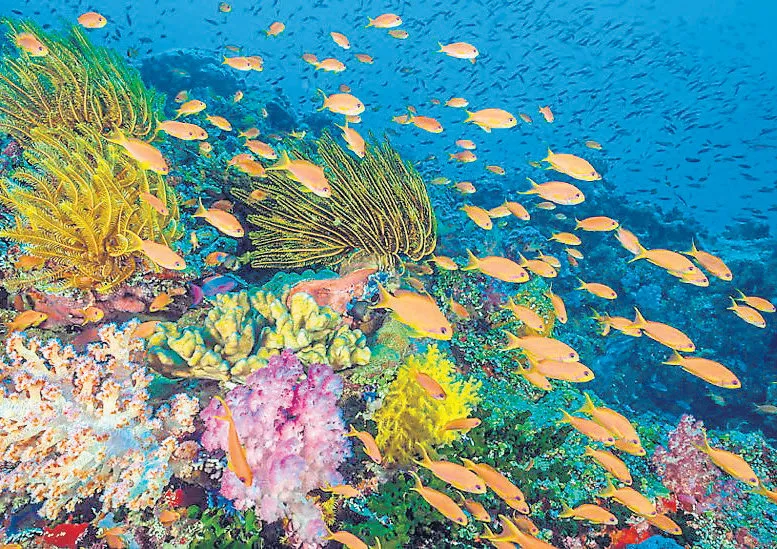
Blue Planet 2 has also revealed finely tuned ecosystems with intricate food chains and symbiotic relationships between very different types of organism. The coral reefs are wonderfully designed to support vast communities of life where each organism plays its own important role.
The vast array of creatures and the finely balanced ecosystems shout evidence of intelligent design by a Designer who is infinite in understanding (Psalm 147.5).
God provides in abundance
Blue Planet 2 has helped viewers to appreciate the staggering abundance of life in the seas. Herring form shoals that stretch for several kilometres; jellyfish swarm in their millions; dolphins form super-pods of more than a thousand; king penguins form rookeries of hundreds of thousands and corals stretch for thousands of kilometres.
Even in the deep sea there is abundant life, with luminescent creatures gathering in their millions. In the second programme of Blue Planet 2 David Attenborough said: ‘Astonishingly, there is more life in the deep sea than anywhere else on earth.’ Scientists were astonished to find such abundant life because the deep sea is so cold and dark and with crushingly high pressures.
But abundant life is exactly what we would expect from a great Creator. In fact the Bible tells us that God created abundant life in the seas at the beginning of creation. Genesis 1.20 says: ‘Let the waters abound with an abundance of living creatures,’ and Genesis 1.22 says: ‘ fill the waters in the seas…’. So Blue Planet 2 has provided wonderful confirmation of the accuracy of the book of Genesis!
By filling the seas with abundant life, God not only revealed his great power but showed his goodness by providing abundant food for man (Job 36.31). Throughout the ages, the seas have been an important source of food for human communities around the world.
God creates beauty
Another striking feature of seas revealed in Blue Planet 2 is their immense beauty. Coral reefs come with a great variety of colours and forms; fish come with a myriad of different colours and shapes; jellyfish come in amazing varieties; dolphins and turtles look elegant; whales look majestic; sea snails come with immensely beautiful shells and many deep-sea creatures glow with beautiful bioluminescent lights.
The beauty of the oceans reminds us that God made all things beautiful in their time (Ecclesiastes 3.11). The beauty and complexity of the seas should be a great encouragement to Christians. If God so clothes the creatures of the sea, it follows that he will perform even greater acts of care for his children (Matthew 6.28). One of the things that helped Job to trust in God during his suffering was to study creation (Job 37.14).
Evidence of a fallen world
As well as containing beauty, the oceans reveal the ugliness of death, disease and extinction. Blue Planet 2 contains plenty of footage (maybe too much) of the predator-prey relationships that illustrate the violence and suffering that often takes place in the seas.
It is important to realise that God made a world without death and suffering. Death and suffering only came after the rebellion of Adam and Eve in the Garden of Eden (Genesis 3.17). Following Adam’s fall, God cursed the ground which resulted in thorns and thistles and other things that marred creation, such as the predator-prey relationship. As well as the predator-prey relationship, the whole of creation is now decaying (Romans 8.22) with many species becoming extinct and ecosystems like coral reefs in decline.
A new feature of Blue Planet 2 is a greater focus on man’s damage to the planet, such as pollution and damage to coral reefs. That damage is a reminder of man’s selfishness. One reason why pollution is hard to control is that, while everybody wants less pollution, not everyone is prepared to pay for clean technology and lifestyles.
Even though creation is in a natural state of decay, this is no excuse for man to accelerate that decay by poor stewardship. The programme will no doubt encourage people to be more environmentally conscious and that will be a good thing.
The witness of creation
Whilst Christians can be very grateful for the excellent filming work of Blue Planet 2, there are some negative aspects to be aware of. The most obvious is that the programme makers implicitly support atheism by not acknowledging or praising the Creator for his work in creation. Mankind has an important duty to ascribe to the Lord the glory due to his name (Psalm 29.2). Another negative aspect is the absence of a biblical view of the origin of death and suffering. Viewers may have the false impression that if there is a Creator, he does not care about suffering.
Despite the lack of acknowledgment of God in Blue Planet 2 there is no doubt that many people will feel compelled to believe in a Creator as they view the marvels of the sea. Modern camera technology is continuing to demonstrate that in creation God has done wonders without number and things past finding out (Job 9.10).