The TV adaptation of Margaret Atwood’s 1984 novel The Handmaid’s Tale received a lauded debut in the US several months ago.
It has finally hit our screens, courtesy of Channel 4. The hype and early reviews revealed a common thread as many reviewers compared the dystopian world of the adaptation to the current political and social climate of the US. It only takes a brief scan through the Twitter hashtag to see that the regular viewing public find an uncomfortable level of resonance between the show and Donald Trump and Mike Pence’s attitudes towards women.
Women stripped of their lives
The setting is the Republic of Gilead (the new name for America) in the present day, and begins with a frantic car chase as the protagonist, Offred (Elisabeth Moss), is pulled apart from her daughter after her husband is shot dead. The name Gilead, a name referred to in the Bible as a fertile region of Palestine, is employed in dreadful irony in Atwood’s world, as a plague of barrenness and infertility causes it to be a society ruled by the fear of scarcity. And so, fertile women are taken from their families to be stripped of their lives and to become reproductive surrogates.
When captured, the fertile women are brought to the Rachel and Leah Centre, where they are trained and prepared for their new roles before being sent on placement to fulfil them. A character reminiscent of Mrs Trunchball from Matilda, only much more sinister, educates the women in the ‘glorious privilege’ of being handmaids. ‘Blessed are the meek’ is the mantra repeated to quell rebellious handmaids in training, and Offred points out through her interior monologue that they never include the rest of the verse ‘...for they shall inherit the earth’ (Matthew 5.5). The explicit biblical references don’t end here. Just before ‘the ceremony’ of the rape of a handmaid, the patriarch reads aloud the story of Rachel, Jacob and Bilhah from Genesis 30. Choral music plays throughout the act.
Colour coding
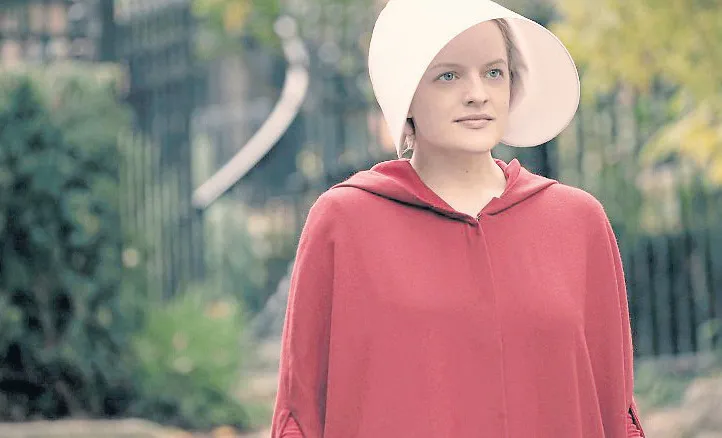
When they exit the Rachel and Leah Centre, the handmaids are reclothed and renamed. They become known by the name of the patriarch of their ‘posting’, prefixed by ‘of’. Our protagonist goes by Offred, literally ‘of Fred’. We soon meet Ofglen (Alexis Bledel), and other names follow suit. The handmaids are instantly recognisable, clad in identical long red dresses, heads shrouded and faces covered by huge white bonnets. Wives, who retain that role by belonging to wealthy families of status, wear simple dark blues, while Marthas (as in, sister of Mary, famous for being too busy in the kitchen), are a class of women who serve as domestic servants and wear green.
Greetings take on language of blessings: ‘Praise be’, ‘Peace be with you’, ‘Blessed be the fruit’, ‘May the Lord open’, ‘Go in grace’ are said as characters pass each other and depart from rooms. ‘May God bless your endeavour and bring forth his miracle’ one handmaid says to another after she learns ‘the ceremony’ is about to take place. This liturgical language is repurposed to play a key part in the overall sense of paranoia and dread which pervades Offred’s experience.
Living hope in God
At one point in the first episode, Offred asks God that her young daughter would remember her, even though they are separated. Until this point, it is implied that far right Christianity has led to the devastating situation the country is in – but this prayer, uttered silently by our protagonist, offers the unexpected suggestion that there is real, living hope to be found in drawing close to God, and that he might be something separate from the ideology by which she and the majority of society are being subjugated and manipulated. Although only one episode in to the ten-part series at the time of writing, there’s a sense of hope that the light of the true gospel will powerfully redeem and bring justice to a world twisted by the false teaching of the politicians who have used it for their advantage.
The world of The Handmaid’s Tale exists because its human characters treat each other as rungs on a ladder to climb, as things to be gained from rather than people to know and be known by. In other words, it is the easily imaginable outcome of a society which not only values but encourages and promotes narcissism. We’ll have to wait and see how well that plays out for those in power in this series, because something tells me justice will be done.