Kieran Beville asks if the right to free speech should include the right to intentionally offend?
‘The pen is mightier than the sword.’
This is something that radical Islamists might want to factor into their war. Words win every time! The first edition of Charlie Hebdo since the massacre at its Paris offices has continued its tradition of being provocative and controversial, featuring cartoons of a weeping Prophet Mohamed, a masturbating nun and the Pope dressed as a mafia boss.
The magazine, which has had a circulation of 50,000, produced a print run of 3 million which sold out within minutes. A further 2 million copies are being printed to cope with the overwhelming demand, bringing the circulation to a staggering 5 million copies!
Limits to free speech?
The late Conor Cruise O’Brien (former editor of The Observer) once said that there must be some limit to freedom of speech, citing an example of somebody shouting ‘Fire!’ in a crowded cinema, as reckless.
He was speaking in defence of Section 31 of the Broadcasting Act in the Republic of Ireland which was used to prevent spokespersons for the IRA using the media as a propaganda tool. Should the right to free speech include the right to be intentionally offensive about what others deem sacred? If it is illegal, in France and elsewhere, to deny the holocaust, why should it be permissible to ridicule the faith of others?
The law concerning holocaust denial is in place to prevent the rise of neo-Nazism. Is it time to now consider introducing a similar law to protect the general Muslim population from the rising tide of anti-Islamic sentiment? The debate must go beyond the right to free speech and also discuss limits to free speech – incitements to hatred, racism etc. are, rightly, not tolerated. Tolerance is not necessarily a virtue – people can tolerate harmful things. It is not decent to intentionally ridicule things that people deem to be sacred. It is uncharitable, and profoundly disrespectful. Charlie Hebdo disregarded the sensitivity and gravity of this issue, flagrantly violating the feelings of millions of French citizens.
Militant secularism
I am in favour of reasoned argument with people of different religions (and those of none) but I find it distasteful, offensive and inappropriate to ridicule what others hold to be sacred, even if I believe they are wrong in their beliefs. Charlie Hebdo’s sustained assault on things deemed to be sacred by others comes from a long history of French anti-religious sentiment which has become enshrined in the French psyche. This is militant secularism and aggressive atheism (better called anti-theism) baptised in the name of liberty, equality and fraternity, which found ultimate expression in the French Revolution of 1789. The Catholic Church was one of three pillars of the ancién regime, along with the monarchy and the aristocracy. The church was a wealthy and corrupt institution and the revolutionaries began by attacking its abuses, but it could not conceal its inherent anti-clericalism. Diderot said ‘man shall not be free until the last king is strangled with the entrails of the last priest’.
A new kind of ‘religion’
The revolutionaries struck the keynote for all subsequent attacks on religion. Alexis de Tocqueville complained that they turned the revolution into a ‘new kind of religion.’ Was he right? Certainly the new order had its own rituals and secular saints. For example, the remains of Voltaire and Jean-Jacques Rousseau were transferred to the Panthéon with elaborate processions and ceremonies. It is illegal to publish racist material and nobody is calling that restriction an unacceptable limit to free speech. Yet Muslims have to endure the publication of deeply offensive images. Respect for the opinions of others seems to be in short supply in society. Is it not wrong to be gratuitously offensive to millions of people for the entertainment of others? Furthermore, I think this exacerbates tensions between Islam and other cultures and, consequently, has the undesirable outcome of destabilising society.
The function of satire
Satire has a useful function, especially in challenging autocratic narratives. Fine examples of this may be found in Blaise Pascal parodying the Jesuits in The Provincial Letters and Jonathan Swift pillorying the Church in Gulliver’s Travels.
Today, the British magazine Private Eye and the Irish magazine The Phoenix combine investigative journalism and satire very well. the Week TV programmes like Mock and Have I Got News For You are favourites that I love to watch. I like the cynicism of The Simpsons, even when it takes a punch at Christianity through Homer’s perspective or pokes fun at Ned Flanders and the Revd Lovejoy. Father Ted makes fun of Catholicism by creating scenarios that point out the incongruities, ridiculousness and absurdities of that institution’s manifestations in Ireland. But it is not blasphemous.
In Praise of Folly by Desiderius Erasmus is a good example of satire guiding toward a better moral vision. Charlie Hebdo lacks the sophistication of good satire and has not served society well. Liberty should be exercised responsibly. Liberty should not be a licence to attack. Words can be weapons and images can have an incendiary effect. Good satire will amuse and also stimulate reflection. Limiting free speech is not a suppression of liberty – exercised properly it enhances liberty. Satire is a good thing in a world where ‘power corrupts and absolute power corrupts absolutely’. But the cartoons of Mohammad are an act of hatred masquerading as free speech and it is inappropriate and unnecessary.
Tally ho! attitude
Almost anything is fair game in comedy, even taboo subjects such as race, rape and the holocaust, in the right context. Much depends on whether the jokes come from insiders or outsiders. Sacha Baron Cohen can get away with jokes about Jews, because he is Jewish – such as his song ‘Throw the Jew Down the Well, So My Country Can Be Free’ saying outrageous things like ‘You must grab him by the horns’ and referring to Jews as cockroaches in his film Borat. Likewise Woody Allen can make fun of Judaism because he is Jewish. The Irish are experts at self-deprecating humour but don’t like outsiders ‘having a go.’ Western ‘secular’ or ‘Christian’ journalists should be aware of the outsider syndrome.
Blatantly hypocritical
Ironically, just days after the Charlie Hebdo killings and massive public displays in favour of free speech, French police have arrested comedian Dieudonné M’bala for a Facebook post – one that appears to sympathise with the Charlie Hebdo attackers: ‘I feel like Charlie Coulibaly’. This takes the Charlie part of ‘Je suis Charlie’ mantra to refer to Amedy Coulibaly, the man whose attack on a Kosher supermarket on 9 January was coordinated with the assault on Charlie Hebdo.
In this Dieudonné appears to be saying that he sympathises both with free-speech advocates and a killer who targeted Jews. Under Article 421-2-5 of the French Criminal code, condoning terrorism is a crime – one punishable by a fine of up to €100,000 and seven years imprisonment. As repugnant as Dieudonné is, (he is virulently anti-Semitic and has been arrested many times) his detention appears hypocritical. While the French government is lauding free speech they are at the same time arresting someone for an ambiguous Facebook post. Free speech that defames the humanity of a group or community can be restricted in France, as can speech that represents a threat to public order. Thus Holocaust denial is banned. This raises the question as to why the Charlie Hebdo cartoons of Mohammed are not included in the scope of the protection this law is meant to afford to French citizens.
Time for real debate
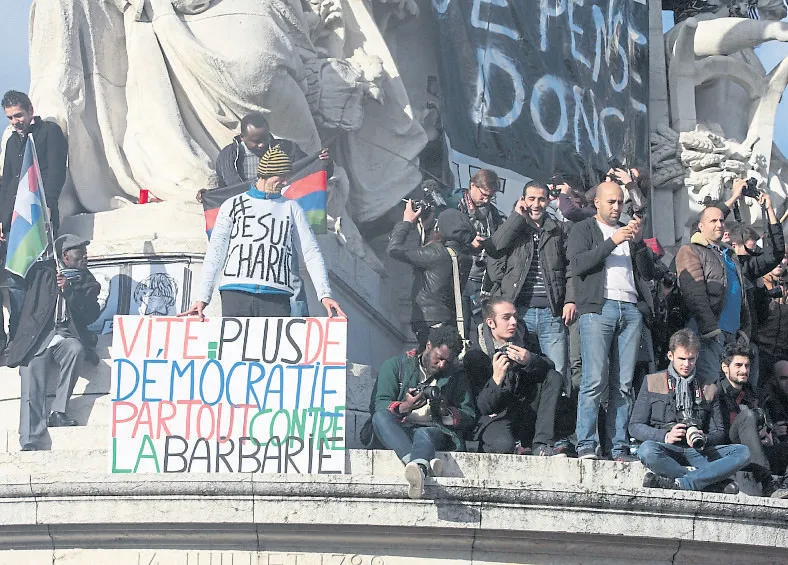
Recent street marches in France have demonstrated solidarity of secularism as well as sympathy from religious groups, including Muslims. The solidifying of national identity should include Muslims. Freedom of speech should not mean freedom to say anything. Cartoons that diminish people by ridiculing their faith come into the category of journalistic jihadi and are on a par with hate speech. Charlie Hebdo has deepened a sense of discontent and alienation among French Muslims. The Western media’s publication of images of Mohammed in the wake of the January incidents in Paris is understandable but unhelpful. Many newspapers and magazines did not publish such images, either out of fear or respect, hopefully the latter. One could say that Charlie Hebdo remained within the bounds of what was legally permissible, but it is time to have a debate about the law, liberty and morality in relation to this issue.