Calvin Peat interviews Nate ND Wilson about his latest film project
Nate ‘N D’ Wilson is an American author whose writing has been described as stirring up a sense of wonder at life, love and the beauty of Christian truth.
Calvin Peat met up with Nate and asked him some questions for en about his latest, 18 minute, short film, The Hound of Heaven, narrated by the Christian rapper Propaganda (aka Jason Petty) and based on the 19th-century poem of the same name by Francis Thompson.
en: What was it about the poem TheHound of Heaven that inspired you to make this short film?
NW: First it was a couple of producers who asked me if I thought that it could be done; could there be a live-action film done around the poem Hound of Heaven? Initially I thought, wow, that would be really difficult, maybe a terrible idea. And then as I read the poem, immersed myself in the poem a little bit more, I thought it could be incredibly striking. A really powerful picture of what Francis Thompson was trying to describe.
Secondly one of the things that really drew me to it the most was how anti-sentimental it is. For a poem coming out of the Victorian era to be so hard, to be so terrifying, gritty, destructive, really struck me as unique to the time period.
I would never expect somebody to write a fundamentally religious-faith poem from that era that was this hard-hitting, just devastating. And so I enjoyed it immensely, and I thought it would be really fun to picture that on film.
How atypical it was for a Victorian faith is probably what drew me to it. Which I think is probably because of the roughness of Francis Thompson’s life. This was a homeless opium addict, not a preening curate!
en: But there’s hope at the end, right?
NW: Oh, absolutely. But it’s so rough; it’s so very Old Testament. It’s not the gentle, evangelical thing that you would have expected in that time period.
en: So it really engages with life?
NW: Yes. Every temple he tries to hide in, everything he tries to run to, gets shattered and destroyed and taken from him, until the end, and that’s what we tried to capture in the film.
My favourite thing about the film is how the end makes sense of all the rest; how it’s a representation of learning that God is gracious. As it says in Psalm 103, ‘The LORD is compassionate and gracious, slow to anger, abounding in love’.
Many times the kindest thing God can do is smash what you want; because what you want is self-destruction, what you want is chains, so that destruction is kindness.
en: How do you go about the process of expressing an idea like grace in the context of a story?
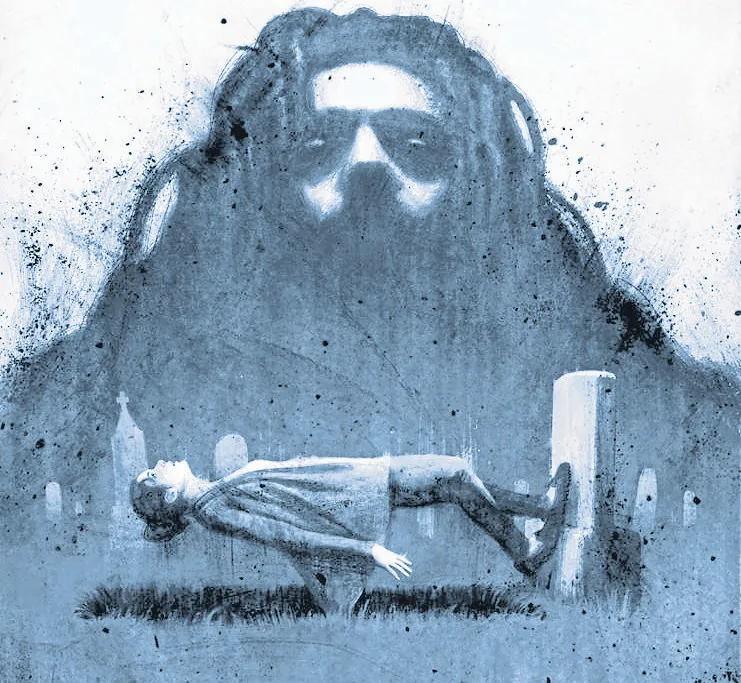
NW: I try to imitate the rhythm of the poem, beginning with somebody who initially flees, initially runs. I use a female protagonist and she runs from what appears to be death, so there’s a grave in the floor of her bedroom, and she runs from it. She runs away to different things, out into the darkness. She runs across water, and she runs further and further down, fundamentally she goes further and further down, and the grave that she thinks is a grave is actually the underside of the grave.
So in my film, she’s looking at the grave, but she’s looking at it from the inside, so you see the butt of the headstone, not the head of the headstone. But she and the viewer mistake it for an open grave.
It is an open grave, but it’s an invitation to resurrection. Which she runs from. And so, over time, as she breaks down, as all her idols are destroyed and taken from her, she finally relaxes, gives way, submits, and steps into what she thinks is the grave, but is actually exiting the grave.
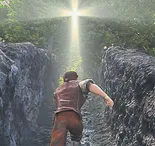
And of course at the very end we have probably my favourite scene, of the actual above ground, natural light, graveyard, hatching from the earth.
en: What is it about stories that makes them so powerful, in terms of communicating ideas, conveying emotion, and exploring our humanity?
NW: Stories can give you vicarious experiences: they can give you guilt if you’re innocent; they can give you grace, they can let you taste it for the first time; or condemnation, when that’s what you need to feel.
It’s the ability to feel what somebody else feels, to experience it without having to walk that road yourself. So you can know what it’s like to walk through Mordor (the badlands of Tolkein’s Lord of the Rings)and throw a ring into a volcano without having to actually do it. It knocks the walls down in your imagination. Stories can really broaden you as a human, in the real world.
They can also culture you and catechise you as to what you aspire to. What is noble, what is lovely… (Philippians 4.8). Good sto-rytelling is like good food; it makes your imagination healthier.
en: How does the gospel illuminate the way that we look at stories? Or if you want to think of it the other way around, how do stories help us understand the nuances of the gospel?
NW: Both ways. It’s the story. It’s the lynch-pin of the story. It doesn’t matter; across the secular-sacred divide, what we really love in film, what we honour in film, what we find to be most honourable, always imitates the cross. And no matter how hard a filmmaker will try, they can’t do anything else. So, the man who lays down his life for a friend, the man who lays down his life for his bride, the man who lays down his life for his people, remains the greatest hero. Always, in every story.
And it doesn’t matter whether it’s told by an atheist or a Christian. It’s imitating the story. And so the gospel is just the headwaters of storytelling, especially in the Western world. Here are the headwaters, and everything else imitates.
A really well-told story that imitates successfully and explores nuances you didn’t think of, it can point back, it can reflect back. Like the moon to the sun, you know, the light is not its own, but in seeing the reflected light, you can learn more about the nuances and details about the source. So that’s human story-ing, that’s where human story falls.
en: You have four feature film projects in development, with The River Thief up next, followed by adaptations of CS Lewis’s The Great Divorce and two of your own novels, 100 Cupboards and The Ashdown Burials. What’s The River Thief about?
NW: It’s about a boy who jumps boats and trains up the canyon to Portland, into a little factory town. And he’s a thief. He’s just a born thief. He robs the right people – good people – and he robs the wrong people. And he’s pursued by both of them. He’s pursued by the criminals he’s robbed and he’s pursued by the good man he’s robbed, and the tension is between those two pursuers and the way that resolves.
It resolves in just an explicit imitation of the cross. The whole thing is kind of riffed off the concept of the thief on the cross. Like how did the thief on the cross, a modern-day thief on the cross, end up there, happy, dying joyfully, when he’s clearly a pretty horrible person? That’s really what I was trying to have fun with. And I did. I’m really excited about our cast, and what we were able to shoot. So, we’ll see.