UN investigates North Korea

Features
Date posted:  1 Oct 2014
Share Add       
UN investigates North Korea

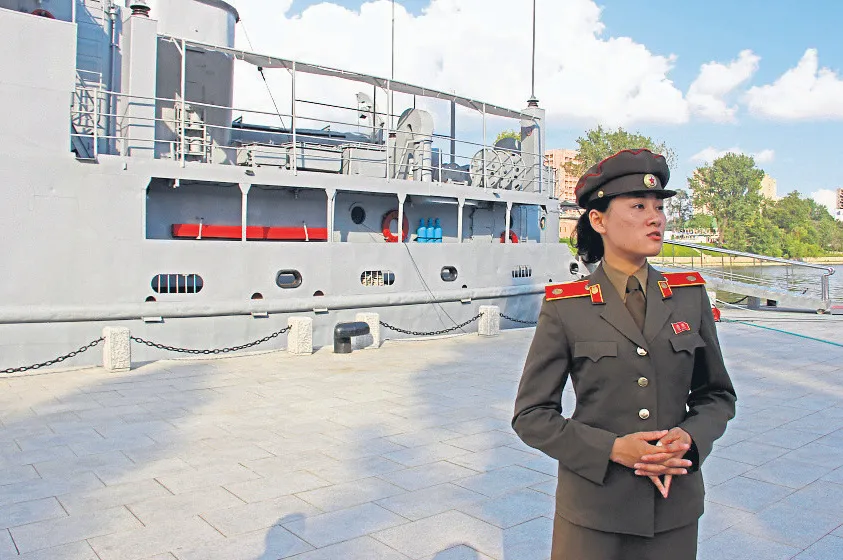
North Korean military guide at the Victorious Fatherland Liberation War Museum | photo: iStock

Tim Riddington looks at the United Nations Commission of Inquiry report

What comes to mind when you think of North Korea?

Nuclear threat? Rhetorical attacks on South Korea? Dennis Rodman and ‘basketball diplomacy’?
A perhaps less appreciated, but devastating, reality for ordinary North Koreans is their government’s shocking disregard for human rights. Such is the gravity and extent of the human rights violations there that the United Nations Human Rights Council established in March 2013 a Commission of Inquiry (CoI) with a mandate to: ‘…investigate the systematic, widespread and grave violations of human rights in the DPRK, with a view to ensuring full accountability, in particular, for violations that may amount to crimes against humanity.’

Detailed violations

The CoI report detailed violations by the North Korean regime including: ‘…extermination, murder, enslavement, torture, imprisonment, rape and other grave sexual violence and persecution on political, religious and gender grounds’. The chairman of the commission, Mr Justice Michael Kirby, found many of these violations to be without parallel in the contemporary world and to constitute crimes against humanity.

Christians face particularly harsh treatment and the CoI report states that: ‘The spread of Christianity is considered by [the North Korean regime] a particularly serious threat since it ideologically challenges the official personality cult [of the ruling Kim family] and provides a platform for social and political organization and interaction outside the state realm … [and therefore] … Christians caught practising their religion are subject to severe punishment…’.

The propaganda of the North Korean regime reinforces its hostility to Christianity and the CoI found that: ‘…Christianity … has been compared to a drug, narcotics, a sin, and a tool of Western and capitalist invasion … Christianity is not explicitly crimi-nalized … [but] effectively the authorities consider it a political crime.’

Rejecting human rights

The North Korean regime was invited to scrutinise the evidence of the Commission and to attend its public hearings but such invitations were ignored. Upon publication the regime responded to the CoI report: ‘… the Government of North Korea completely rejects the raising of human rights issues related to North Korea … Under the wise guidance of Kim Jong Un, North Korea … is continuing its governance with respect and love for humanity and its policies of true protection for and enhancement of human rights’.

Can things really be as bad as the CoI report suggests? Well, the legal firm Hogan Lovells LLP was commissioned by the human rights group Human Liberty to provide an independent legal opinion on whether the CoI had used reliable sources of evidence, appropriate methodology and correct legal assumptions. It confirmed the CoI report but went further regarding the persecution of Christians: ‘We consider there to be good arguments that the targeting by DPRK … officials of … Christians … with the intent to destroy [them] could be found to amount to genocide…’.

How did it come to this?

North Korea – officially the Democratic People’s Republic of Korea (DPRK) – was established after World War II when the Korean peninsula was partitioned at the 38th parallel. Hopes of unification never materialised in the environment of the Cold War and the DPRK was established in the north, led by Kim Il-Sung, with the Republic of Korea in the south. Thus two separate nations developed under radically different political, economic and social systems. The cult of personality was established around the ruling Kim in the north and is now in its third generation with the current leader, Kim Il-Sung’s grandson, Kim Jong-Un. Along with this powerful personality cult came the crushing of opposition, including through political prison camps, which have lasted twice as long as the Soviet gulags and 12 times longer than the Nazi concentration camps.

Totalitarian state

Politically the DPRK is characterised by totalitarian control of all aspects of life. Children are indoctrinated from an early age to worship the ruling Kim and to hate the ‘imperialist’ Americans as the enemy. The individual is subordinate to the state and absolute loyalty to the ruling Kim is demanded. Any deviation from political orthodoxy is severely punished, up to and including public execution. The economy is a failure, resulting in widespread and ongoing food insecurity, the rise of informal (often illegal) markets and a culture where bribery is a common means to secure goods and services. The regime seeks to control all information about the outside world to prevent the people of the DPRK from understanding their true situation. Unauthorised departure abroad is severely punished upon repatriation, particularly if those who depart have had contact with Christians or South Koreans.

How do Christians fare?

The Christian charity Open Doors ranks North Korea the most difficult place in the world to be a Christian. In a population of 24.5 million there are an estimated 300,000 Christians of whom up to around 20% (70,000) are in political prison camps where they face forced labour, deliberate starvation and torture. There have been reports of individual Christians being publicly executed after having been discovered by the authorities with a Bible.

This is a far cry from the period before the DPRK was established. During the early 20th century the DPRK’s capital Pyongyang came to be known as the ‘Jerusalem of the East’ with so many Christian churches there. The CoI report estimates that the proportion of the population adhering to religious belief fell from 24% in 1950 to 0.16% in 2002.

What can we do?

Pray:

• To get you started go to www. opendoorsuk.org/campaign/northkorea/

Find out more:

• The UN CoI report on human rights in the DPRK can be found at www.ohchr.org/en/hrbodies/hrc/coidprk/ pages/commissioninquiryonhrindprk.aspx

• David Alton and Rob Chidley, Building Bridges – is there hope for North Korea? (ISBN 978 0 745 955 988): David (Lord) Alton writes that there is hope.

• Blaine Harden, Escape from Camp 14 (ISBN 978 0 670 023 325): The story of Shin Dong-Hyuk who is said to be the only person ever to have been born in and escaped from a ‘total control zone’ in a political prison camp.

• Soon-Ok Lee, Eyes of the Tailless Animals (ISBN 978 0 882 643 359): The memoir of a North Korea woman incarcerated in a political prison camp after being tortured into a false confession. On release she escaped to South Korea and later became a Christian.

Take action:

• Contact your MP to express your concerns and to ask your MP to contact the government on your behalf. Writing to your MP gives them a mandate. Find your MP at: http://www.theyworkforyou.com/mps/

• Write to the BBC about extending World Service broadcasting to the Korean peninsula. Information from outside will be key to change and the BBC World Service is a globally trusted source. The BBC does not currently intend to launch a Korean service, although it keeps the possibility under review.

Give:

• Opportunities exist to support persecuted believers in North Korea through the Barnabas Fund (www.barnabasfund.org), Open Doors (www.opendoorsuk.org) and Release International (www.releaseinterna-tional.org)

Stay informed:

• The All-Party Parliamentary Group on North Korea, chaired by Lord Alton, has a mandate to promote relations between the UK and the DPRK, to support human rights and to promote democratic government. It holds sessions open to the public and other public events: www.appgnk.org

Never lose hope

The work of the CoI is finished but follow -up actions are being pursued in response to its recommendations. These may include a referral by the UN Security Council of the DPRK to the International Criminal Court and will include the establishment of a field office in Seoul to continue to monitor and gather evidence about human rights violations in the DPRK.

‘One day our country will be opened and reunited with South Korea. Then the North Korean and South Korean Church will work together with our Chinese brothers and sisters to evangelise Asia. That is going to be a hard, difficult task. We see the current persecution as preparation for that time.’ – North Korean pastor.

Share
< Previous article| Features| Next article >

Subscribe

Enjoy our monthly paper and full online access for just £40/year

Find out more

Need to advertise?

We can help you reach Christians across the country

Find out more