Andrew Atherstone meets the man who led Justin Welby to Christian faith
The convert is now a global religious leader.
He is one of the best-known Christians in the world: Archbishop of Canterbury, Primate of All England, and figurehead of the Anglican Communion comprising 80 million people in over 165 countries. Almost 40 years ago he was led to Christian faith by a college friend who himself had only been converted a year previously.
Altering the future
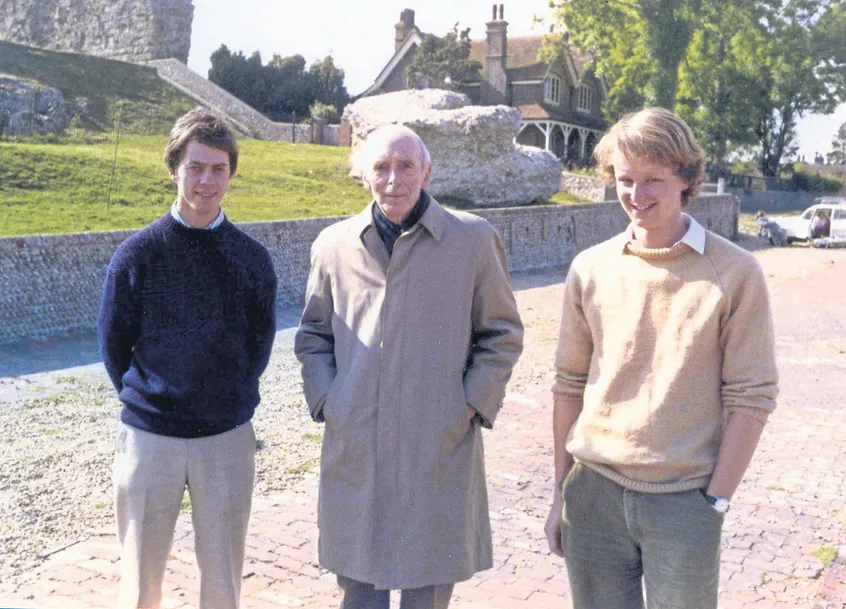
The man in question is Nick Hills, an art dealer in Kent. After months of searching, I finally tracked him down to the Redleaf Gallery in Tunbridge Wells, where he specialises in watercolours and oil paintings from an eclectic range of modern artists. Over a fish and chip supper, we talked about bygone student days and his brief friendship with Justin Welby, which altered the entire direction of the future archbishop’s life. Their paths have diverged and they lost touch many years ago.
Hills and Welby, fellow Old Etonians, were both undergraduates at Trinity College, Cambridge in the mid-1970s. Hills sang in the chapel choir, but was an ‘out-and-out atheist’ until he attended a mission run by the Cambridge Inter-Collegiate Christian Union (CICCU) in February 1974. Several dozen students became Christians that week, including the man now reckoned more influential than even the Archbishop himself – Nicky Gumbel, vicar of Holy Trinity Brompton, pioneer of the Alpha Course.
Supper evangelism
As a new convert, Hills sought to persuade others. The usual plan was to invite friends to a supper party, followed by a talk about the Christian faith. ‘It seemed more civilized’, Hills explains, ‘less a real confrontation’. Welby accepted an invitation. One Sunday evening Hills took the future archbishop to Holy Trinity Church in Cambridge to hear evangelist John Gladwin address the question ‘Who is Jesus?’ Gladwin himself later became an Anglican bishop, but the talk was ‘not particularly spectacular’, Hills remembers. Welby is, typically, more blunt: ‘I was bored out of my mind’.
But they returned to Trinity College and talked further, as the archbishop recently recalled: ‘He showed me that the heart of Christian faith is nothing to do with rules and regulations, it is all about a person called Jesus who died for me on the cross so that all my sins could be forgiven and the barrier between me and God could be broken down’. Hills read a verse from the Book of Revelation (‘Behold, I stand at the door and knock; if anyone hears my voice and opens the door, I will come in to him and eat with him, and he with me’), and then asked: ‘So what now?’. Welby replied: ‘I think I need to pray’.
Surrendering to God
There and then, in Room K2 of Trinity’s New Court, Welby ‘surrendered to God’. He can date the event precisely, October 12 1975, at ten minutes to midnight. He described it in a recent radio interview: ‘I opened my life to Jesus, and was aware of something changing completely … There was someone there. When I said, “Come
into my life, be in charge of my life”, clearly something happened. God answered. It was-n’t very emotional – I didn’t burst into tears, or fall over or anything. It was just I was very clear that something had changed’.
So did Welby need much persuasion? Not at all, Hills insists. ‘I suspect that Justin wanted to be convinced – he was crying out to be convinced … I don’t think I would have lent on him to any degree’. Indeed he believes Welby was already ‘almost converted’ before their encounter, perhaps a result of his ‘gap year’ with the Church Missionary Society in Kenya. Hills simply helped him to take the final step. Over the next few months the two young men read the Bible together most weeks.
Round Church and Bash Camps
Welby’s evangelical faith was nurtured at the Round Church in Cambridge and through ‘Bash Camps’ at Iwerne Minster. He threw himself into evangelism amongst his fellow students, and had the delight of leading another Trinity friend, James Behrens, to Christ just a few weeks after his own conversion. The pattern was very similar. Welby invited Behrens to a CICCU evangelistic address one Sunday evening, and led him in a prayer of Christian commitment before lectures the following morning.
Welby dismissed the public school Anglicanism in which he had been brought up as mere religious formalism. He advised friends to steer clear of Trinity College chapel, which was liberal in its outlook, lest it undermine their faith. Nick Hills was more relaxed about doctrinal distinctions. He was in chapel five times a week to sing in the choir, and was confirmed by the Dean of Trinity, the infamous Bishop John ‘Honest to God’ Robinson. Hills enjoyed the philosophy of Nietzsche as much as the theology of St Paul.
Not him!
In Cambridge days, who would Hills have guessed would become Archbishop of Canterbury? Certainly not Welby, he confesses. Nicky Gumbel was ‘well ahead’ of the rest in leadership abilities, as was another Trinity friend, Charlie Arbuthnot, with whom Welby later went Bible smuggling behind the Iron Curtain with the Eastern European Bible Mission. They rowed together in the Trinity first boat, Arbuthnot as the physically impressive stroke, Welby as the scrawny cox who starved himself on lettuce leaves to lose weight. By ‘force of personality’ and physical stature, Gumbel and Arbuthnot were natural leaders. Until just a few years ago, Welby used to joke, ‘I’ll never be a bishop – I’m too short!’.
Different directions
The stories of Hills and Welby were briefly intertwined at a formative stage in their lives. But after Cambridge they moved in different directions. Welby plunged into the oil industry, before giving it all up to become a clergyman. Hills was attracted by ‘the lure of singing’. A scholarship at the Royal College of Music led to an operatic career as a tenor at Glyndebourne, Amsterdam, Lyon, Florence and other centres of high culture. Welby was drawn deeper into charismatic Christianity at Holy Trinity Brompton, one of the wealthiest and fastest-growing congregations in the Church of England. But Hills drifted away from his evangelical roots and was constantly on the road between European cities. ‘I’m not sure it did me any harm spiritually, but it didn’t do me any good’, he admits. ‘I was prepared to make my Christianity a little broad’.
By the late 1990s Welby was on the fast track to promotion through the ranks of the Church of England. But Hills’s career came crashing to a halt. Whilst walking across a bridge in Lyon after a concert, he suffered a heavy stroke, aged only 41. He was forced to abandon his profession as a singer. ‘How does one measure one’s life?’, he asks. Punning unintentionally, he now describes his illness and the long months of convalescence as ‘a real stroke of luck for me. It made me confront where I was at’. Hills recalibrat-ed his life. He married his Dutch girlfriend, started a family and bought an art gallery. He also reconnected with the Christian faith of his undergraduate years.
Nick Hills would barely be recognised at Lambeth Palace today. But his actions 40 years ago were instrumental in kick-starting Justin Welby’s Christian journey.