John Stott, 1921-2011

Julia Cameron  |  Features
Date posted:  1 Sep 2011
Share Add       

John Stott went to be with Christ on the afternoon of July 27, aged 90. He was listed by TIME magazine (April 2005) as one of the 100 most influential people in the world.

Column inches for his obituary in the UK broadsheets (all July 29) were more than would be afforded to most cabinet ministers.

His grandfather was a cotton mill owner in the north west of England; his father, later Sir Arnold Stott, was a Harley Street cardiologist. John followed in his father’s footsteps to Rugby School (where he became head boy) and to Trinity College, Cambridge. Sir Arnold hoped his only son would join the Diplomatic Service, and John’s eirenic nature and felicity with languages would have suited him well for this. But everything changed in 1938.
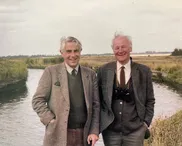
A friend in the year above at Rugby invited him to the Christian Union, to hear a visiting speaker. The speaker was the legendary public schools evangelist E.J.H. Nash (better known as Bash). John Stott professed faith in Christ that Sunday afternoon. Sensing his gifts, Bash drew him into leadership of the camps he ran at Iwerne Minster. In his early days at Cambridge, John Stott formed a lifetime friendship with Oliver Barclay, who became General Secretary of the Inter-Varsity Fellowship. 50 years later, he was to say that the two biggest influences on his spiritual growth were ‘Iwerne and the CICCU’ (Cambridge Inter-Collegiate Christian Union).

In an engaging interview in 2007 with Brian Draper, marking the 25th anniversary of the London Institute for Contemporary Christianity, which John Stott founded, he was asked when he felt ‘most alive’. He gave a threefold response: in worship, where praises reach to the heavens; in enjoying the gift of friends; and in the natural world, early in the morning, where the sights, sounds and smells are all clear and fresh.

An ordinary Christian

Brian Draper also asked him how he would most like to be remembered. He was, by this stage, speaking slowly, and occasionally faltering, but there was no hesitation in the content of his response. ‘As an ordinary Christian who has struggled to understand, expound, relate and apply the Word of God’, he said.

He remained a humble man in the face of all his achievements: the author of 50 books, translated into some 65 languages, selling millions of copies; and the editor of more; a Commander of the Order of the British Empire, and an Extra Chaplain to the Queen; the recipient of a Lambeth doctorate and three honorary doctorates from universities — he accrued two more before he died; and the subject of several PhD theses.

‘Recycling’ royalties

His royalties alone could have afforded him a comfortable life. But he chose to invest them (‘recycle’ was his term) in books for pastors and libraries in the majority world. He lived simply, and brought iron self-discipline to everything he did. John Stott’s home was a modest two-room flat built above the garage behind the All Souls Rectory. His bedroom doubled as a corridor, and as a study for his research assistant. One wall of his living room was lined with bookshelves, and when he was not travelling, or at The Hookses — his writing retreat in Wales — he worked from his dining table. I recall some years ago asking him how many books he had written. ‘I don’t know’, he replied, with his characteristic smile. ‘I haven’t counted them. It would seem a little like David numbering his troops.’

Pastors and students

His two major foci were pastors and students. The Langham Partnership continues and multiplies his commitment to pastors around the world. Its threefold ministry of providing books for libraries, training in preaching, and financing doctorates for the most able theological thinkers in the majority world, all have as their end goal a more vibrant and strongly-rooted local church.

At Billy Graham’s invitation, John Stott was drawn into the 1974 Congress on World Evangelisation, which gave rise to what is now the Lausanne Movement, of which he became Honorary Chair. He was chief architect of The Lausanne Covenant. He took a keen and prayerful interest in The Cape Town Commitment, which in his view was ‘beautiful and profound’ and achieving ‘an astonishing degree of unity’.

‘Uncle John’

Billy Graham filled sports stadia around the world. John Stott’s arena was the university campus. Numbers were smaller, but the longer-term influence was significant. He was ‘Uncle John’ to students and student workers around the world, praying for many by name, enjoying fellowship with them, and inviting them to visit if they were in London. ‘Come for an English cup of tea’, this quintessential Englishman would say. He conducted week-long evangelistic missions in many of the world’s universities, drawing even the most cynical students into the pages of the New Testament to read for themselves of the historic Christ. His warm yet serious style, and his sheer conviction of Scripture’s authority, brought students back night after night.

‘Double-listening’

John Stott had wide interests. He loved the arts; he was an expert ornithologist; he enjoyed the gift of friendship, and he could laugh so much when reading Saki’s short stories to his friends that he had to stop. He has been described as ‘a Renaissance man with a Reformation theology’. For over 50 years he read the whole Bible through annually, using Robert Murray McCheyne’s reading plan. Martyn Lloyd-Jones had introduced him to it in the early 1950s and he valued the way it began with the ‘four great beginnings’ of Genesis, Ezra, Matthew and Acts. It became his pattern to rise early to read and pray, and to listen to the BBC World Service news. Listening to God through Scripture should not be removed from world events. We must practise ‘double-listening’, he would say, so that we can apply the Word to the world.

In 1950, while only 29, he was appointed rector of All Souls Church, Langham Place in London’s West End. He had grown up through its Sunday School and served there as a curate. He was deeply committed to the poor section of his parish, and in 1958 took the bold step of founding the All Souls Clubhouse, years ahead of the game in terms of fresh expressions of church.

In 1956 he appointed Frances Whitehead as his secretary, a role in which she continued to serve until the time of his death. It was to Frances that he dedicated the book he considered his best: The Cross of Christ. In 2001, the Archbishop of Canterbury recognised the unique role Frances Whitehead played in John Stott’s ministry through awarding her a Lambeth MA. This gave John Stott great pleasure.

Richard Bewes who succeeded John at All Souls reminisced, ‘On Saturday nights, when in town, we would pray together in his tiny two-room flat. For me — and many thousands of others — knowing John Stott has been a life-long education in how the ministry of a single individual can touch the world.’

The Apostle Paul was his model as a minister of the gospel, and he was described by friends as being, ‘like Paul, obsessed with the cross’. The words of Daniel 12.3 surely apply to John Stott: ‘Those who are wise will shine like the brightness of the heavens, and those who lead many to righteousness, like the stars for ever and ever’.

Julia Cameron

The website http://www.johnstottmemorial.org has details of the many thanksgiving services being held around the world. The press obituaries may be found online.

Julia Cameron’s biography of John Stott (written for teenagers) will appear shortly in the Christian Focus Trailblazer series.

Share
< Previous article| Features| Next article >
Read more articles by Julia Cameron >>
People
Timothy Dudley-Smith: A life in three scenes

Timothy Dudley-Smith: A life in three scenes

RT REVD TIMOTHY DUDLEY-SMITH OBE: 1926-2024Timothy Dudley-Smith will be remembered best for his rich contribution to hymnody. He is …

People
Tom Houston: Gifted leader with huge global influence

Tom Houston: Gifted leader with huge global influence

Tom Houston was one of the most highly-gifted leaders of his generation. He led three movements of global reach, bringing …

About en

Our vision, values and history

Read more

New here?

Register and get three free articles each month!

Register