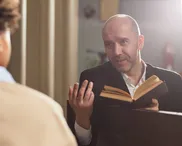
Chuck Colson delivers a daily radio commentary which is listened to by an estimated one million people.
On February 21 he discussed Jim Wallis’s new approach to abortion and poverty issues, suggesting that, by advocating an ethical stance on both, Wallis was working out of a framework of ‘moral equivalency’. Jim Wallis replied with an Open Letter. Colson ditto.
Republican v. Democrat
What is interesting about this debate is that Chuck Colson is (of course) a Republican and Jim Wallis a Democrat. The thin Red/Blue line has become rather a thick prickly hedge, not to say a barbed wire wall. It is possible that Jim Wallis is operating within a very much more theologically liberal viewpoint than Colson. But, at face value, taking an entirely dispassionate view, their two positions on this matter seem almost identical, ethically speaking. Both are against abortion. Both are against poverty. Both campaign actively to bring release to the disadvantaged in America and the world. Here’s the difference: Wallis thinks these principles are commensurate with voting Democrat.
One has to admire Chuck Colson, not just for his stellar evangelical track record, but also for insisting (in his open letter where his position is clarified) that it really will not do to believe that it is okay to vote for a candidate who, say, wants partial birth abortion but is actively pursuing shelters for the homeless. To think thus, he argues, is to have moral equivalency. Abortion is simply a more important matter.
Two-way criticism
Yet, as admirable a figure as Colson remains, is this really the issue? Jim Wallis says he isn’t a moral relativist and I’m inclined to accept his protestations. For him there is a desire to critique both sides of the fence. His new book says it all: God’s Politics: Why the Right Gets It Wrong and the Left Doesn't Get It. If the conclusion of such criticism is that all moral issues are equally right, or equally wrong when flouted, then that would be bad. I’m not sure that is where Wallis wants to go, however. I think he just wants to say that if it isn’t good enough to vote for a pro-abortionist because he’s nice to the poor, it also isn’t good enough to vote for an anti-abortionist even though he’s nasty to the poor.
Colson’s point, nonetheless, is well taken: it also is a bit unrealistic to say because no one on a particular electoral rostrum is perfect on these moral matters we’re not going to vote for anyone. A certain real-politik requires democratic involvement by voting for good if less than perfect options. That is why Colson thought it was wrong for Mark Noll (the evangelical historian) to vote for no one at the last election because there wasn’t a candidate who was both anti-abortion and anti-poverty.
Why the heat?
So the debate could go on. As I say, though, the really interesting point, to my mind at least, is the subtext. Why on earth is there such emotional heat to this technical ethical debate between two people who are both anti-abortion and anti-poverty? The answer might be simple if unnerving. Christians in America are finding it hard to believe that similar ethical principles might call brothers or sisters to vote for different parties.