In 1828 the so-called “Tariff of Abominations” was enacted by the US Congress. The reference to abominations indicated just how fraught and divisive the legislative process had been.
Additionally, the use of such an Old Testament word was no accident. For much of the 19th Century and even into the early 20th Century it was second nature for American politicians and electorates to consider questions of government policy within a Biblical frame.
Of course economic policy decisions such as President Trump’s trade tariffs can be subjected to the “tests” set by professional economists (of which I am one). Such testing against economic theory, like every part of human knowledge and “science," is fallible. Nevertheless, it is notable that the polling by the University of Chicago Clark Center [sic] for Global Markets demonstrates how the overwhelming consensus amongst economists is that the tariffs will, on balance, cause considerable harm to both the US and the rest of the world.
Faith, politics, and MAGA
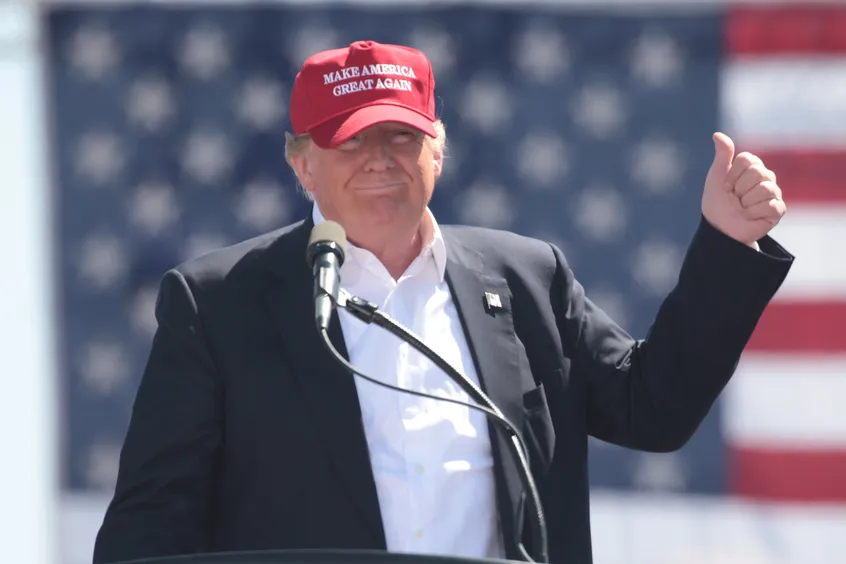
But, in all this there is something which concerns me more that any forecast decline in America’s economic growth rate: reputational damage to Christianity. We know that the Make America Great Again (MAGA) movement is a coalition of those who feel themselves disadvantaged by several decades of economic globalisation alongside those who feel themselves marginalised by "woke" culture. That coalition has been successful electorally. The existence of that coalition, especially the extent to which white evangelicals have backed Trump, also implies that if MAGA is seen to fail economically this will somewhat discredit American Christianity.
It is indicative of the blending of the religious/cultural with the economic within the MAGA movement that the MAGA leadership has tried to justify the tariffs on moral or even theological grounds. We should take their arguments seriously although they are flawed as we shall see.
JD Vance and the 'Order of Love'
Vice President JD Vance argued that there was an “Order of Love” such that as a Christian one could quite properly love one’s country more than the rest of the world. All Christians could accept that there is some order in love. If we love even a good thing more than we love God that thing has become an idol. Vance’s attempt to apply Aquinas’ and Augustine’s teaching about the Order of Love, Ordo Amoris, to modern government policies proved controversial. Pope Francis and Cardinal Prevost (now Pope Leo) denied that love could be envisaged to operate in declining concentric rings. (The Vice President’s initial comments in January 2025 related to the early policies of the Trump Administration such as those concerning controlling illegal immigration but to the extent that he was defending “America First” it seems reasonable to see him as offering a moral defence of what would be the tariff policy.)
'Love at a distance'
Whatever the rights and wrongs of Vance’s application of the Order of Love, it does seem likely that economic life does present us with the challenge of how “love at a distance”. (I am indebted to the Australian Christian economist Gordon Menzies for his description of international free trade as love at a distance.) If my son or daughter comes to me for help, or even a near neighbour, I would tend to give without expecting any return. However, if, say, I am buying a cell phone (smartphone) how do I rightly order my economic relationship with production workers in south eastern China and designers in California and so on? They are entitled to be paid but how much? (Obviously, in this process there are intermediaries such as some large corporate bodies.)
My contention would be that for all its flaws a substantial degree of free trade is an approximation to love at a distance. Other forms of trading relationships increase the danger that the strong and powerful, be they countries or companies, will be able to exploit the weak. So, there may be an irony in that the Vice President has nailed his colour to the mast of Order of Love. It is quite plausible that free trade is entirely compatible with the application of the Order of Love.
'Reciprocal Tariffs'
On the same day that the President announced the “Reciprocal Tariffs” from the Rose Garden of the White House, his Deputy Assistant Sebastian Gorka treated British television viewers to an attempted Biblical defence of what the President had just said. [1] Gorka claimed that the tariffs were very much in the spirit of Matthew 7 verse 12’s Golden Rule. A case of doing to others what you would have done to yourself. In fact, almost every commentator has agreed that the formula used to calculate the Reciprocal Tariffs bears no real correspondence to the extent of any trade malpractice by other countries against the US in terms subsidies, tariffs against the US or exchange rate manipulation.
The President himself, as he announced those Reciprocal Tariffs, was very clear that they were morally justified in terms of the level of injustice which other countries had inflicted on the US. According to Trump the US has suffered years of “rape and pillaging” at the hands of other countries. This is not the case. In technical economic terms the American trade deficit is the inevitable result of the high level of demand in the US economy. The latter is in turn a product of the enormous US Federal Budget deficit.
Trump and mercantilism
It would seem that the President is a latter day mercantilist. Mercantilism was a view of economics very much in vogue in the 17th and early 18th Century until Adam Smith exploded it in an intellectual terms in the 1770s. According to mercantilists the cake of world wealth is a fixed size. The only way one country can prosper is by expanding its slice of the cake at the expense of other countries. Mercantilism is a pretty dismal theory in moral and geopolitical terms. It tends to lead to trade wars and even, in the worst cases, shooting wars. Mercantilism also goes against the grain of Biblical revelation. The early chapters of Genesis (1 to 11) imply God’s purpose for humanity is a growing population which will spread across the earth. That world is, as we know, characterised by a variety of resources and climates distributed across geographical zones. Could we not draw the deduction that God is pro-trade and if free trade leads to more trade that would imply that in most cases He is pro-free trade?
So, thankfully, the cake of world wealth is certainly not a fixed amount and there is abundant evidence from history that trade can be mutually beneficial. Admittedly, countries may benefit to differing extents.
Globalisation
A more sophisticated moral defence of the President’s trade and tariff policy could still be attempted. According to this view, whatever the theoretical benefits of free trade, in practice globalisation has been working against the US because other countries, notably China, cheat.
It is certainly true that under World Trade Organization (WTO) rules China has used its self-designation as a “developing country” to allow it to continue to provide massive subsidies to various start-up industries such as electric vehicles (EVs) and solar panels. However, wouldn’t a better US policy be one of attempting to reform rules rather than crashing out of the rule bound international economic order? Reform would involve working alongside allies. Instead, the Trump Administration seems determined to alienate most of its economic and military allies given the level of tariffs imposed on countries such as Japan, South Korea, Canada and the Philippines, let alone the UK and the European members of NATO. The evangelical moral philosopher Oliver O’Donovan has argued that an international order which to some degree respects the autonomy and equality of various countries is most likely to be compatible with God’s will for the nations of the world. Certainly, preferable to some sort of geopolitical equivalent to the survival of the fittest. Consider Lesotho, amongst others, the “African nation no one has heard of” as the American President described. The US tariffs, even though now at a 15 per cent rate rather than 50 per cent, will have a very damaging impact on its Levi and Wrangler jeans exports to the US.
To be fair, there is a history behind MAGA’s fury against globalisation. For most of its history, certainly from the 1780s until the 1950s, the American Republic operated behind a high tariff barrier. It is understandable why Trump and his supporters might what to go back to the (alleged) good old days of the late 19th Century. Hence the President’s veneration for President William McKinley as the tariff king (Trump seems to be unaware that McKinley was turning against protectionism immediately prior to his assassination).
Nostalgia, however, is no basis for sound government policy. The world and the American economy have changed: what worked in the 1890s will not necessarily work again in 2025. The US is now a predominately service sector economy. Even manufacturing itself does not generate all that many well paid blue collar jobs. And there are worrying indications that large sections of the American “white working class” may not be sufficiently well qualified in educational terms to work in either advanced manufacturing or service sector activities (that point is evidenced in JD Vance’s autobiographical and somewhat ethnographic Hillbilly Elegy).
It is also important to recognise that sections of the American Right, Centre and Left did at times have exaggerated confidence in globalisation. President Clinton, for example, in a hymn of praise to the North American Free Trade Agreement (NAFTA) and other free trade policies, argued that such policies would increase the "prospects of people around the world for democracy, freedom and peace." A line from idealism into hubris was crossed. Perhaps a secular equivalent to millennialist zeal. However, whilst previous policies may partly explain Trump’s tariffs they do not excuse them.
The likely outcome
It is overwhelmingly likely that the President’s assault on the post-War global economic order will not work. Even if recession is avoided the costs will exceed the benefits. The attempted moral/theological defences of the tariffs do not really stand up. The Christian component of MAGA (particularly the evangelicals) will therefore suffer guilt by association to the extent that the policy fails.
- BBC Newsnight Programme, 2 April 2025
Should UK Christians go to Franklin Graham’s rallies?
Charles Colson was a senior member of President Nixon’s White House Staff who was sentenced to prison for his role …