
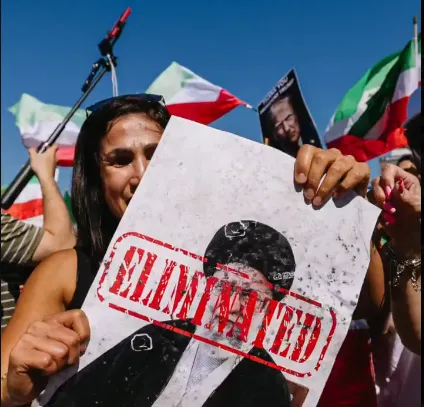
Last weekend, the US and Israel launched military strikes on Iran that killed the country’s Supreme Leader, Ayatollah Ali Khamenei, and other senior leaders.
Iran has retaliated by striking Israel and other countries in the Middle East with US bases, such as the UAE, Qatar, Bahrain and Kuwait.
The British RAF base in Cyprus was also targeted. In Lebanon, Hezbollah – funded by Iran – have also attacked Israel.
Instability and uncertainty are rife. No one knows where this will end.
The UK is clear that Iran must give up its nuclear ambitions but the Prime Minister has said the government “does not believe in regime change from the skies”. The US overtly wants regime change but has not set out a plan for how that might happen or what its endgame will be. So far the Iranian regime remains in control, but the country is perilously close to civil war.
And there is never a guarantee that regime change leads to better government – we just need to look at Iraq, Afghanistan, Libya and Syria to remind ourselves that there is not a good track record here. No situation is ever so bad, that we can’t make it worse…
What happens next?
The Iranian people – and the wider world – are naturally fearful about what happens next, and justifiably so.
Christians take differing stances on the necessity of war, from pacifism to "just war" theory, but I am concerned that Trump’s dictum that "might is right" is clearly front and centre here. From his perspective, he has been successful in changing the leadership in Venezuela by force, so why not have a go at fixing Iran next?
The Bible tells us that God gives governments their authority. But it also tells us that the use of their power should be limited and proportionate, tempered with wisdom and justice for the benefit of the people. In Romans 13v4, Paul states that “the one in authority is God’s servant for your good.”
Iran’s regime is brutal and repressive. But does that make it acceptable for another country to swoop in and assassinate its Head of State?
Before toppling Iraq’s Saddam Hussein more than 20 years ago, America at least sought agreement from Congress and the international community – but Trump and Netanyahu have acted unilaterally, seeking neither permission nor forgiveness. And, despite disagreeing with the initial US response, the UK government is now allowing America to use British airbases for further strikes, without requesting Parliamentary assent.
Leaders have the power to order assassinations, and today they have the capability to target these with precision. But there is always what is euphemistically known as "collateral damage" – in other words, the death and injury of innocent people caught up in the conflict. Saturday’s strikes are reported to have hit a school in southern Iran, killing at least 153 people, including children.
Looking to the Bible
When wars break out, civilians suffer. But the Bible is clear that human life is precious, and should be protected. In 1 Samuel 25, Abigail acts as a peace-maker and prevents David from acting in anger against the residents of Carmel to avenge an insult. She reminds him that “needless bloodshed” would be a “staggering burden” to have on his conscience.
John Stott reminds us that peace-making is a divine activity. God has made peace with us and between us through Christ. Therefore we too should be peace-makers.
I respect those Christians who are pacifists, but I am not one. I think there can be a just war. Wars are always tragic, yet they can be necessary to defeat greater evil and prevent greater suffering… but we should never rush into one, especially if there is no clear objective or exit strategy.
Our response?
We may not know where to start when praying for events in the Middle East and around the world, where people are caught up in wars and destruction. Let’s make sure we do not respond either with indifference or despair. Instead, we should intercede for peace and for justice.
"Let’s make sure we do not respond either with indifference or despair. Instead, we should intercede for peace and for justice."
As a church we should model a peace-making community, rather than withdrawing or shrugging in the face of international upheaval. And to those in our communities around us who are feeling hopeless, we can hold out to them the amazing hope that Christ has offered us. This hope transcends earthly wars and instability, and invites us to spend an eternity with God where there will be no more death or mourning, crying or pain.
We are currently in the season of Lent, a time of waiting, sadness and preparation. Let’s be people of peace in an age of uncertainty and fragility, and let’s look forward to the joy of Easter and to the hope of John 3v16: “For God so loved the world that he gave his one and only Son, that whoever believes in him shall not perish but have eternal life”.
*Christian MPs and political figures contribute as believers not party politicians. en does not endorse any one particular party.
Tim Farron is MP for Westmorland and Lonsdale, and former Leader of the Liberal Democrats. He is the author of 'A Mucky Business: Why Christians should get involved in politics'.




The rise of populist politics?
The Clacton by-election takes place on 13th August with 33 candidates – none from the main political parties – challenging …