I bring you good news!
We aren't used to good news, so much so that back in 1993, the BBC newsreader Martin Lewis complained that there wasn't enough good news being reported. I understand that the BBC responded by setting up a team dedicated to solution-focused news - whatever that means!
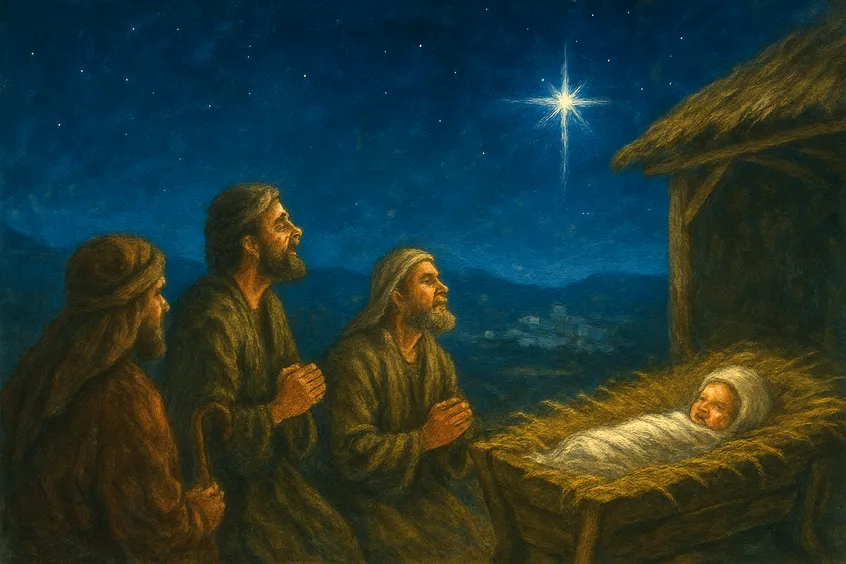
Of course, good news is what the angel tells the shepherds - in Luke 2vv. 10-11 - about the birth of Jesus.
Going back to the BBC example, maybe Luke’s account would have been recommended as an example of such reporting - because the report was not just about what took place but why. It’s unusual in that Luke spends more time on the announcement than on the birth itself. He wants to make sure we understand the meaning behind it. In BBC terms, the “solution-focused” element is, well, the arrival of Jesus - the Saviour of the world!
The good news, in a world of fake news
The problem, though - as the BBC has been rather painfully reminded by President Trump of all people - is that we can’t always rely on the news we read or hear.
But Luke wants us to know that the news of Jesus’ birth is not “fake news” at all. It’s a historical, detailed account; full of real people, in real places, in real history.
So – to whom do you make this announcement of the most important birth ever? A global press conference or proclamation in the Jerusalem city square? No. It was a very ordinary evening when this good news was announced... and to very ordinary people. Shepherds were the first recipients of the good news; they were eyewitnesses and broadcasters of this good news to others.
God could have chosen more "special" people to receive and broadcast the news. However, the focus on the shepherds reminds Luke’s readers, and us, that if God is for lowly shepherds, He is for all of us. Shepherds are not the kind of people that deserve God's love - like you and me. God's good news - the birth of Jesus Christ - is for all of us.
Jesus Christ may be the promised King of kings, the Wonderful Counsellor, Mighty God, Everlasting Father, the Prince of Peace, but this message of good news came first not to the rich and powerful.
The shepherds were about to become eyewitnesses - not just to a remarkable birth, but to the remarkable purpose of this special child, Jesus. “Today in the town of David a Saviour has been born to you; he is the Messiah, the Lord" (v11).
The shepherds were then told by the angel about the birth of a Saviour. “This will be a sign to you: you will find a baby wrapped in cloths and lying in a manger" (v12).
What a sign of the all-knowing, all-seeing, all-powerful and all-glorious Son of God! If God had employed a spin doctor, they would not advise the best news ever to be of a baby wrapped in cloths in an animal's lunchbox! But this was a sign of the reality of Jesus’ life and mission - being humbled and rejected throughout His life, the suffering servant foretold by Isaiah hundreds of years earlier - obedient to death on a cross.
Our response
We should be like the shepherds who, when they had seen Jesus, just as the angel said, spread the word concerning what had been told them about this child. They did not get lost in the trappings of Christmas.
They didn't go around saying, "Hey, we had an amazing experience out in those fields with angels and there was this lovely sweet baby born in a manger." No. The good news they were spreading, which we can, as well, as we look ahead to Christmas, was all about this child: “A Saviour has been born to you! He is the Messiah, the Lord.”
'Diana or Christ?': The 'choice' to give up Christianity or be killed
We have recently moved house and are now putting up some pictures. A favourite is a print of a painting …