Choose you this day whom ye will serve

Pooyan Mehrshahi  |  Comment
Date posted:  31 Oct 2025
Share Add       
Choose you this day whom ye will serve

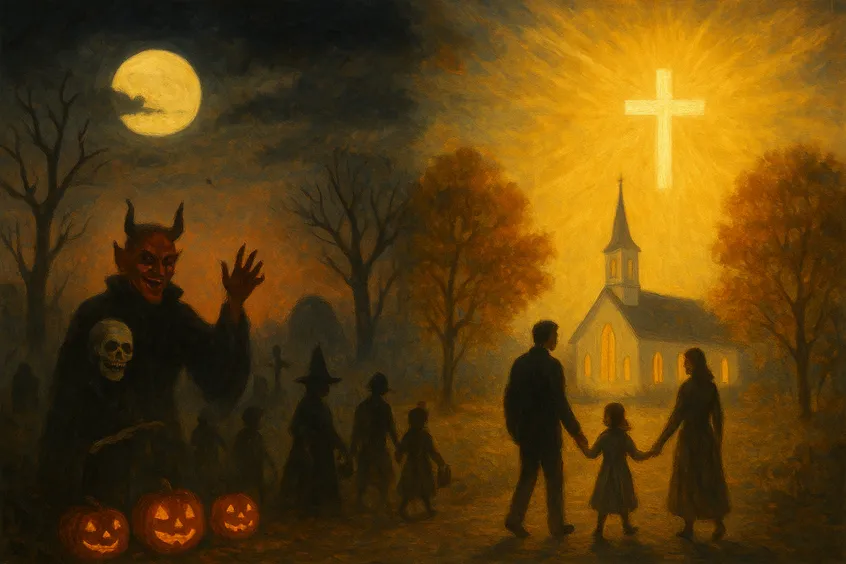
Every year, when the end of October comes, the Western world dresses itself in darkness. Streets fill with images of death, devils, and horror. Even many who name the name of Christ shrug and say it is “harmless fun.” But the Christian must not reason as the world reasons.

“What does the Bible say?” is our standard (Romans 4v3). The Bible, not popular opinion, must govern your conscience. Halloween is not innocent. It is unbiblical in its meaning, pagan in its roots, and contrary to the holiness God requires of His people.

Pagan roots and their persistence

The festival we now call Halloween traces back to the ancient Celtic celebration of Samhain, a pagan feast marking the end of harvest and the beginning of winter darkness. The Celts believed that on this night the boundary between the world of the living and the dead grew thin. Bonfires, sacrifices, and disguises were used to ward off or appease spirits. [1]

When the Roman Church spread across Europe, it absorbed rather than abolished these customs. In the seventh century, Pope Boniface IV consecrated the pagan Pantheon to “St Mary and all martyrs,” inaugurating what became All Saints’ Day on 1 November. [2] By the ninth century, All Hallows’ Eve, the night before, was fixed on 31 October, and the old pagan superstitions merged with the Romish festival. [3] The Reformers judged this as corruption, not conversion, since Scripture gives no warrant for such holy days.

The testimony of Scripture

The Word of God is plain. “There shall not be found among you any one that maketh his son or his daughter to pass through the fire, or that useth divination, or an observer of times, or an enchanter, or a witch… For all that do these things are an abomination unto the Lord” (Deuteronomy 18v10–12). “What concord hath Christ with Belial?” (2 Corinthians 6v15). “Have no fellowship with the unfruitful works of darkness, but rather reprove them” (Ephesians 5v11).

Halloween glorifies what God condemns. Even the playful version makes light of hell, death, and the reality of devils. Scripture calls you to be distinct. “Love not the world, neither the things that are in the world” (1 John 2:15).

What happens to a culture that takes up Pagan practices

When a people drink from pagan wells, their moral sight dims. Conscience grows dull. Cruelty and superstition creep in like fog after sunset. Augustine watched Rome cling to its festivals while its virtues withered. He mocked the claim that the old gods made the city strong, and he tied Rome’s decay to the lewd shows, false worship, and moral looseness that those rites encouraged. [4]

"Children learn to smile at what destroys souls."

A culture that toys with spirits soon fears them. It trades truth for a show. It laughs at sin, then lives in it. You see the same in any age that prizes the gory. Death becomes entertainment. Violence turns into costume. Children learn to smile at what destroys souls. Public life grows coarse. Words lose weight. Oaths mean little. The altar of feeling replaces the throne of God. The fruit is confusion, broken homes, and a rising appetite for the sensational.

What happens to a culture that follows the Bible

When a people bows to Scripture, light spreads. Truth reforms worship, then work, then the home, then the street. The Reformers tied piety to learning. They built schools so children could read the Bible. Scotland planned parish schools in every town so the Word would shape the nation. [5] New England ordered every township to maintain a grammar school “to the end that learning… may not be buried in the graves of our forefathers,” and so youth might read the Scriptures. This was law, not slogan. [6]

Where the Bible governs, you see plainer worship, cleaner morals, care for the poor, honest trade, and strong families. A people taught to fear God learns to fear sin. They honour vows. They value truth. They seek mercy and justice. It is like opening curtains at dawn to let the light in a dark room. Houses fill with light.

The hope of the gospel

While the world celebrates death, the Christian rejoices in life. Christ has conquered the grave. “He hath abolished death, and hath brought life and immortality to light through the gospel” (2 Timothy 1v10). The message of Halloween is fear. The message of the cross is hope. The world mocks judgment. The believer proclaims salvation.

Let your household be known for the light of truth. Speak of the Saviour who triumphed over sin, death, and Satan. “But ye are a chosen generation, a royal priesthood, an holy nation, a peculiar people; that ye should shew forth the praises of him who hath called you out of darkness into his marvellous light” (1 Peter 2v9).

Remember the Reformation

There is something better to remember in October. On 31 October 1517, God raised up Martin Luther to nail his Ninety-Five Theses at Wittenberg, and the Reformation dawned. [7] Give thanks for God’s mighty works in history, the recovery of the gospel of grace, the translation of Scripture, and the preservation of truth.

Read of Luther, Tyndale, Calvin, Knox, and the Reformation martyrs. Teach your children why the Reformation mattered. The same issue remains today. Will we follow Scripture or the world?

To conclude

Halloween belongs to darkness. The Christian belongs to light. “Choose you this day whom ye will serve” (Joshua 24v15). Let the Word of God rule your conscience. Stand fast. Be watchful. Let your home and heart bear witness that Christ alone is Lord.

When the world celebrates fear, you celebrate faith. When they glory in death, you glory in the risen Christ. “For ye were sometimes darkness, but now are ye light in the Lord: walk as children of light” (Ephesians 5v8).


  1. Ronald Hutton, The Stations of the Sun: A History of the Ritual Year in Britain (Oxford University Press, 1996), 360–370.
  2. Butler’s Lives of the Saints, vol. XI (Dublin: James Duffy, 1866), 506–509.
  3. The Catholic Encyclopedia, “All Saints’ Day,” 1911 ed.
  4. Augustine, The City of God, II.5–8; I.29.
  5. The First Book of Discipline (1560), “Of the Office of the Kirk in Schools,” in James K. Cameron, ed., The First and Second Books of Discipline (St Andrew Press, 1972).
  6. Records of the Governor and Company of the Massachusetts Bay in New England, vol. II (Boston, 1853), 203 — the “Old Deluder Satan Act” of 1647.
  7. Roland Bainton, Here I Stand: A Life of Martin Luther (Abingdon, 1950), 77–8.


Subscribe to Pooyan Mehrshahi on Substack.
This piece has been republished with permission.

Share
< Previous article| Comment| Next article >
Read more articles on:   Halloween
Read more articles by Pooyan Mehrshahi >>
Features
How can we know what God is doing in afflictions?

How can we know what God is doing in afflictions?

When inward trials and painful providences press upon the soul, how is a Christian to discern whether he is under …

Comment
Iran and the danger of OT prophecy speculation

Iran and the danger of OT prophecy speculation

I was born in Iran and grew up there till my midteens. So this subject is at times brought up …

Subscribe

Enjoy our monthly paper and full online access for just £40/year

Find out more

Looking for a job?

Browse all our current job adverts

Search