
How did the church win over so many ancient civilisations, and how could that be done again?
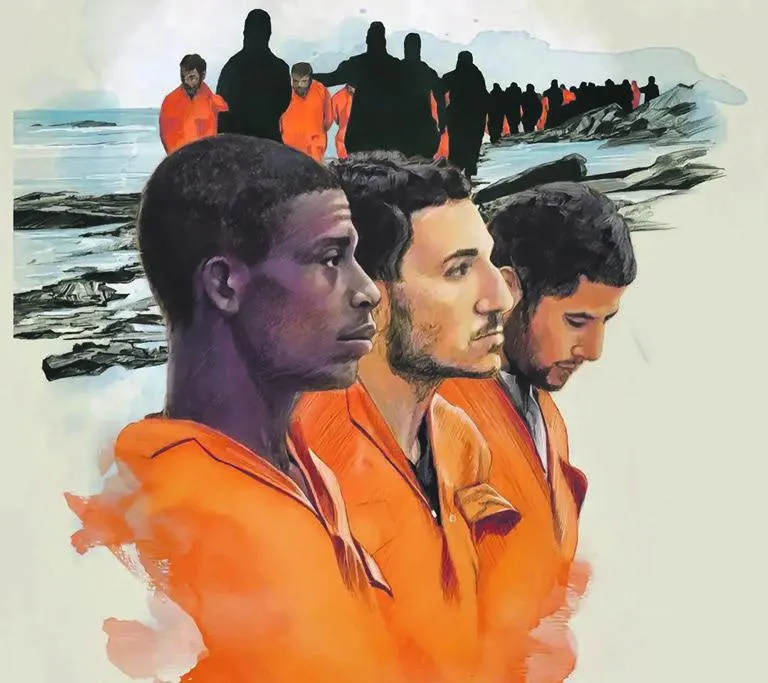
The Libyan Christian martyrs on the beach in 2015 made an immensely powerful witness to the reality of the Lord Jesus Christ. If He offered any of us the opportunity to do the same, would we accept that?
The secular age is fading away. It was an interesting Enlightenment project born out of a Christian culture that, throughout global history, has mostly lived under governments that were at best indifferent and typically hostile to us. The secular age could only ever be a relatively brief experiment because it is built more on the absence of a governing worldview than a positive, self-sustaining one. As the supporting Christian foundations were eaten away, so the secular age crumbles.
So, more and more secular people can see that the choice set before modern Britain is “Trust Allah” or “Trust Jesus”.
The progress of Islam
For one reason or another, Islam seems to be making much more progress in this challenge. There may be many reasons for this: clarity of moral framework; detailed code of life which appeals so powerfully to younger people; strong community cohesion; visual presence in the public square; moral courage in public witness; implicit support from media and politicians; compelling public marches and international campaigns; strong polemics. Any and all of these reasons are regularly suggested.
However, how do we respond to this challenge?
The answer we perhaps want to hear is that if we are good, friendly, well-liked citizens then people will want to come along to church and eagerly enquire about what we believe. There are a few Biblical verses that glance in that direction. Deuteronomy 4:5-8 and 1 Peter 2:12 speak of us living such good lives that pagans are brought to glorify God. However, even that must be seen in the context of verses 20-25 of 1 Peter 2 where we are to endure beatings and receive insults without retaliation, following the example of Jesus Himself as He was killed.
Perhaps another popular answer involves producing excellent, attractive evangelistic material and courses that will be received with appreciation and conviction. Again, there is little evidence that our materials are received as warmly as we hope and pray. If as wonderful a gospel preacher as Isaiah asked “Who has believed our message?!” (Isaiah 53:1 and Romans 10:16), then few of us are going to receive a better reception. John 15:18-21 seems to indicate that we will be hated by the world just as Jesus was – and none of us are more likeable or Spirit-filled than Jesus!
We might like to look back to times of “revival” and pray that the Holy Spirit will do all the work, miraculously bringing crowds of people flooding into church without us really doing anything at all. Yet, when I read about John and Charles Wesley from the 18th-century revival, I am constantly shocked at how much opposition and genuine violence they faced.
For example, in November of 1742, Charles Wesley was preaching at the market in Walsall when a mob came shouting with roars and hitting him with stones the whole time he preached.
Revival does not mean an easy time of church growth, but rather such an outpouring of the Spirit draws great self-sacrifice from the true saints and a corresponding intense opposition from the world; smelling like life to some and like death to the rest (2 Cor. 2:15-16).
Younger Christians are going out onto the streets of the UK with a much more confrontational and publicly vocal form of evangelism. It may make some of us uncomfortable. We are more used to the secular age in which evangelism was more “civilised” and “seeker-friendly”. Nevertheless, Revelation 6:9-11 reminds us that, throughout Christian history, there are always those who are martyred for the sake of Jesus and the full number of the martyrs is not yet complete. There is still room for more: are we willing?
What are we really living for?
Revelation 6:9-11 says, “When (the Lamb) opened the fifth seal, I saw under the altar the souls of those who had been slain because of the word of God and the testimony they had maintained … They were told to wait a little longer, until the full number of their fellow servants, their brothers and sisters, were killed just as they had been.”
Martyrdom tests us so deeply because it asks us what we are really living for.
Thinking of Paul in Philippians 1:20-26, is it really better that most of us remain in the body? For Paul, his service for the Lord Jesus was a constant service for Jesus and church, but how many of us can honestly say the same? For most of us, genuinely self-sacrificial service and unashamed, risk-taking witness does not occupy the majority of our free time.
What are we really living for? What are we bearing witness to, if we are brutally honest about the two great witnesses in life: our wallets and our diaries?
Paul desired to “depart and be with Christ, which is better by far” because all of his treasure was invested in that heavenly bank account. He had nothing earthly to leave behind that was worth anything to him. To die as a martyr was a fast-track journey to his treasure, to where his heart really was – and that was centred on the Lord Jesus Christ Himself.
So, what do we leave behind?
The minimalist urges us to get rid of everything in our lives that does not give us pleasure or everything that is not essential.
Is it Jesus that really gives us pleasure? Is it Jesus who is everything we really need?
The martyr leaves everything behind in an ultimate act of minimalism. We can take nothing earthly with us into the third heaven, our Paradise waiting room. The Puritans urged us to keep a very light grip on everything we possess so that we can share with others and then release everything completely in death.
"In one sense, there is only one kind of Christian: a martyr."
That is only possible if we live “spiritual minimalism” – living and speaking as if Jesus is all that matters to us. When was the last time anyone accused us of being a “fanatic” for Jesus?
Are we uncomfortable talking about Jesus to our friends and neighbours – or are they uncomfortable because they know we always talk about Jesus?
The challenge of martyrdom is to live so that we are ready to die – to bear witness to Jesus in life so that we are ready to bear witness to Him in death.
Without the witness of Christians like the Libyan 21, it is all too easy to slip into a comfortable, anonymous worldliness, choosing forms of “evangelism” that leave most people still on the broad way to hell.
In the aftermath of the emperor Constantine the Great’s edict of toleration, some Christians were in a state of panic. If martyrdom is vital for the health of church life, then was the ending of persecution actually harmful for salvation within the Roman Empire?
Cyprian had foreseen this and had referred to other kinds of martyrdom. In normal martyrdom, someone else puts us to death, but Cyprian believed that we can all be martyrs if we truly put ourselves to death in daily mortification.Gregory the Great preached a sermon in which he described how those that have been killed for the sake of Christ (“red martyrs”) inspired those who died to the world and their own lives even in times of peace (“white martyrs”). All Christians must have the underlying reality of dying to themselves, so the Lord grants the gift of red martyrdom to inspire many of us to die in every sense of the word.
The Lord may call us to live lives that happen to be outwardly comfortable despite the fact that we are Christians, and Origen warned against people seeking out martyrdom when the Lord had not called them to it. Yet we must recognise the intense danger of a “comfortable life” – of going to sleep in the army of the Living God, not even hearing the call to charge into battle because we are dozing away our time.
John Owen would agree: “When we neglect mortification, sin gets a substantial victory … It is sad to consider the effects of this neglect that lie under our eyes every day. We see those whom we knew to be humble, melting, broken-hearted Christians. They were tender and zealous for God and all His ways. By neglecting this duty, they have grown earthly, carnal, cold, and wrathful. They conform to the men and to the things of the world, making a scandal of religion; and they become a fearful temptation to those who know them. The truth is, true evangelical mortification is almost lost among us.”
All Christians, no matter their other callings or political circumstances, are called to be brave, to share the gospel, be ready to lose even the closest family, ready to die for the faith.
Although we are not all called to be killed in brutal ways for the faith, we are all called to share the faith constantly and live in such a way that we provoke questions, knowing that this can get us killed.
We should never avoid any gospel opportunity for the sake of safety or convenience, and certainly never for some “higher” vocation.
We all need to live as if the gospel could kill us but we’re going all in for it anyway. To keep us living this way, there are those the Lord has allowed to be killed. They make the threat real and therefore they make our bravery in the face of opposition to the gospel real.
In one sense, there is only one kind of Christian: a martyr.







Does Jesus hate people because of their ancestry?
I have been involved in reaching out to Muslim people for over 35 years and, surprisingly often, I hear Christians …