Of criminalisation and the civilising mission

David Shepherd  |  Comment
Date posted:  1 Jan 2022
Share Add       
Of criminalisation and the civilising mission

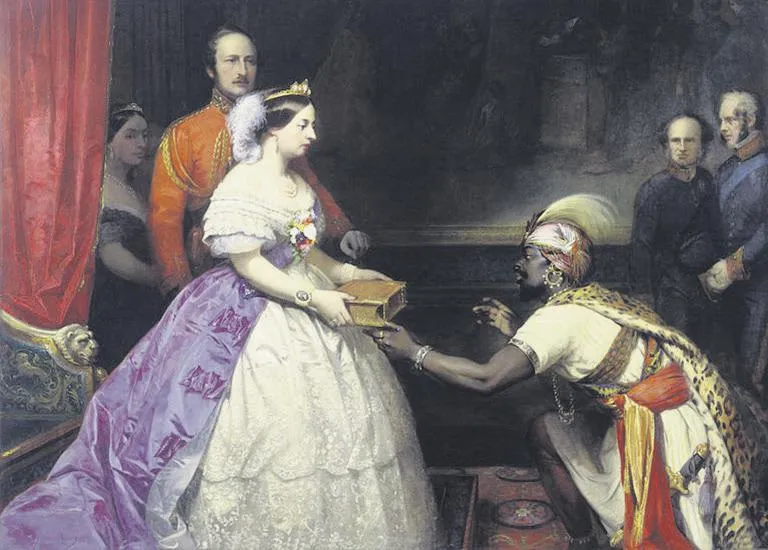
'The Secret of England`s Greatness' by Thomas Jones Barker - see the picture footnote at the end of this article

A few months ago, a group of Ghanaian MPs tabled a draft bill aimed at criminalising the ‘public show of amorous relations between or among persons of the same sex’ and ‘intentional cross-dressing … with intent to engage in an act prohibited under the act.’

That country’s Anglican archbishop, Cyril Kobina Ben Smith, joined several other prominent Ghanaian Christian leaders in endorsing the bill. He wrote: ‘The church does not condemn persons of homosexual tendencies, but absolutely condemns the sinful acts and activities they perform.’

As expected, Western reaction to the news of this draft legislation was swift and largely negative. For example, the Archbishop of Canterbury stated that he was ‘gravely concerned’, while prominent LGBT advocacy groups described the bill as the ‘worst homophobic document ever’.
Thus far, on the Revd Ian Paul’s blog, 205 people (including several prominent evangelicals) have co-signed the Statement* on the criminalisation of LGBTQI+ which opposes the Ghanaian bill and which, among other things, stated:

‘Scripture teaches both that marriage is the lifelong union between one man and one woman and the proper place for sexual union, and that all people are made in the image of God, and so should be treated with dignity, respect and care by every individual and by the law … We are grieved when we see Christians, especially church leaders, failing to uphold either of them whether in the life of the church or in the church’s witness to its culture.’

I didn’t sign that statement because, in the absence of a consistent objective rationale for determining why certain types of sexual behaviour should be decriminalised (but not others), I don’t assume that support for criminalisation of certain kinds of sexual behaviour is an unbiblical failure ‘to uphold that all people are made in the image of God, and so should be treated with dignity, respect and care by every individual and by the law’.

In fact, the drive to decriminalise certain kinds of sexual behaviour/relationships owes more to Western liberal tradition than to Scripture. In 1957, the Wolfenden Report, which advocated decriminalisation of private homosexual acts, was heavily influenced by liberal philosophers, J. Bentham and J. S. Mill. Mill argued that the harm principle should decide the issue of criminalisation:‘If anyone does an act hurtful to others, there is a prima facie case for punishing him by law or, where legal penalties are not safely applicable, by general disapprobation.’

At that time, (Law) Lord Devlin’s key counterargument to Wolfenden’s recommendations was that: ‘It is not possible to settle in advance exceptions to the general rule or to define inflexibly areas of morality into which the law is in no circumstance to be allowed to enter.’

Since states have the sovereign right to decide the areas of morality into which the law can enter, why should Western states be allowed to do this, while readily imposing sanctions aimed at discouraging non-Western nations from exercising that self-same sovereign right?

In 2014, both the UK and US imposed aid sanctions on African nations that opposed LGBT advocacy. In a Huffington Post interview, Sir Alan Duncan, a Cabinet member of the government, described non-Western countries that adamantly rejected LGBT identities as ‘more primitive cultures’.

This unfortunate phrasing was a ‘red rag’ to Africans because it echoed the ‘civilising mission’: the centuries-old impetus for European and American colonial expansion, which developed from medieval notions of Western moral and political superiority.

The irony is that African anti-LGBT legislation is more shaped by English legal tradition than by anything in Africa that Western minds might deem to be primitive. The draft bill refers to ‘unnatural carnal knowledge’ and ‘gross indecency’. These terms come from the Offences against the Person Act (1861) and the Labouchere Amendment which, with other laws, the British imposed throughout its Empire.

Among UK evangelicals, what has been sadly lacking is any understanding that the toughening of anti-LGBT laws expresses African reaction to perpetual Western attempts to ‘civilise’ (read, ‘coerce’) them through foreign-aid (and other) sanctions.

There is nothing Scriptural or insightful about just denouncing such hardened reaction but not addressing the coercive imposition of sanctions and the notions of Western superiority that provoke and exacerbate African reaction.

It’s our duty to do both: ‘You should have practiced the latter without leaving the former undone’ (Luke 11:42).

* www.psephizo.com/sexuality-2/statement-on-the-criminalisation-of-lgbtqi-people/

David Shepherd is an active member of Beacon Community Church in Camberley and was formerly a Deanery Synod Representative in the Diocese of Guildford.

Picture footnote: 'The Secret of England`s Greatness' is a portrait by Thomas Jones Barker of Queen Victoria meeting an African envoy and presenting him with a copy of  the Bible. Painted in around 1863, it has become an icon of British imperialism in this period and of the justification of colonial expansion in terms of the transmission of the values of the Bible. David Shepherd says: ‘It perfectly captures the essence of the “civilising mission” that I mention in the article'.

Share
< Previous article| Comment| Next article >
Read more articles on:   gender & sexuality
Read more articles by David Shepherd >>
Comment
Churchill & Arday: Double standards?

Churchill & Arday: Double standards?

In 1898, the young Winston Churchill rode with the 21st Lancers at Omdurman, later describing the charge as a desperate …

Comment
Are we missing the point about ‘equity’?

Are we missing the point about ‘equity’?

Over the past few weeks, the word “equity” has almost become a pejorative.One writer on the en website expressed …

About en

Our vision, values and history

Read more

Give a subscription

Our monthly newspaper is the perfect gift for those who love to think deeply

Give here