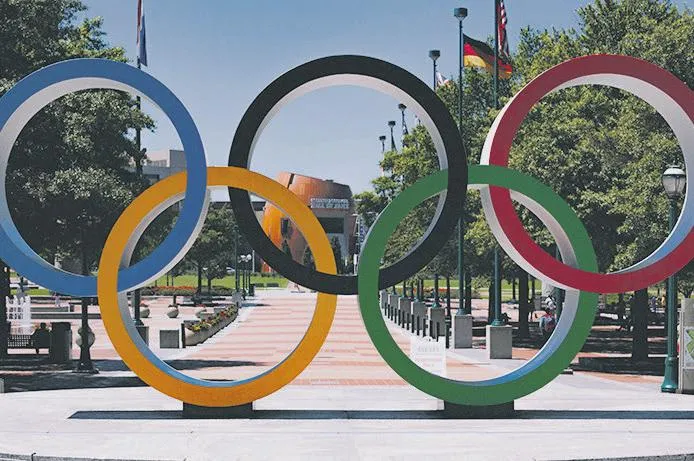
I can’t be the only person for whom half the pleasure of the Olympic Games is in reminiscing about previous Olympic Games.
What happened, and where we were and who we were with when it did. ‘Can you remember that time when… ?’ ‘Ah yes, we were on holiday in Cornwall the year that…’ ‘Was that 1992 or 1996?’ And so on.
My earliest Olympic memory is from the 2000 games. At age eight, I was watching the canoeing while eating my breakfast (it was in Sydney, you’ll remember, so they were several hours ahead) when my mother came in to tell me than my hamster had died. Unscarred by the experience, my siblings and I went on to play the Sydney 2000 PC game for years afterwards, furiously tapping the arrow keys alternately to get our athlete around the running track. It was cutting-edge stuff.

London 2012
Like many people, the London 2012 games provide a rich seam of reminiscences. As a volunteer, I spent the best part of those two weeks scanning tickets, telling people where the toilets were, and watching spectators watch events. On one particularly thrilling occasion, however, the boxer Amir Khan came down the escalator I was guarding.
The Tokyo games already seem destined to be memorable: the postponement to an odd numbered year, the will-they-won’t-they-happen build up, the masks and half-empty stadiums. Although hopefully, by the time you’re reading this, the games will have proved memorable for all the right reasons too: the spectacle of humans pushing themselves to the limits to achieve their best; the sheer creativity of human beings in coming up with weird and wonderful games to play, things to measure, targets to beat; the thrill of victory; the pride on the faces of athletes and families when their years of hard work pays off. And perhaps, above all, our irresistible human urge to collaborate in pursuit of greatness – the reminder that we can do together so much more than we can do on our own. It’s all distinctly human. It is, in one sense, just how God made us to be. No wonder so many of us find it so enthralling.
A spot of Greek poetry…
And it was ever thus. I’m reminded of a poem by the Greek poet Pindar, one of a series of Victory Odes written in praise of competitors in athletic games in the ancient world (okay, that’s a lie – my colleague was reminded of said poem; I’d never heard of him). And yet, after 14 stanzas celebrating one athlete’s wrestling triumph, this is how it ends:
Creatures of a day! What is anyone?
What is anyone not? A dream of a shadow
Is our mortal being. But when there comes to men
A gleam of splendour given of heaven,
Then rests on them a light of glory
And blessed are their days. (Pythian 8)
For all the joy we’ll get watching Simone Biles in the gymnastics, or Adam Peaty take on the 100m breaststroke, such athletes are just that: creatures of a day. Or, granted, two or three Olympic cycles.
When another ancient poet, Moses, considered the mortality of man, these are the words he penned:
[Lord] you sweep people away in the sleep of death –
they are like the new grass of the morning:
In the morning it springs up new,
but by evening it is dry and withered.
…
Teach us to number our days,
that we may gain a heart of wisdom.
Ps.90:4-6,12)
It seems likely that our memories of the Tokyo Olympics will be tied to our memories of this pandemic. But it remains to be seen whether we’ll learn the lesson of both: that we are merely creatures of a day, who, for all our brilliance, will fade and fall unless we seek a glory from outside of ourselves; a splendour from heaven.
As we age, Olympic Games – like World Cups and Parliamentary Elections – appear to come round more and more frequently, leaving us saying to one another: ‘Is it really four years since the last one? Two decades since Sydney? Where does the time go?’
[Lord] teach us to number our days, that we may gain a heart of wisdom (Ps.90:12).
What stand-up comedy showed me about teaching the Bible
Three weeks, more than 2,000 shows and 2.6 million tickets sold last year. August is the month of the Edinburgh …