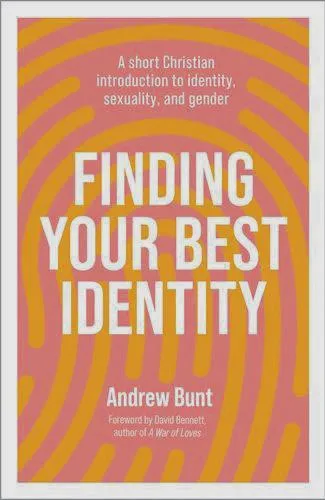
FINDING YOUR BEST IDENTITY:
A short Christian introduction to
identity, sexuality and gender
By Andrew Bunt
IVP. 90 pages. £8.99
ISBN 978 1 789 744 200
Andrew Bunt is the Emerging Generations Director of Living Out, co-ordinating their work especially among same-sex attracted Christians aged under 25.
This book asks not primarily ‘What is my identity?’ but ‘How do I discover what my identity is?’. It is a question Bunt has wrestled with in his own life.
At the outset, he describes identity as ‘our controlling self-understanding’ which will deeply ‘affect how we feel and how we live’.
He looks in turn at three ways to discover what our fundamental identity is: ‘I decide’, where I look inside myself and determine what my identity will be; ‘Others decide’, where I let the opinions of those around me determine my identity; and ‘God decides’, where I accept what God has said my identity is and should be.
Bunt tellingly shows the insecurity and instability in insisting on deciding myself or in submitting to the opinions of others. He also briefly, but convincingly, shows from Scripture that God gives all human beings the important identity of being made in the image of God, and all Christians the still-more fundamental identity of being a child of God. In this ‘best’ and unchanging identity is the stability and relationship with God as Father on which a healthy life can be built.
An important passage Bunt refers to is 1 Corinthians 4:3-4 where Paul says: ‘As for me, I care very little how I might be evaluated by you or by any human authority. I don’t even trust my own judgment on this point… It is the Lord himself who will examine me and decide’ (NLT).
There are weaknesses in the book. Bunt so emphasises these two fundamental identities (in the image of God and child of God) that he denies we have any other identity: ‘Neither my sexuality nor my gender is my identity’ (p.64). Yet less than a page earlier he has said: ‘My identity as a man is given to me by God’. It is surely of considerable importance, and part of my overall identity, that (in my case) I am a man, and a husband, and a father, and a pastor, etc. These need to be affirmed and explored, as well as my still more basic identity as child of God.
I also have hesitations about the statement ‘God speaks of His relationship with us in terms of sex and marriage’ (p.54). Marriage, certainly. But I’m not convinced that God’s gift of marital sex is to focus our minds on God’s love for us. And the section on transgender is too brief to answer the pressing pastoral questions raised by trans men and women.
But this is a book which many will find helpful, particularly those who recognise that romantic and/or sexual thoughts towards those of their own sex are never far from their mind; and are constantly being told that not to express their sexuality is to suppress who they really are.
Among many pithy statements, born of both Scripture and his own experience, Bunt says: ‘God doesn’t ask me to suffer by denying who I am: He has invited me to thrive by embracing who He says I am’ (p.64).
The UK's 'spiritual openness' is both an opportunity and a challenge
In recent months, I’ve noticed something shifting. Church leaders across the UK tell me that political conversations are becoming more …