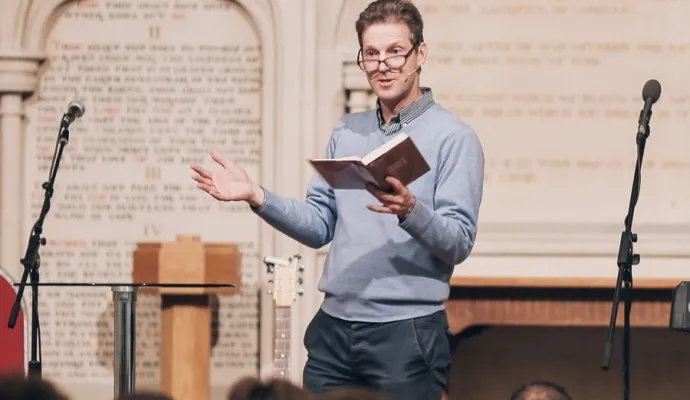
Evangelicals in the Church of England are currently in an ‘unsustainable’ position following an ‘unprincipled’ process to liberalise teaching on same-sex relationships, leading evangelical minister Vaughan Roberts is warning.
Speaking to en, Roberts, who is rector of St Ebbe’s Church, Oxford, called on more bishops to engage in face-to-face discussions with leaders of the Alliance, the umbrella group bringing together a spectrum of orthodox Christians in the denomination.
He declared that a matter of ‘first order’ in terms of doctrine required ‘first-order differentiation’ via a different structure within the CofE.
And he described the process in Synod thus far as ‘unprincipled,’ saying a change of this kind clearly required a two-thirds majority in each House of the Synod rather than the method used by bishops which required and secured only narrow majorities.
Roberts said: ‘The bishops who have driven where we’re at have really misunderstood where orthodox Christians are at. Many of them thought they could find a way of giving some kind of partial affirmation to same-sex relationships, without changing the doctrine of the Church of England, and without really upsetting those who can’t go along with it, thinking “we’ll find a way of meeting in the middle”.
‘But the reality is that there’s never been a middle place that they could land on this, and I think there’s naivety that there could be. And so where we are at the moment is in a completely unsustainable position.’
He stated: ‘For those who hold to the traditional teaching of the Church, then to bless unions which are assumed to be sexual, goes beyond partial accommodation and is actually to bless sin. So that’s a red line that’s passed. And where we are now is with a clear trajectory set towards same sex-marriage for clergy and standalone services for same-sex unions. So we’re in a really difficult position, and what we need is bishops to recognise that.’
Roberts said that while there had been discussions about alternative structural provision, these had mostly been with what he called ‘civil servants’ at Church House, the CofE’s headquarters building, with ‘one or two bishops’ occasionally, ‘but very few’. He said that as the officials at Church House did not themselves make decisions, what tended to happen was that people felt progress was being made, only to be rebuffed when it went to the College or House of Bishops.
‘The situation now is so serious that there needs to be negotiation. And as I said in my speech in Synod, we’re not “impossibilists”, but that doesn’t mean that we’re going to change our mind. These are first-order issues. But nonetheless, there are things we can discuss in terms of a settlement that could be acceptable, that actually would enable the bishops, should they wish, to keep going in the direction they have been taking, but would preserve the integrity of those of us who are determined to stay in the Church of England,’ Roberts said.
‘I think there’s an important conversation we’re still not having... we have not given enough attention to the important question of how we engage evangelistically and pastorally with those who identify as LGBT.'
‘We’re not getting a negotiation where we actually cut to the chase. And I think there are many bishops who don’t feel the need for that, and I fear that they’re still underestimating the strength of feeling that is there among a broad coalition across the country.’
He added: ‘Talk of the de facto province is basically just saying “Well, we’re going to have to operate on that basis”.’
Asked whether such a province would be a ‘paper province’ or a ‘proper province’ Roberts said: ‘Well, time will tell. What we long for is to be thoroughly part of the Church of England, but with integrity, and so that needs formal structures and so on. We’re a long way from having them at the moment. That’s why de facto is quite significant. No one’s saying this really is a province. It’s not. It’s a de facto.’
Roberts also had a warning for evangelicals: ‘I think there’s an important conversation we’re still not having. The impact of the sexual revolution should certainly not lead us to change our sexual ethic, given the clear teaching of scripture. But, in the midst of seeking to defend this teaching, we have not given enough attention to the important question of how we engage evangelistically and pastorally with those who identify as LGBT. How can we best express Christ’s gracious love and welcome to all? And what does faithful, wise and loving pastoral practice look like?
‘For example, what should repentance and godly living look like for a long-term same-sex married couple with children? The priority must be to welcome everyone. But then what should we do if, for example, they want to be part of a home group or offer to serve? These are really tricky questions and it’s vital we begin to address them. While some churches are strong on welcome and integration, but can compromise on doctrine, others are in danger of the opposite problem. We must strive to be like our Lord: full of both grace and truth.’
A helpful challenge – but I don’t recognise those views
This article was written in response to the article "Same-sex attraction and identity: Are evangelicals on the right track?" …