‘Woe to me if I do not preach the gospel,’ writes Paul in 1 Corinthians 9:16.
As we move from 2021 to 2022, and with so many things potentially crowding our minds – the pandemic, rising gas and electricity prices, the refugee crisis, climate change, moral relativism, transgender issues, cancel culture, or whatever it might be – it is good to return simply and firmly once again to… the gospel.
‘Quis custodiet ipsos custodes?’ (Who guards the guardians?) is the question the Roman poet Juvenal asked, at just about the same time as the New Testament church was rapidly expanding.
It’s not often that Latin phrases come to mind (mainly because I know so few), but this one seems entirely appropriate for the increasing tendency we are seeing in our major internet platform providers to decide that they, and they alone, are the arbiters of truth.
Even before lockdown the listener figures for BBC Radio 3 were going up. In February 2020 they were up to 2.13 million compared with 1.83 million the previous year. One suspects that the privations of the pandemic will have driven them up even more.
One reason might be that Radio 3 has revamped itself somewhat.
Two triangles merge to make the symbol of an hourglass – the end is nigh! From New York to Paris the chants and banners herald an ‘inconvenient truth’. An Australian protester speaks with passion and reason: ‘We are simply telling people what to expect. Our politicians are asleep at the wheel. We need to tell the truth.’
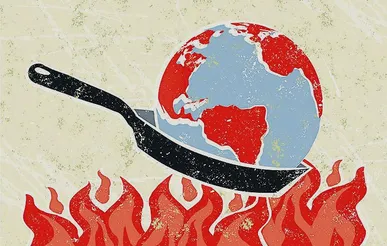
Yet, as I watched the Extinction Rebellion demonstrations in my own city, I couldn’t shift the overriding emotion – ‘Have these people just taken my job?’ For if we are Christians, we are those who know that the end is nigh. This end will not arise because of any increasing ocean acidification or glacial retreat, but rather because the Judge is at the door (James 5:9). The message of climate change is vital (we are to be good stewards of creation), but it cannot be equated with the immanent and glorious return of Christ. And it is this inconvenient truth that really is the grounds for waking up those are asleep at the wheel.
I was 16 years old. A new convert. Enthused and encouraged in my new-found faith. I loved reading the Bible, until one day I was given a book with a title along the lines of ‘101 problems in the Bible – resolved’. I actually didn’t have any problems with the Bible – but after I read the book I had 101!
The problems were real, but the answers were shallow and superficial. It was my first ‘crisis of faith’. The only way I got out of it was to realise that I was very young in the faith and that I could not be expected to know everything at once. I believed that over the years the Lord would guide and show. Over the years most were gradually and graciously answered as the Lord taught me to read and think biblically. I came to understand that I needed to be transformed by the renewing of my mind (Romans 12:2) and to have the mind of Christ. I only have about four or five problems to go – although new issues still arise.
Are evangelicals obsessed with sex – to the detriment of other important issues?
It seems to have passed into our constituency mindset that ‘people’ – by which we generally mean liberals or the world at large – think we have a particular ‘thing’ about sex and that we are always talking about it.
‘What do you think?’ she asked me. Someone in our congregation had been asked on Facebook about the accusation, which hit the headlines recently, that the heavy storms across Britain were God’s judgment for the government’s legalisation of gay marriage.
The question put me on the spot. My response was to say that as a nation we are guilty before God of all kinds of sins and already under his judgment. Whether or not the floods were related to that matter specifically was beyond my wisdom.
Increasingly the signs seem to be that we are moving towards some kind of world government. This phenomenon (much loved by those who deal in prophetic timetables of the last days) may not happen soon, but it seems fairly clear that it must emerge sometime on the long-term political agenda.
The need for such a body is argued from many starting points. First, there is the current widespread economic recession. As he met President Obama at the beginning of March, Gordon Brown insisted that our financial difficulties stemmed from a failure of the banking system worldwide. ‘Bold global action, a global grand deal, is not now just necessary, but is vitally urgent to deal with the challenges of the world economy’, he said. In April, a meeting of leaders is scheduled in London, hoping to take decisions to secure the world’s economic future. Wouldn’t an authoritative body to oversee the planet’s economics make sense?





Always the gospel
‘Woe to me if I do not preach the gospel,’ writes Paul in 1 Corinthians 9:16.
As we move from 2021 to 2022, and with so many things potentially crowding our minds – the pandemic, rising gas and electricity prices, the refugee crisis, climate change, moral relativism, transgender issues, cancel culture, or whatever it might be – it is good to return simply and firmly once again to… the gospel.