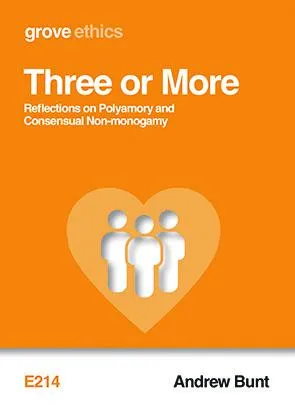
THREE OR MORE:
Reflections on Polyamory and Consensual Non-monogamy
By Andrew Bunt
Grove Books. 28 pages. £4.95
ISBN 978 1 788 274 012
Grove Books pride themselves in maybe not providing the last word on a topic but often offering the first!
Here the author is Andrew Bunt of Living Out, who wrote a helpful piece on polyamory and consensual non-monogamy (CNM) in the August issue of en. Here he offers a carefully researched and well-written booklet that shows his workings on these vital contemporary topics.
In the complicated world of human identity and sexuality there are always fresh challenges to be faced by the church. For example: ‘Polyamory and consensual nonmonogamy are already realities in modern Western society. They are the next step in the radical transformation that has been permeating society since the start of the sexual revolution.’
The booklet seeks to equip Christians to think clearly and act wisely on these issues. The author does so by setting the scene concerning what is happening in this rejection of traditional monogamy and what this in turn says about human aspirations.
Bunt seeks to bring clarity on how to shape an ethic of human sexuality from Scripture. This includes looking at Biblical descriptions of polygamy, and what can be learned from the pastoral handling of polygamist converts in Africa. He examines the Biblical material, and engages with some of the arguments that are used to defend polyamory and CNM; these include the relationship of Jesus with the millions who make up His bride the church, and arguments from the Trinity! He helpfully suggests that: ‘Scripture never indicates that human relationships are modelled on the Trinity … by contrast, Scripture does explicitly present two-person marriages as a picture of Christ and His church.’
This booklet challenges the church to make a four-fold Christian response:
1. Adopting a posture of gospel humility and gospel hope, that sensitively offers a message of transformation to fellow sinners.
2. Living out God’s plan by making friendship a priority; recognising that not all relational needs are met within the nuclear family; and modelling healthy marriages.
3. Talking about God’s plan that offers what is ultimately good for everyone.
4. Preparing for pastoral questions, because they will come. Like all pastoral issues there is huge value in anticipating what is beyond the curve and at least thinking the issue through.
We do need to get ready. This little booklet is a good start.
A helpful challenge – but I don’t recognise those views
This article was written in response to the article "Same-sex attraction and identity: Are evangelicals on the right track?" …