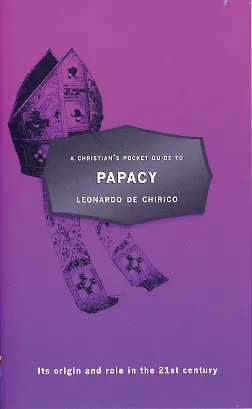
A CHRISTIAN’S POCKET GUIDE TO PAPACY
Its Origin and Role in the 21st Century
By Leonardo de Chirico
Christian Focus. 105 pages. £4.99
ISBN 978 1 781 912 997
The Pope is popular. From the moment he stepped out onto the famous balcony and said ‘Brothers and sisters, good evening,’ and said that he was a Pope ‘all the way from the end of the world’ he seems to have struck a chord not only with Roman Catholics, but in other religious and non-religious circles too.
We are a celebrity culture, after all, a culture in which a nice smile goes a long way, and rumours that he likes simplicity and travels by bus do him no harm.
I recently found myself preaching on Matthew 16, where Jesus says to Peter, ‘On this rock I will build my church’, and also on John 21 where Jesus reinstates and re-commissions Peter, and it made sense to mention how these passages have been used to justify the papacy – and why they should not be!
And here is a new brief introduction to the papacy, written for evangelicals, in the Christian’s Pocket Guide series. The author is a Reformed Baptist from Italy, with degrees from various places including Evangelical Theological College of Wales (now Wales Evangelical School of Theology, WEST) and King’s London. He is a pastor and church-planter in Rome, a theologian and bioethicist, and Vice-President of the Italian Evangelical Alliance.
The misuse of Scripture
He explains what a Pope is, and explores the misuse of Scripture: ‘The ‘rock’ certainly does not refer to Peter, nor are his successors envisaged here. The ‘keys’ do have a ministerial role in the service of the church, but nothing of a magisterial and absolute power in the name of Christ. The ‘shepherd’ image is not in any sense exclusive to Peter, but defines all those who are called to be servant leaders of the church.’
There follow some short historical chapters which are also fascinating, and reveal how Rome came to make its top-down, authoritative and legal claim to be the church over all other churches. We know the worst of the medieval papal excesses: immorality, nepotism, corruption; and we know too the accusation from our Reformers that the Pope is the antichrist. These are examined, as are the Vatican Councils.
Will serve us well
The ending brings us right up-to-date with a chapter on John Paul II, Benedict and Francis (‘who judges dogma less important than attitude’). Few evangelicals will wish to read a long book about Popes, but here is a marvellously short one which will serve us well in conversing with Roman Catholic contacts and in understanding a significant religious celebrity of the modern world.