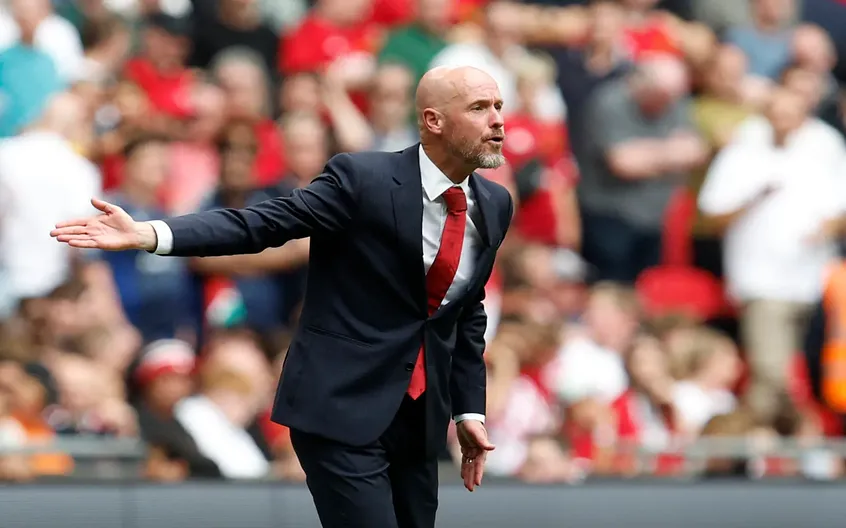
When Erik ten Hag became the manager of Manchester United in April 2022, it must have felt like the high point in an already impressive playing and managing career. How differently must he feel today?
It must be tough enough looking into the stands and seeing the three 'Sirs' - Alex Ferguson, Jim Radcliffe, and David Brailsford - keeping a watchful eye on his match-day performances. Then there are the TV pundits, the mainstream media and millions on social media who assess his results daily. Who can imagine receiving the criticism he has to endure?
The life of prominent public sporting figures is indeed challenging. What appears fulfilling can be quite the opposite. Andre Agassi's 'Open' is perhaps the most illuminating autobiography in sport. He describes a childhood driven by his father's ambition for his son to become a world-class tennis player. Agassi narrates his despair and self-flagellation every time he lost games as a child. He also talks about how fear of shame drove him until he won his first Grand Slam at Wimbledon in 1992, at 22.

At this point, Agassi discovered something that astonished him, yet, in hindsight, seemed so obvious. 'Winning changes nothing. Now that I've won a slam, I know something that very few people on earth are permitted to know. A win doesn't feel as good as a loss feels bad, and the good feeling doesn't last as long as the bad. Not even close.'
Even winning a Grand Slam could not heal his wounds.[1] Ultimately, Agassi could not find his sense of self-worth in athletic performance.
The World Cup-winning English rugby player Jonny Wilkinson shares Agassi's perspective. In his autobiography, Wilkinson writes about his struggles with depression while being perhaps the best outside half in the world: 'It feels as if I spent years trying to fight depression with another Six Nations Championship, or more caps, or titles, or points. "Surely," I told myself, "that will keep you off my back?" It doesn't. It's never enough.' [2]
The cultural significance of sport means that the pressure on well-known athletes and coaches can often be overwhelming. As spectators and supporters, we can quickly view them through the one dimension of their lives that we see on the TV screen or from the stands. It's important to remember that they are more than just their performance on the field. This balanced perspective is crucial for the audience to understand the athletes' experiences better.
Yet, their lived experience determines that they feel pressure to base their identity and sense of personal value on sporting performance. The result is that sport becomes their idol, a concept that refers to the tendency to place excessive importance on something, such as winning and losing. As a result, their self-worth becomes tied to their performance, leading to a cycle of inflated ego when they succeed and deep despair when they fail. Tim Keller elegantly puts it regarding any performance-based identity: 'If you make work your identity and you succeed, it'll go to your head. If you fail, it'll go to your heart.' [3]
The Bible tells us that achievements can never bear the weight of your sense of self-worth. We find fulfilment only by separating self-worth from achievements (or potential ones). Ashley Null worked as a chaplain in six Olympics and knows this only too well: 'Only love has the power to make human beings feel truly significant, not achievement. Only knowing that they are loved regardless of their current performance has the power to make Olympians feel emotionally whole.' [4]
The gospel does not define us by what we achieve but by what we receive from God through Jesus Christ. We must pray that all our elite athletes and coaches meet someone who can explain this good news to them. Then, sport can reside in its rightful place, as part of creation, not as the source of ultimate meaning.
[1] Andre Agassi, Open: An Autobiography (HarperCollins, 2009), p 166.1
[2] www.theguardian.com/sport/2019/sep/08/ jonny-wilkinson-mental-iilness-rugby-union (accessed 3 June 2024).
[3] Keller: https://www.thegospelcoalition.org/article/50-quotes-tim-keller
[4] Ashley Null, Reformation Care in the Olympic Village, in A. Parker and N.J. Watson & J. White4 (eds), Sports Chaplaincy: Trends, Issues and Debates(London: Routledge, 2016), 120-131
England vs. Argentina and the verdict that matters most
For England supporters, Wednesday night was painful.After taking the lead against Argentina, hopes of reaching another World Cup final …