The origins of Christendom

Michael Haykin  |  Features  |  history
Date posted:  1 Feb 2024
Share Add       
The origins of Christendom

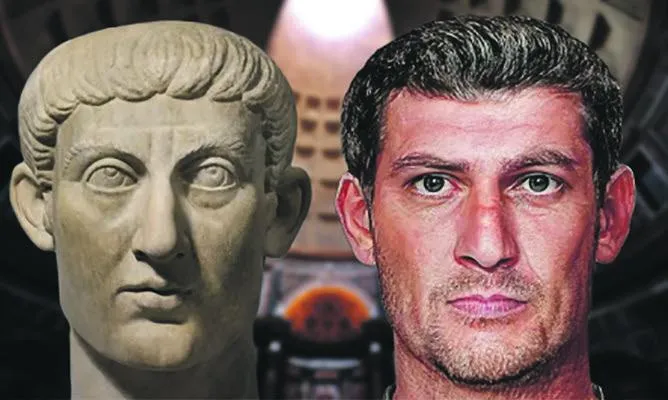
A bust of Constantine and a facial reconstruction of how he may have looked

‘One of the greatest blows to the kingdom of Satan in the history of the church’ is the way that the New England divine Jonathan Edwards once described it. His English evangelical contemporary, John Wesley, strongly disagreed however. He maintained that it initiated an age of iron, of doctrinal and spiritual compromise and weakened the church.

What were they talking about? None other than the formal embrace of Christianity by the Roman emperor Constantine and his clear favouring of the church in legal policies that he enacted after his 312 victory at the Battle of the Milvian Bridge over the pagan Maxentius.

Whatever the reality of the impact upon the church of the Constantinian legislation, as well as the authenticity of Constantine’s conversion – both of which have been hotly-debated topics ever since those far-off events in late antiquity – there is little doubt that the reign of Constantine ignited a revolution in Roman society.

History and power

It forced church leaders throughout the empire to rethink the nature of the relationship of church and state. Prior to Constantine, the Biblical city that most readily came to the mind of Christians when they thought of Rome was that urban enemy of God, Babylon. Now it was Jerusalem. The empire came to be regarded as a sacral state. In the thinking of the historian Eusebius of Caesarea, who wrote a life of Constantine, the Christianisation of the Roman Empire constituted the apex of God’s work in human history.

It is amazing that the church, which had gone through times of brutal persecution during the pre-Constantinian era, soon found herself using power in the very same way the pagan Roman had used it against her, namely, to repress dissenting voices, in this case, those of pagans, Jews, and those deemed heretics. If ever there was proof needed of Lord Acton’s dictum – ‘Power tends to corrupt, and absolute power corrupts absolutely,’ penned in an 1887 letter to an Anglican bishop – it can be found in the Christian Roman empire in the course of the fourth and early fifth centuries. By 382, only those churches that upheld orthodox Trinitarianism (as defined by the creed published at the Council of Constantinople one year earlier) had the legal right of assembly. What we know as Christendom was thus born in this revolutionary era and henceforth Christians would be tempted to have recourse to the sword to promulgate their views.

There is much that we can learn from this remarkable era of history. I, for one, am deep-ly thankful to God for the detailed enuncia-tion of the Triunity of God by authors like Athanasius and Hilary of Poitiers, as well as the Cappadocian Fathers, and Augustine. The remarkable spirituality found in the works of Basil and Augustine and that Syrian author, Macarius, merits our ongoing atten-tion in this day of spiritual shallowness.

At the same time, though, we would be wise to learn about the folly of thinking that the acquisition of political power in this fallen world is a safe pathway to spiritual blessing.

Share
< Previous article| Features| Next article >
Read more articles on:   history
Read more articles by Michael Haykin >>
Features
The sword and doctrine:  Killing in the name of God?

The sword and doctrine: Killing in the name of God?

The acceptance by Constantine the Great in 313 of Christianity as a legal religion within the Roman Imperium was a …

Reviews
Raising an Ebenezer!

Raising an Ebenezer!

What a delight it was to come across this board book in a Christian bookstore, Reformed Book Services in Brantford, …

Need to advertise?

We can help you reach Christians across the country

Find out more

Looking for a job?

Browse all our current job adverts

Search