AI – souless, risky, misunderstood…?

Nicola Laver  |  Features
Date posted:  1 Aug 2023
Share Add       
AI – souless, risky, misunderstood…?

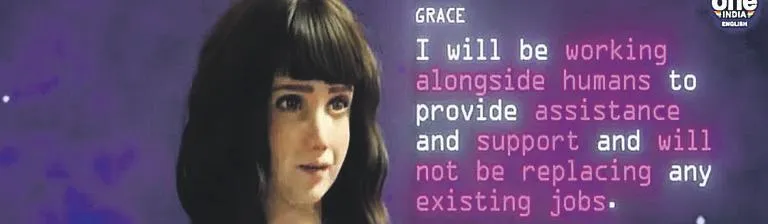
What was described as ‘the world’s first human-robot press conference’ was held in July at a United Nations’ AI conference in Switzerland

So I went on the search engine Google and typed in ‘AI’ (Artificial Intelligence).

Ironically, and paradoxically, that very search engine is itself a form of AI, of course.

My Google search, at precisely 17.06 on 6 July, revealed the best and the worst of the latest AI news. The headlines are pretty accurate as headlines go: ‘AI chatbot “encouraged” man who planned to kill queen, court told’ and ‘AI robots could play future role as companions in care homes’.

Such is the power of AI today. Though we cannot ignore the dangers and heightened ethical concerns around its prodigious capabilities, AI has an inherent, incurable weakness.

Paul Ewart, chairman of Christians in Science and former director of The Faraday Institute, suggests a less intimidating frame of thinking: ‘It’s better to think of AI as a super-fast calculator that can, almost instantaneously, gather huge amounts of information and data...’

The term ‘intelligence’ is, he says, misleading: ‘AI is not the same as human intelligence – only better. We do not fully understand how our own brains work and even what consciousness is, but AI systems are not conscious or intelligent in the same sense as we are… AI simulates a human’s intelligent argument by its answer but there is a difference between human and artificial “intelligence”.’

But as Ewart acknowledges: ‘There is a lot of unnecessary angst, misinformation and misunderstanding.’

Even so, Christian scientists warn of the risks of idolatry and overreach around AI, and are encouraging Christians to engage with the issues. ‘AI is here to stay, and nothing is to be gained by pretending otherwise’, says David Brenner, founder of AI and Faith. ‘Be very careful not to confuse functionality with sentience or consciousness, to work hard to not anthropomorphize these technologies’, he adds.

We’ve long been warned about the mental health risks of overexposure to social media (and it’s not just the younger generations), not to mention the hours we can waste on our devices. But while AI has a valuable place in our lives to a greater or lesser extent, over-reliance on the latest AI raises the risks to a new level.

‘Above all,’ says Brenner adds, ‘we must not let them become our idols. Lately, I have been thinking of the log in Isaiah 44 – half of it warms our food and ourselves, the other half becomes our idol.’

No spiritual compass

The sophistication of ChatGPT has undeniably raised the stakes. Brenner warns: ‘When key technologists are shocked by the speed of improvement, we should be doubly concerned about the subtle rise of idolatry and potential overreach.

‘Never before has man encountered a thing that has functionality mirroring or even greater than our own with regard to language formation, relational capability, and oracle-like knowledge as we see in GPT.’

Notwithstanding its super-human powers, AI can neither possess nor display a spiritual compass. Though its self-learning abilities are, says, Brenner, ‘wondrous and alarming… [it] confabulates, hallucinates, [and] does not actually understand anything’.

And as Ewart observes: ‘The AI response will potentially be skewed by irrational or amoral prejudices and have no moral compass of its own to guide it… AI can simulate a moral argument, but it is not moral in the sense of being morally responsible. Christians should be stressing that those using AI need to take ultimate moral responsibility for whatever a system operating AI will do.’

For instance, he points out that it should be obvious a Christian should not pass off a piece of ChatGPT-produced work as their own. ‘This would be morally equivalent to plagiarism and is certainly dishonest,’ he comments. A more serious danger is that ‘AI could be given de facto responsibility for the use of battlefield weapons’.

Christians should be stepping into the breach – restraining, applying and utilising AI for good. ‘There is an important stewardship role for us to play,’ says Brenner - actively engaging with governments and businesses.

AI is a global phenomenon – but in the wrong hands, it is a significant problem. Yet despite genuine concerns around the future of the human race, Brenner is reassuring: ‘Evangelical Christians ultimately do not need to worry about existential risk; we know that humans will not be wiped out by our own doing, but we recognise from the apocalyptic teaching of the New Testament that there is likely to be a great deal of human misery before Christ returns.’

Ewart encourages Christians to consider the spiritual consequences of life affected by AI. ‘The Bible teaches us that how we think, speak and act, especially in relation to others, affects the spiritual development of our character. This principle is at the heart of all the Abrahamic faiths. An AI machine does not have a spiritual dimension, unlike humans who are made in God’s image.’

And he warns of a further danger or over reliance on AI: ‘We may end up thinking like a machine and neglect the spiritual and moral dimensions of the decisions we make and actions we take.’

Ewart acknowledges the opportunities that AI presents, while challenging Christians to speak up and do all we can to make sure we ‘take moral responsibility’ for its use. ‘There is much to be thankful for... Science, nurtured in a Christian culture, is a wonderful gift from God and the technologies that flow from the understanding of God’s world can be the means by which all nations of the earth may be blessed.’

Share
< Previous article| Features| Next article >
Read more articles on:   Artificial Intelligence
Read more articles by Nicola Laver >>
UK & Ireland
Report hears of ‘30-plus years’ of abuse at church

Report hears of ‘30-plus years’ of abuse at church

Warning: the following content relates to issues of abuse and could be both upsetting and triggering. A …

UK & Ireland
Insurer rejects car over ‘Jesus Loves You’ stickers

Insurer rejects car over ‘Jesus Loves You’ stickers

A Christian is considering legal action after he was reportedly denied car insurance unless he removed “Jesus Loves You” stickers …

Subscribe

Enjoy our monthly paper and full online access for just £40/year

Find out more

Give a subscription

Our monthly newspaper is the perfect gift for those who love to think deeply

Give here