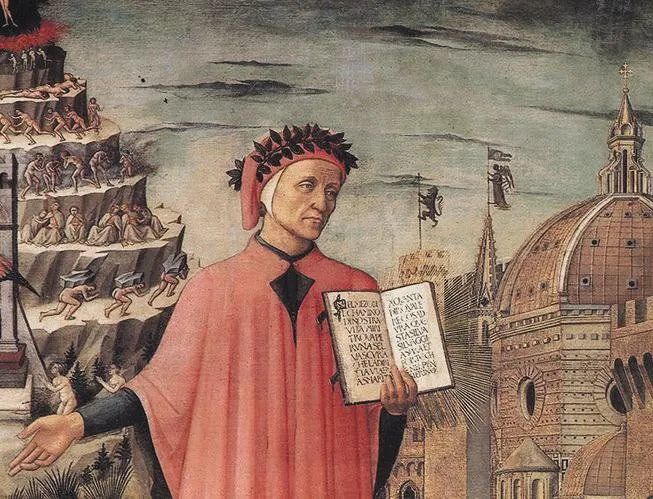
On the occasion of the 700th anniversary of Dante Alighieri (1265–1321), Pope Francis wrote an Apostolic Letter to celebrate Dante as a ‘prophet of hope and poet of mercy’.
The magnitude of Dante’s significance for Western civilisation is extensive. Here the focus will be to sample Dante’s relationship with the Bible in The Divine Comedy, his most-known work.
Inferno
The Divine Comedy is a journey into the realms of the afterlife. His journey starts from Hell (‘Inferno’) which is a Biblically-attested space, even if he imagines it as a chasm in the shape of an inverted cone, a shape that has no Biblical origin.
In the first canto of ‘Inferno’, Virgil explains to Dante that, having come out of the dark forest, one cannot climb the hill of happiness except by taking another path through the kingdoms of the afterlife. It was forbidden to human beings, except for Aeneas (in the Aeneid) and Paul (according to an interpretation of 2 Corinthians 12:2-4, which in reality does not speak of hell but of heaven). In this double inspiration (classical and Biblical) we find the sources of Dante’s thought: on the one hand the classical Graeco-Roman heritage, on the other the Biblical one interpreted according to the canons of medieval Christianity.
Dante’s Inferno is preceded by Limbo, a place not attested in the canonical Gospels, but in the apocryphal Gospel of Nicodemus. In this place that is neither hellish nor heavenly he meets the virtuous non-Christians who lived before Christianity. A sacramental interpretation of baptism as necessary for salvation (and which these Old Testament believers had not received) makes Dante think that the saints of the Old Testament are not truly saved. When Dante speaks of divine grace, he associates it with sacramental grace and dilutes it in a view of the Christian life still encrusted with a works-based gospel.
Purgatory
The second canticle of The Divine Comedy is ‘Purgatory’. Purgatory is a child of medieval theology that broke off from the Biblical vision of the afterlife, and added an ‘intermediate’ place between Hell and Heaven.
In the prevailing conception of the Middle Ages (which Dante makes his own in the Comedy), salvation is not a gift that is received by faith alone according to the imputed righteousness of Jesus Christ. Salvation for Dante is a path of continuous purification which, once earthly life is ended, continues in Purgatory and then finally reaches its completion in Paradise. Except for the saints (the heroes of the faith), for the ‘normal’ Christians salvation is always ‘incomplete’. For Dante, salvation is a mountain to be climbed from below with a view to progressive sanctification, not a divine declaration on the penitent sinner which clothes him with the righteousness of Jesus Christ.
Paradise
After crossing the seven terraces of Purgatory, Dante and Virgil arrive in the earthly Paradise, which is located on the top of the mountain of Purgatory.
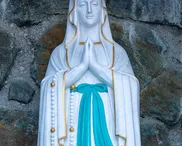
Towards the end of Paradise, Dante reaches a peak of Marian devotion, further demonstrating the profound but spurious character of the Biblical influence on his poem. Mary is defined as ‘the face which to the Christ is most resemblant’ (XXXII, 85-86). The climax is a Marian prayer placed in the mouth of Bernard of Clairvaux (a Father of the medieval church much loved by Dante) which opens with the famous verses: ‘O Virgin Mother, Daughter of thy Son, humbler and loftier than any creature’ (XXXIII, 1-2).
The Divine Comedy is a masterpiece that, despite its extraordinary richness and complexity, does not understand the gospel as a gift from God received by faith alone, but reflects a spirituality strongly attracted to the figure of the ‘mother’ (Mary) and the ‘woman’ (Beatrice) in whom to look for love. It is this comedy that, from Dante onwards, is the canvas of Roman Catholic life.