Gary Clayton remembers five missionary martyrs and tells us of a new play about their story
Missionary Ed McCully wrote this to his friend Jim Elliot on 22 September 1950:
‘I have one desire now – to live a life of reckless abandon for the Lord, putting all my energy into it. Maybe he’ll send me someplace where the name of Jesus Christ is unknown.’
Reflecting on the death of her martyred husband Ed, who died in 1956 on a blood-soaked beach near the rainforest home of a fierce Ecuadorian tribe, Marilou McCully explained: ‘God led us there. God could have stopped the men in any number of ways, but God didn’t want to stop them. God was leading them to do it.’
Friendly at first
Although initial contact with the ferocious Waodani tribe appeared to be friendly, Jim Elliot, Ed McCully, Pete Fleming, Roger Youderain and MAF (Mission Aviation Fellowship) pilot Nate Saint were speared to death by six brutal killers defending their territory.
The news of the five missionaries’ deaths shocked the world and was broadcast globally, with Life, Picture Post, Paris Match, Reader’s Digest and many other publications covering the story.
Yet, according to Nate Saint’s son Steve, who was only five when his father died, ‘What the Waodani meant for evil, God used for good.’ Far from being the end of the story, it was just the beginning.
Telling the story on stage
‘When I was about 12,’ says Natalie Holman, Operations Director for 4Front Theatre, ‘a team of Americans came to my church in Bradford and told the story of these incredible missionaries. A couple of weeks later I was baptised, wearing a T-shirt showing Nate Saint’s plane along with Jim Elliot’s quote, “He is no fool who gives what he cannot keep to gain what he cannot lose.”
‘As I grew up, I read some of Elisabeth Elliot’s books, and while I was spending a gap year in Austria, I even wrote to her and received a lovely letter back from Lars, her husband, since Elisabeth was too ill to write back herself.’
When committed Christians Rob and Natalie Holman founded 4Front Theatre, Natalie began to think of stories she’d like to tell – including that of the five American martyrs. After extensive research – ‘I think I own every book and DVD about it!’ – she ended up with a script involving ten actors.
‘One of my favourite parts,’ says Natalie, who appears as Marj Saint, ‘is the acappella musical arrangements done by Rob. I love hymns and so did Elisabeth Elliot, so I’m pleased they’re a large part of the show.
‘I remember when Elisabeth died in 2015. I was moved to tears as if she had been a friend of mine. But, oh, how glorious it will be in heaven when we meet all the people we’re portraying on stage!’
Mission Aviation Fellowship
The cast met MAF at Creation Fest last year. It was exciting, she says, ‘to meet members of the organisation that sent Nate and Marj Saint to the mission field all those years ago – an organisation that continues to do such great work today!’
At the end of one show, Natalie met Stuart King, one of MAF’s founders, who knew Marj Saint. ‘This,’ smiles Natalie, ‘was both daunting and exciting. Was I doing a good job at portraying a woman Stuart was friends with?’
Ripples through to today
The story, however, doesn’t end with the missionaries’ deaths, but continues to this day. Rachel Saint, Nate’s sister, who worked for Wycliffe Bible Translators, had befriended two Waodani women, Dayuma and Ome, who had fled the forest to avoid being speared. Through this, Rachel began learning their language.
In 1958, because of her relationship with Dayuma and Ome, Rachel Saint and Elisabeth Elliot, Jim’s widow, were invited to live with the tribe in the jungle. There they practised basic medicine and developed a written form of the Waodani language, eventually translating Mark’s Gospel into Waodani.
In time, several of the tribe were born again. ‘We acted badly,’ recalled Mincayani, the killer responsible for the deaths of Ed McCully and Nate Saint, ‘until they brought us God’s carvings [the Bible]. Now we live happily and in peace.’
As he grew up, Nate’s young son Steve spent the summer living with his Aunt Rachel in the jungle. ‘What’s wrong with Steve?’ Mincayani once asked her. ‘He does-n’t know how to make poison for his darts or use a blowgun or track animals – who’s going to teach him how to live?’
‘You, having speared his father, who do you say should teach him to live?’ she answered.
‘Me, having speared his father, now I say I myself will teach him how to live,’ the former killer replied.
So Mincayani taught Steve how to hunt and live in the forest: providing Steve with the skills that, when he became an adult, would have enabled him – had he followed the tribe’s culture of revenge killing – to avenge himself on his father’s murderer.
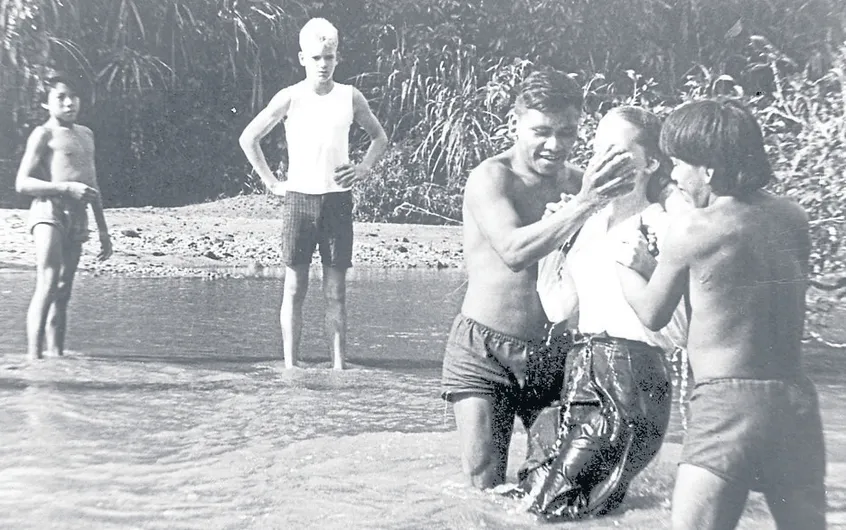
In 1965, however, Steve was baptised by Kimo and Mincayani, two of his father’s killers, in the river in which the missionaries’ bodies were found. ‘I saw them,’ says Steve, ‘as the most special people in the world.’
Only after Rachel’s death in 1995 did Steve discover what had happened that fateful day on 8 January 1956 – and who it was who had killed his father!
Steve, founder of I-TEC, an organisation that seeks to give indigenous Christians the tools necessary to fulfil the Great Commission, believes that only God could have fashioned such an incredible story from such a tragic event.
It’s possible, he maintains, that thousands of people who dedicated their lives to helping the gospel reach remote people throughout the world might not have done so were it not for the missionaries’ fearless example.
Although Steve has never forgotten the pain of losing his father, he says: ‘I can’t imagine not loving Mincayani, a man who has adopted me as his own. ‘Given the chance to rewrite the story,’ he concludes, ‘I would not be willing to change it.’
The vision of Steve’s father to reach some of the world’s remotest people with help, hope and healing continues today, aided by MAF – the organisation Nate Saint served in the 1950s, which now flies 135 planes in 26 developing countries, including Ecuador.
Performances of Reckless Abandon continue throughout 2017. For more about the work of MAF and the show visit www.maf-uk.org/recklessabandon