After the battle of Waterloo (June 18, 1815), Arthur Wellesley, the Anglo-Irish 1st Duke of Wellington and the commander-in-chief of the Allied forces fighting Napoleon, famously commented that “I don’t know what it is to lose a battle, but certainly nothing can be more painful than to gain one with the loss of so many of one’s friends.”
That battle brought to a close a tremendous global struggle that, for over 20 years, had pit the British Empire, first against the Revolutionary forces in France and then against the French dictator Napoleon I.
Wellington’s words are a good reminder that war, though often a sad necessity, exacts a terrible price.
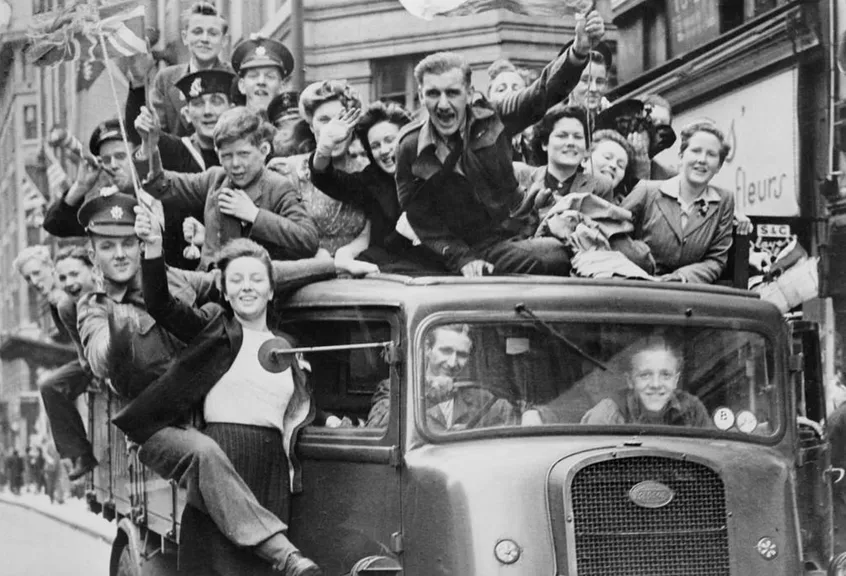
Today, we celebrate the 80th anniversary of the conclusion of World War II in Europe, another global struggle that had to be waged to preserve the democratic political experiment that had come to fruition in the twentieth-century West. The Second World War, rightly described by historian John Lukacs as “Hitler’s War,” took the combined energies of the British Empire, America, and the Soviet Union to defeat Fascist Germany and her allies. The men and women who gave their lives from this nation, and what is now the British Commonwealth, fighting the evils of Fascism should never be forgotten, nor the cause for which they fought.
As recent events in the West have shown, our political and religious liberties are not something that we can take for granted.
The war also revealed a latent evil within the heart of Western civilisation that should also never be forgotten and that is, the plague of anti-Semitism. The Holocaust could never have taken place without the enablement of significant numbers of the German people and other Europeans. Alongside the development of a tradition of political liberty in the West, there has also been the persistence of this horrific evil of the hatred of Judaism. And this too has been in evidence in recent days. Again, the horror of the Holocaust necessitates our ongoing remembrance.
Counter-factual histories in the form of novels like Len Deighton’s SS-GB (1978) or Robert Harris’ Fatherland (1992) remind us that it was not beyond the realm of possibility that Hitler and his regime might have won the war. To be sure, that they did not has much to do with the grit and gumption of the men and women of these islands. Some words from a 1933 speech by Winston Churchill now seem downright prescient. Speaking on the subject of “Life, The Greatest Secret of All,” he stated: “It may well be that the most glorious chapters of our history are yet to be written.”
That Hitler and his thugs did not win the war, though, is owing ultimately to the great mercy of the Living God. During these days of celebrating VE Day, let us not forget His gracious act of deliverance.
In the words of the Psalmist:
"Give thanks to the Lord, for he is good…
It is he who remembered us in our low estate,
for his steadfast love endures forever;
and rescued us from our foes,
for his steadfast love endures forever…"
(Psalm 136:1, 23‒24, ESV)
Should the CofE pay slavery reparations?
During a recent trip to Ghana, Archbishop of Canterbury Sarah Mullally renewed her commitment to a £100 million reparation fund …