Ten years on from the Scottish independence referendum

Luke Randall  |  Comment
Date posted:  20 Sep 2024
Share Add       
Ten years on from the Scottish independence referendum

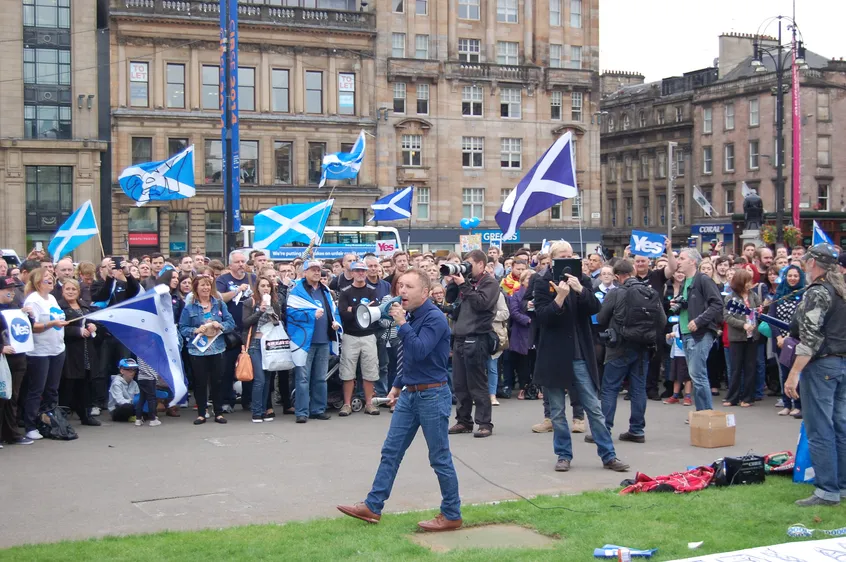
Scottish referendum 18 September 2024. Source: Flickr | Jordi Gabarró Llop

Ten years ago, Scotland voted to remain a part of the United Kingdom on one of the momentous days in its history. The No Campaign won the vote by 55 per cent to 45, bringing an end to nearly two years of fierce campaigning on both sides.

The period in the lead up to the referendum vote on 18 September 2014 saw unparalleled levels of political engagement in Scotland; over 3.6 million people voted, representing a turnout of almost 85 per cent, which supported claims that it was Scotland’s biggest decision for hundreds of years. However, the legacy it has had on Scotland to this day is perhaps not so edifying.

Following the Edinburgh Agreement struck between then Prime Minister David Cameron and Scottish First Minister Alex Salmond in late 2012, almost two years of fierce campaigning ensued, with Salmond and deputy Nicola Sturgeon leading the Yes campaign, and Alistair Darling leading the No Thanks equivalent.

It was perhaps understandable that, given the monumental decision that was about to be made, debate became increasingly polarised and bitter, as the nation was virtually split in half. Rifts arose between families, friends and colleagues, and tensions came to the fore as the vote neared.

However, such tensions were supposed to be temporary. Scotland was told over and over again during campaigning that the referendum would be a ‘once in a lifetime’ choice, and that once votes were cast, the result must be respected.

The No campaign’s win, declared early in the morning on the 19th, which came alongside Salmond’s devastated resignation, was meant to be the line in the sand for the independence debate in Scotland. However, it was not to be so.

The Scottish National Party (SNP) went on to enjoy remarkable dominance of Scottish politics, winning big victories in the 2015, 2017 and 2019 UK General Elections, as well as in recent Scottish Elections, all of which saw them lobby for another referendum on the issue.

Tensions over the UK’s decision to leave the European Union (EU) only fuelled their bullishness, as over 60% of Scots voted to remain, while the entire UK voted to leave.

Where are we now?

However, polling across the last ten years has remained static, with support for independence staying at around 45%. This has been reflected in election results, as even though the SNP won strong majorities at several elections, the vote share won by independence supporting parties never really exceeded 45%.

The SNP consistently argued during Nicola Sturgeon’s tenure as First Minister that the Scottish electorate would vote for independence should they be asked again, but the polls never appeared to support these claims.

Even during the Brexit period and the Covid pandemic, alongside what has felt like a revolving door of Prime Ministers at times, support for separation has never really moved above the level it reached when Scotland voted on the issue in 2014.

The reality is that 10 years on from one of the most momentous days in Scotland’s history, bitter divisions remain, with both sides firmly entrenched in their respective camps, and discourse concerning the issue not greatly edifying.

Support for the SNP is now waning after 17 years at the top of Scottish politics, and perhaps with it the ever-lingering issue of independence might finally be returned to the background.

It may be that Scotland is finally about to move on from a constitutional question which has plagued its politics for so long, despite the issue being decided upon by its people a decade ago.

However, if it is to move on, then what Scotland really needs is to look Heavenward to its maker, as hurt caused by divisions which have been prominent over the last decade will not be easy to move on from.

Forgiveness, self-control and gentleness are difficult attributes to embody, but attributes like these will be required in great abundance in leaders who seek to foster greater unity in what has been a divided nation.

In a time which has seen so much division over the independence question, as well as significant social reforms which go against God’s plan for humanity since then, Scotland needs His hand to be at work in a nation which used to be known as ‘the land of the book,’ because of its loyalty to Him. Scotland needs the Lord now as much as it ever has, as it looks set to move into a new era.

Share
< Previous article| Comment| Next article >
Read more articles on:   politics  /  Scotland
Read more articles by Luke Randall >>
World
China ‘criminalising core elements of ministry’

China ‘criminalising core elements of ministry’

Significant persecution continues for Christians in China, with raids becoming increasingly common and house churches facing increased surveillance as Xi …

World
Hope and uncertainty after Colombian election

Hope and uncertainty after Colombian election

Christians remain hopeful but uncertain that the new Colombian administration will restore protections for religious leaders following the recent national …

Looking for a job?

Browse all our current job adverts

Search

Subscribe

Enjoy our monthly paper and full online access for just £40/year

Find out more