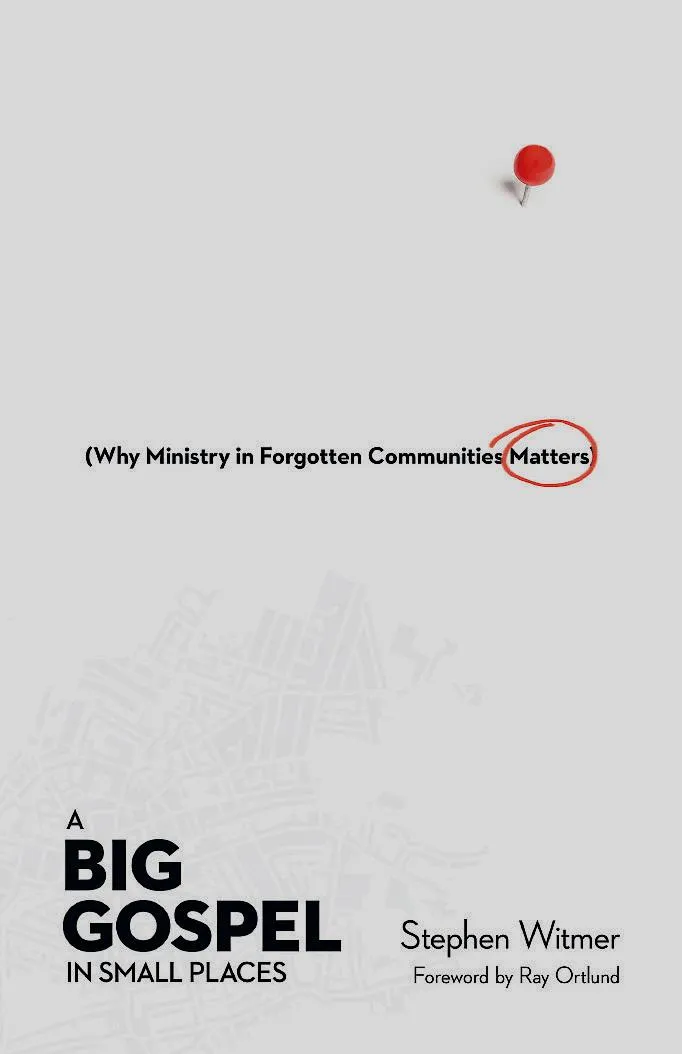
An extract from Stephen Witmer’s new book
In one sense, love itself is not very strategic. Anyone who’s ever been a parent understands this.
Loving parents live on repeat. They tell their children a thousand times not to touch the wall socket; they change their diapers a thousand times and kiss a thousand boo-boos; they clean up messes, repeat words of love, and retell the same stories over and over again. Good parents regularly ‘waste’ time with their kids, coloring and hosting imaginary tea parties and playing silly games when they could be accomplishing more important things. All that energy and attention squandered on just one little person is called love.
The gospel proclaims God’s own extravagant, sacrificial love, which comes to people not because of what they can contribute (in leveraging influence with others) but because of what they can’t contribute (in saving themselves). It may seem inordinate for God to surrender his own Son to death in order to purchase for himself, well, you. But that’s gospel love. And it’s precisely as each one of us comes to experience this inordinate love that we’re changed forever. The apostle Paul had this very experience. After his conversion on the Damascus Road, he came to see that the Son of God ‘loved me and gave himself for me’ (Gal. 2:20), and that Christ Jesus had made Paul his own (Phil. 3:12). Christ’s love became the defining force and motivation of Paul’s life (2 Cor. 5:14).
Jesus himself seems often to have been unstrategic about the people he loved. Luke’s Gospel particularly emphasises his interest in the marginal, the oppressed, the outsider, the non‐influential. He appears to have focused largely on underprivileged people: ‘the peasants and the fishermen, rural wage labourers and tenant farmers, day labourers and serfs, artisans and traders, beggars and prostitutes.’ The apostle Paul followed Jesus’ pattern of relating to all types of people, including those who didn’t seem to have much to offer. ‘I am under obligation both to Greeks and to barbarians, both to the wise and to the foolish’ (Rom.1:14).
It may seem odd to cite Paul as an example of being unstrategic since those who commend city-focused ministry often ground their approach in Paul’s own ministry strategy. It’s commonly held that Paul focused his efforts exclusively on strategic cities, the centres of commerce, arts, and government, influencing influencers, expecting that gospel influence would radiate out from those cities into surrounding regions.
But it’s worth questioning this view. Did Paul target great cities because they were filled with affluent, influential creators of culture? The evangelical New Testament scholar Eckhard Schnabel, who has written several important books on early Christian mission, doesn’t think so. ‘Paul did not have a mission strategy that sought to initiate (or consolidate) missionary work by establishing contacts with the powerful elites of the cities or provinces in which he preached the gospel.’ Of course, Paul did speak to some influential people, but it’s equally clear that he regularly associated with ‘nobodies’. His strategy (if it can even be called that) seems to have been to engage whoever would listen. His ministry in one particular Greek city (Corinth) seems to have resulted mostly in a church of nobodies: ‘For consider your calling, brothers: not many of you were wise according to worldly standards, not many were powerful, not many were of noble birth’ (1 Cor. 1:26).
To be clear, I’m not saying that all strategic thinking is the opposite of gospel love. I believe God sometimes calls some of his people to big-picture thinking, to consider how to influence the wider culture and the greatest number of people possible. I’m thankful for the humble, visionary leaders he has gifted to do such thinking in our generation. I’m not saying that all strategising of that sort is bad. But there’s a lavishness, an extravagance, a prodigality at the heart of the gospel that can subvert our conceptions of what is strategic. I’m saying that the lavish nature of the gospel may be uniquely expressed through seemingly un-strategic ministries in seemingly unstrategic churches in seemingly unstrategic places.
What’s strategic for the kingdom of God isn’t always the same as what’s strategic for the world. Thinking about this on a personal level is helpful. Call to mind someone you know and love. What’s the best ministry strategy for reaching that person with the gospel? It’s certainly not leaving them and going elsewhere to influence other people who will eventually influence them. In fact, the best strategy is not very strategic at all. It’s going deep in friendship, listening a lot, spending time together, serving and being served. It’s genuinely caring and praying over the course of many years and speaking gospel words when you have the opportunity. Similarly, a call to a small, unstrategic place is actually the most strategic way of reaching that particular place … The lavishness of the gospel gives God’s people permission and encouragement to love and serve uninfluential, unstrategic people in forgotten places.