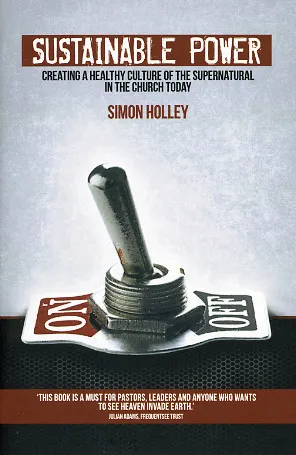
SUSTAINABLE POWER
Creating a healthy culture of the supernatural
in the church today
By Simon Holley
Authentic Media. 256 pages. £7.99
ISBN 978 1 860 248 849
In Sustainable Power: creating a healthy culture of the supernatural in the church today, author Simon Holley challenges the local church to stop limiting the work of God.
He feels it does this when it despises supernatural signs and wonders. Indeed, this book is really the story of how his own fellowship learned to develop a culture of the supernatural that he views as ‘healthy’. He wants others to tread a similar path for greater impact in evangelism and ministry.
Informal style
Holley writes in an upbeat, informal style, candidly relaying stories of alleged miraculous healing, words of supernatural revelation and other unusual spiritual experiences within the lives of people he and his fellowship have encountered. He is careful to appeal to Scripture, and church history, to support his claim that such events should be the norm for effective churches today, making the shift from dry times to high times in the work of God.
As I read I felt at times challenged to have greater faith in the supernatural power of God. How often do I really pray to God expecting him to do great things in people’s lives in seemingly impossible situations? Pride also comes in for a particular bashing by Holley. Fear of how we may look, what others may think of us, can often hinder people like me from launching out in obedient faith. It’s good to be challenged.
Unconvincing
But I also found this book unconvincing in some of its practical application through personal experience. For example, his experience of how God apparently broke down pride and introduced greater freedom in his and his congregation’s life involved doing things that to me just seemed eccentric. Being divinely inspired to slide to the floor and remain there after introducing a visiting speaker and doing a congregational conga in a church meeting are some examples. This left me confused as to where precisely the line falls between being a fool for Christ’s sake and acting like a wally.
Also, a number of the accounts of so-called supernatural healings and miracles simply weren’t persuasive. In fact, some claims of spiritual impact and healing were qualified by footnotes that, to my mind, left me questioning the judgment of the author. Consider the following footnotes for example: ‘Although vastly improved, Caroline still suffers from back pain and is not completely healed, as yet’ (p.28); ‘Sometimes with this type of healing the pain does not immediately disappear. I think this is because the muscles need to readjust to the new shape of the body’ (p.46); ‘While as far as I know he is still a believer, I understand that for various reasons this man is currently not part of a church’ (p.63); ‘I had no other contact with this lady and so do not know if she was healed completely’ (p.64).
It’s not for me to judge the sincerity or godliness of the author but, to my mind, these footnotes, while being admirable for their honesty, were also undermining of the wider argument of the book – namely that such a culture of the supernatural is ‘healthy’. They also made me lose confidence in the general substance of the book as a whole. Harsh though it may sound, in the end I sadly no longer felt confident that what I was reading was fully dependable or, more importantly, scriptural.