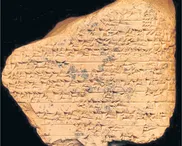
Legend: The Genesis of Civilisation
By David Rohl
Century, London. 453 pages. £20.00
ISBN 0 7126 7747 X
The name of David Rohl provokes very diverse reactions among those who know of him or have read his previous work in this series, Test of Time(The Bible: from myth to history), which was also serialised on television.
Conventional archaeologists have reacted with anger and bitterness to his reconstructions of ancient chronology (specifically Egyptian). Others, especially among evangelicals although not exclusively so, have rallied round in support of this thesis.
David is a mature and experienced Egyptologist. He is not a Christian and makes no pretence to be such, but has believed for many years that the Bible is an archaeological document that must be taken seriously historically.
This second volume goes back in time from the history of the Egyptian exile, to the beginnings of time. Rohl does not claim that his is the final answer-indeed, some of his co-workers have suggested minor amendments that improve on his proposals. In this volume, Rohl takes on the early chapters of Genesis (1-11). Normally considered as the area of debate between creationists and evolutionists, Rohl looks at this historically. He is careful to acknowledge the work of others on which he is building.
By studying Scripture and other ancient literature, then visiting the areas concerned and exploring them archaeologically, he believes that he has located the area of the Garden of Eden and so can correlate the subsequent events in biblical history. David distinguishes between 'myth' and 'legend', asserting that the biblical record is not the former. He sees 'legend' as 'traditional oral or written history which has not yet been confirmed by science, historical argument or archaeology'. In contrast to many theologians and non-evangelical archaeologists, Rohl is not a 'minimalist' (dismissing the historical as myth). To the evangelical, he is a man we can respect (even if we disagree with him) because he respects God's word.
Where was Eden?
His arguments are intricate and detailed. The region of Eden is located by a study of the various associated names, starting with the rivers. These are named in the Genesis account and referred to by reference to countries such as Havilah, Cush and Ashur. He identifies these as the Kezel Uizhun (Pishon), Gaihun/Aras (Gihon), Tigris (Hiddekel) and Euphrates (Perath).
Consequently, the general region can be marked out geographically. The garden of Eden is then located more specifically in the east of Eden as in the Tabriz valley (Adji Chay), with Cush in Azerbaijan and Havilah in the Iranian mountains. Nod is around the city of Ardabil. Rohl himself acknowledges that many of his assignments are of themselves speculative, based on a study of the names and how they might have been transposed over time.
From this he is able to move on to discuss the Flood, which he sees as historical and dramatic in its effects on civilisation. He agrees with Woolley's identification of the Flood layers, but identifies the resting place of the ark away from the more recent traditional site of Ararat. He locates it at Judi Dagh.
Comparing the genealogies in the Bible and in Sumerian literature, he shows that they can be correlated very closely. So, he 'confirms' the validity of the antediluvian and post-Flood characters in the biblical and extra-biblical sources, showing that they have a common origin. The author also discusses the family of nations, examining the biblical history of the dispersion of the nations. Indeed, this covers the second half of the book, highlighting particularly the origin of the pharaonic Egypt.
The thesis, from a biblical perspective, is summed up in Chapter 14 in which he 'rewrites' the Genesis account in terms of his interpretation. He sees it as the story of Stone-Age man, originating in the Zagros Mountains. Here was Eden, watered and rich in natural resources. Under Enoch, they reached Shinar. The people then migrated along the eastern shore of Arabia, establishing a trading post on Bahrain. This was a 'new paradise', reminding them of their original home. The Flood then came and wiped out all their achievements. They returned to the lowlands and the rebuilding occurs, followed by the dispersion.
Such a summary does not do justice to Rohl's thesis, but highlights the key issues. Because of his non-Christian position, he dismisses the miraculous and seeks for purely natural explanations. So, we do not have Adam as the first man in the biblical sense. The Flood becomes localised and so much less than that portrayed by Scripture. In fact, from our point of view, this is the weakness of the reconstruction. The biblical Flood was of such dramatic proportions that it must have eliminated the site of Eden under large quantities of sediment, obscuring the original rivers. I believe that what we see today is a renaming of the Euphrates and Tigris after the pre-Flood rivers, a concept which Rohl himself uses elsewhere.
This does not necessarily invalidate Rohl's hypothesis of the location, because it may be described in terms of the post-Flood geography. Man's exclusion from the garden (which Rohl accepts) also makes it unlikely that it can be identified on the post-Flood earth. In studying the biblical genealogies, Rohl equates the lines of Seth and Cain because of the occurrence of identical names in both trees. However, this ignores the fact that families do tend to recycle certain family names.
Is he right?
The measure of disagreement will probably be reflected by the reader's own viewpoints. A creationist will be encouraged by his approach to Scripture, but will have problems with the detail which seems to undermine Scripture. The non-creationist will find an affinity with his link of Adam to New Stone Age man, but theistic evolutionists will probably be uncomfortable too with his use of Scripture. Conventional archaeologists will dismiss him as a crank for even trying to make history out of what they would consider to be myth.
This work should not be dismissed as nonsense but given serious research. It would be good to have an evangelical biblical scholar reworking his observations, but it should be done with the same thoroughness as Rohl has used. We are indebted to the author for putting the Bible on the wider agenda as a serious historical book. As Rohl becomes increasingly convinced of the historicity of the Bible, we pray he may get to know the God of the Bible too and recognise its spiritual message.