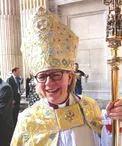
Richard Turnbull, the new chair of the Church of England Evangelical Council and new principal of Wycliffe Hall, Oxford, talks exclusively to EN.
The story of how a young man from a non-Christian family was converted on only his second visit to a Baptist church and now occupies one of the most influential positions in Anglican evangelicalism is a remarkable one.
But for the Rev. Dr. Richard Turnbull (45), the most exciting chapters of his life may well yet lie ahead.
For not only has he recently become principal of Wycliffe Hall, Oxford — one of the Church of England’s main evangelical ministry training colleges — but he has also been elected chair of the Church of England Evangelical Council, the vital umbrella body which seeks to bring together Bible-based Anglicans and give them one campaigning voice.
As principal of Wycliffe, Richard is clear about his priorities: ‘I tell all interview candidates for places here that I’m only really interested in two things: teaching the Bible and seeing people become Christians’, he says.
And as chair of the CEEC, he believes evangelicals ‘have an important part to play in the Church of England’ — especially as the coming years may see ‘some form of international realignment of Anglicanism’.
Wanting to be at church
Richard Turnbull was born in Manchester in 1960 into a non-Christian family. Sent to Sunday School as a child he ‘hated’ it — and dropped out at the age of 11. ‘Nothing would have got me back into church’, he recalls.
It was when he was studying economics and accounting at Reading University and took a summer vacation to the United States that he was forced to think again. There, he was invited to church by his host family almost as soon as he met them, and felt it would be impolite to refuse.
‘The one thing I remember was that the people I met there wanted to be there, and that was not my memory of church’, he says. ‘When I came back I talked with a friend who was a Christian and went to Wycliffe Baptist Church in Reading where I found the people also wanted to be there. So I couldn’t put it down to a cultural thing, which was what I had wanted to do. I was converted in 1982 at the second service I went to there. A visiting pastor from Brixham Baptist Church was speaking, and he preached for a decision for Christ. The Lord turned my heart.’
City and Synod
A job in accountancy at Ernst & Young in London followed university, and it was while worshipping at a small Baptist church in inner London that he met his future wife Caroline, who came from an Anglican evangelical family. ‘That showed me Anglicanism did not have to be as I remembered it from childhood’, he says.
After marriage, the couple settled in Southampton in 1987 and began worshipping at a local Anglican church. From there, he went to Cranmer Hall, Durham, to train for ordination in the Church of England, and gained a first in theology followed by a PhD in evangelical history. Beginning ministry back in the south of England, he quickly found himself elected to General Synod — the Church of England’s parliament — and, with his accounting background, found his skills in demand on the Archbishop’s Council — a panel which advises the Archbishop of Canterbury — and as chair of the Synod’s business committee.
‘It’s a slightly odd job but it gave some reassurance to evangelicals’, he recalls, with his trademark mix of openness and wry humour. In 1998 he became vicar of Chineham, near Basingstoke, and saw the church more than double in size ‘through biblical expositional teaching and a contemporary worship style’, he says.
Wycliffe Hall
His combination of hands-on ministry experience, financial expertise and a doctorate in theology made him a natural choice as the new Principal of Wycliffe Hall, following on from predecessors, including New Testament expert Dick France and writer and apologeticist Alister McGrath. Richard is keen to build on the legacy left by his predecessors. ‘Wycliffe is a great place and a good place’, he says. ‘I have tried to bring a real focus on training for parish leadership. I have also brought a renewed emphasis on having open Bibles before us. I really want to model Bible teaching and preaching for the parish setting. That’s because I believe the Word of God is alive and that the Lord speaks through his Word today. There are so many things that can distract us from our main purpose, but our main purpose has to be teaching the Scriptures and growing new Christians.’ He also wants people to leave Wycliffe with a proper understanding of the atonement.
Making Christ known
Turning further afield, Richard says: ‘There is a real place in the Church of England for mainstream evangelicals who are conservative in doctrine, relaxed in church culture and approach, and committed to the task of making Christ known. Evangelicals can spend too much time fighting the wrong battles and fighting each other. I think the next five years or so will not be easy and there will be many challenges to us. I want the CEEC to encourage evangelicals in the parishes and be a voice for our ministry concerns.
‘Clearly matters affecting homosexuality are significant for the church and for evangelicals. They are significant because they go right to the heart of Scripture, and therefore I am unhappy with the current position on civil partnerships.’ He predicts: ‘We may well see some form of international realignment of Anglicanism over the next five years, and that could be particularly painful in the Church of England.’
On the issue of women bishops, he says: ‘My main objective is to ensure appropriate provision and a place within the church for those who do not agree with this move. But I think bishops in general are a second order issue. Our priority has to be the gospel.’
Listing John Stott and Jim Packer as his formative influences, Richard Turnbull is married with four children and spends time off relaxing with his family, eating out and reading. He is also currently learning to swim.
David Baker,
Emmanuel Church, Tolworth, Surrey