Evangelicals Now
Christian news worldwide
magnifying glass Search archives
home Home check the archives Archives Subscribe Subscriptions Advertising Information & booking of classifieds Adverts Find a local evangelical Church Find a church for the search engines and extremely curious! About us Contact us Site Map
Printable
Version

The BBC floats with Noah - but not the biblical one!

Recently the BBC has been showing an interesting series of archaeological type programmes, Bible Mysteries, which essentially have been showing the Bible to be based on fact. On March 21, they showed a 'drama documentary' on Noah's ark. They claim to be showing once again that the Bible story has a basis in fact, but it ends up very differently from the Bible account.

The programme was presented by Jeremy Bowen (who was also involved with a helpful documentary on our Lord Jesus a couple of years ago). His interest in the Bible arises from his years of broadcasting from the Middle East, particularly in Israel. The Radio Times announces that Bowen 'deconstructs the myth' and 'rebuilds it into a more realistic account'. I suppose we cannot expect the BBC to present the Bible in the way we would like, but it would be good if they presented the facts (rather than misrepresenting them) and included folk who support the Bible account.

Global signature

The commentator rightly states that a great flood like the biblical one would leave a signature and that would be all over the world. Since the only one they located was that of Woolley in Iraq (1931), which was only 12 ft. thick and localised in the Fertile Crescent, they conclude that the flood referred to by Noah was a local event.
Their original surmise is right - if it was on the scale described in the Bible, we should look for a global deposit of great thickness and destructive of all life. I believe the lower part of the geological column demonstrates this condition. Of course, most geologists dismiss this scenario because they believe the Precambrian and Palaeozoic rocks are many millions of years old and predate mankind. (Dr. Andrew Snelling ad-dressed this problem in the light of current research 18 months ago in EN).

The boat is described as the size of the Titanic, built of wood and covered with pitch. A marine archaeologist is called in to declare that this is impossible because wood could not maintain its shape and so the boat would distort and sink. This is displayed by computer graphics but is inadequately discussed and no attempt is made to verify the claim. This must, in part, depend on the actual design of the ark which was not comparable to the Titanic. Interestingly, they show the ark in the style of a Victorian boat, but when they revert to the Babylonian legend, they resort to a box-like structure.

How many animals?

The Bible tells that Noah loaded the animals in seven days. How could he collect 30 million species and load them in that time: it would take 35 years, they tell us. But who said anything about 30 million species? The Bible does not. If they had spoken to anyone who had studied the biblical account seriously, they would have soon corrected that misconception.

In fact, unknowingly they gave the clue themselves. They used the word 'kinds' initially and then switched to species. Creationists have long pointed out that we must not read modern taxonomy into biblical (or other ancient) accounts; it is illogical. Studies have shown that the biblical kind for the animal kingdom can probably be best understood by the modern 'family' category. Modern studies in speciation have demonstrated that from a single pair of parents with a large genetic pool, rapid speciation is possible giving the variety of life we observe today.

The commentators pick on a compromise by comparing the 'clean' and 'unclean' animals with those listed in Leviticus and so propose that about 260 animals were on the ark. If we take the Bible account, which limits the animals to air-breathing land animals and birds, seriously and use the family category as our basis, we can conceive of a population of 1,600 - 3,500 animals on the ark (these are the limits that are generally proposed by those who have applied these principles). This number would certainly fit on the ark without difficulty. As for Noah having problems in fetching them, the Bible indicates that God brought the animals to Noah and that he had rather a long time to collect them (120 years); the seven days was needed to load them.

How much water?

But then, we are told, there is not enough water to cover the world in the way the Bible demands. To support their claim, they bring in geologist Prof. Ian Pilmer who is notorious for his attacks on the Bible and attempts to sue creationists in Australia. To cover Mount Everest, there would have to be three times the amount of water that exists on the earth.

But that assumes their scenario is correct. If, as suggested above, the Flood deposits corresponded to the lower earth strata, then this was before the mountains rose to the modern heights and so far less water would have been needed. Indeed, it has been shown that there is enough water to cover the hills of that time quite adequately. (Amazing that the Bible writers got a consistent account even though it does not fit with current geological thinking!)

The programme describes the hunt for the ark and claims concerning its discovery. Most of us would concur with the claims that the reputed sightings have been ill-conceived. The Bible refers to the mountains of Ararat as the place where the ark rested. The location has been long disputed. The modern Ararat is a much later postulate than the biblical times and could be a long way from the real location.

Bible or Babylonian myth?

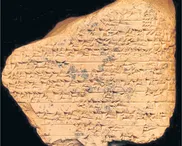
We are then shown the discovery of the Babylonian and Mesopotamian tablets with their accounts of the Flood. Here, the hero is Gilgamesh. He is a business man, the 'king' of Shuruppak. He owned much gold and silver. He built the boat to make money. With a business partner, he built a boat to carry livestock, grain and beer. In fact, when the fresh water ran out, they and the animals drank the beer. Gilgamesh lived on the banks of the Euphrates. The flood was a freak coincidence of natural events: the melt water from Armenia and a once-in-a-millennium catastrophic storm of tropical proportions. They drifted out into the Persian Gulf (hence the concept of a world-wide flood) and landed on Dilmun (modern Bahrain) rather than Ararat.

This was the true story, they claim, and it was while the Jews were in Babylon that they took it and edited it into their own version with a moral message. While it is possible that the latest Hebrew documents were copied and even edited during the Babylonian captivity, it does not mean there was not an original contemporary document. Indeed, Wiseman wrote on this very point some 60 years ago. The Mosaic books (which claim to have been written by Moses whose authorship is endorsed by our Lord) show marks of his Egyptian background.

Isn't it strange that folk dismiss the Bible and give credence to myths? Yet that has always been true and one can but wonder why.

Surely the answer is found in the Scriptures themselves. The Bible shows that the Flood account has ultimate significance. The Lord Jesus referred to this event as a sign of his coming: 'As it was in the days of Noah, so it will be when the Son of Man comes'. The whole world was destroyed and will be. Only Noah and those in the ark with him were saved. So it will be with those in Christ. If the Bible account of Noah can be dismissed as a moral fable, then the force of these passages is weakened.

J.H. John Peet,
Biblical Creation Society