Is Vaughan Roberts a theological liberal? Certainly some may have been tempted to ask the question after he wrote an article in a theological magazine critical of the UCCF basis of faith. Then there is the fact that his views were slated by noted American evangelical Don Carson in his book The Gagging of God.
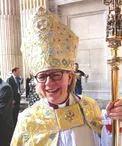
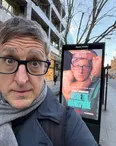
Just as well then, that Evangelicals Now sent me to interview the other Vaughan Roberts. For there are two people called the Rev. Vaughan Roberts, both clergymen, but with somewhat differing theology.
Happily for EN readers, the Vaughan Roberts I went to see is the 34 year-old just coming to end of his first year as rector of St. Ebbe's Church, Oxford.
St. Ebbe's is a conservative evangelical Anglican church, notable (among other things) for its ministry to students. As well as taking on pastoral responsibility for the congregation last year, Vaughan Roberts has also become known as a conference speaker and young evangelical leader within the Church of England.
Now at the 'low church' end of Anglicanism, Vaughan had experience of other forms of church life before actually becoming a Christian.
'I had an Anglican church-going background in a village near Basingstoke,' he recalled. 'It was traditional village Anglicanism - very dull for a child. Then I went to boarding school and had a high church form of school Anglicanism. The combination put me off and, by the mid-teens, I suppose a second-hand faith had become a second-hand doubt.
'My elder sister went to Cambridge University and was converted in her first term. A couple of years later, we were on holiday as a family and she told us we weren't proper Christians. This infuriated me and I started shouting at her and then hardly spoke to her. But when we got home, she wanted me to drive her to a church in Basingstoke. I reluctantly drove her in and found myself at a community house church in a school.
'It made me feel terribly uncomfortable. They kept talking about Jesus and that was the thing that struck me. To me, Christian meant churchgoer, and all the religion I had had before was about a God who was very vague. I thought I had to make my mind up one way or the other about it all, and the question for me was: Who is Jesus?
'I said nothing to my sister and started reading Matthew's Gospel. I was bowled over by it almost immediately. I was profoundly struck by the person of Christ and knew instinctively this was true and right. I was aged about 18.'
A little later on, Vaughan was at Cambridge University, where he was a college Christian Union co-ordinator and then president of the Cambridge Inter-Collegiate Christian Union (CICCU).
There have been a number of formative influences on his Christian outlook. The first were the Iwerne camps run for public school pupils, which at that time were being led by his predecessor as rector of St. Ebbe's, David Fletcher. The second was the Proclamation Trust, dedicated to training ministers in preaching the Bible.
Another important encouragement for Vaughan was being able to spend time in the Sydney diocese of the Anglican church, a bastion of radical conservative evangelicalism.
'Seeing the diocese and St. Matthias church was a huge encouragement,' he said. He was particularly impressed by Sydney's 'principled pragmatism' - an absolute commitment to the gospel combined with complete flexibility in ways of doing things. This, he says, has important implications for how we do our evangelism.
'The Great Commission is to go and make disciples, but we have changed the 'go' into a 'come', assuming people will come from another culture into a church culture,' he said. 'In fact, we are not reaching an increasing number of people outside that church culture. So we don't change the message but the packaging.'
This thinking has undergirded the well-known evangelistic enterprise at St. Ebbe's known as The Tavern, in which non-Christians are presented with the gospel in a seeker-friendly environment. But it also has wider implications, Vaughan believes.
'We have got to think in terms of starting new radical church plants and put that high on the agenda. We have to adapt or die.'
Furthermore, the idea of principled pragmatism has implications for co-operation between evangelicals in different denominations.
'We are really in a mission situation, and if we think denominationally we are dead. All like-minded evangelicals need to work together, and if we stick in a ghetto, we will miss the major opportunities. But I think that means local churches rather than denominations working together.'
Asked about co-operation between conservative evangelicals and charismatic evangelicals, Vaughan responded: 'I think the next few years will be very significant in terms of evangelicalism in this country.
'The question is whether we will remain united on the fundamentals and I think there's a challenge there for both camps. We conservative evangelicals can react too negatively to secondary differences which prevents engagement with each other because we dismiss people on relatively minor things. They then see us as extremists and narrow-minded. And we can be too suspicious of experience.
'The challenge is for them to stay with the Bible. The charismatic movement will have to decide whether it is fundamentally charismatic or evangelical. What comes first: doctrine or experience? Authentic doctrine must lead to a real experience of God - but what is fundamental? If the answer is experience, we can't work together.'
As for the future of the Church of England, Vaughan said: 'I think we need to live out our principles whatever the cost, and it's just possible the Church of England will allow that to happen; it's just possible.'
At the moment, Vaughan's main involvement outside the parish is with the 9:38 Network, which aims to encourage young people into full-time Christian work.
'The thinking there is the need to encourage many more younger people to ask the big questions of what the best use of their life is in the service of Christ. We also see the need for many more to come into full-time gospel ministry.'
He added: 'What we need is a radical ministry of principled pragmatism. And we need many, many more people.'
* The 9:38 Network can be contacted at 9:38, 107 Merton Hall Road, Wimbledon, London SW19 3PY
David Baker